
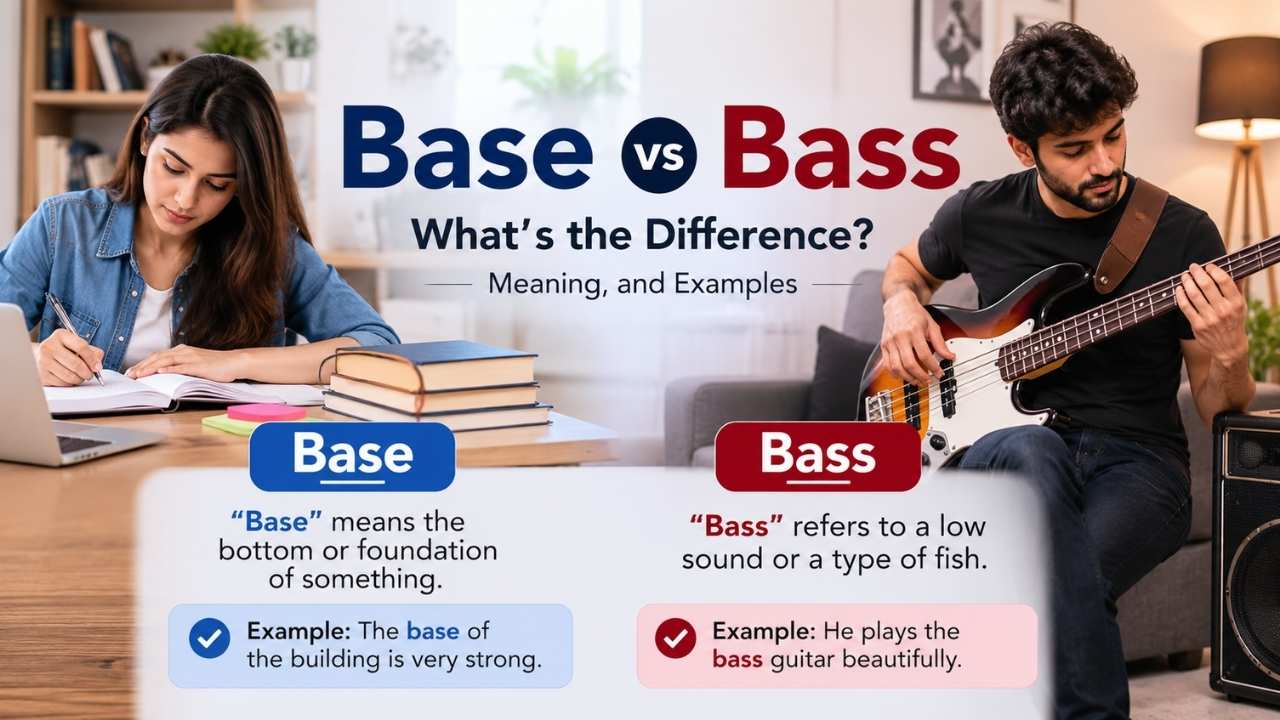
Many people struggle with base vs bass because these two words look almost the same but have very different meanings. If you’ve ever wondered about the difference between base and bass, you’re not alone. They are among the most commonly confused words in the English language, and they often create confusion in writing, speaking, and even reading.
Understanding base or bass becomes easier when you learn their meanings, pronunciation, and proper usage. While base usually refers to a foundation, starting point, or support structure, bass can refer to a type of fish, a musical instrument, a deep voice, or low-frequency sound. Because the spelling is similar, many people make grammar mistakes, spelling errors, and pronunciation mistakes when using these words.
In this guide, you’ll learn the base meaning, bass meaning, correct pronunciation, sentence examples, and simple memory tricks. By the end, you’ll know exactly when to use base and bass and how to avoid common mistakes with confidence.
Quick Answer
The main difference between base and bass is their meaning and pronunciation. Base refers to a foundation, support, starting point, or one of the bases in baseball. Bass can mean a type of fish, a bass guitar, a deep singing voice, or low-frequency sound in music. Although they look similar, knowing the context helps you choose the correct word.
What Does Base Mean?
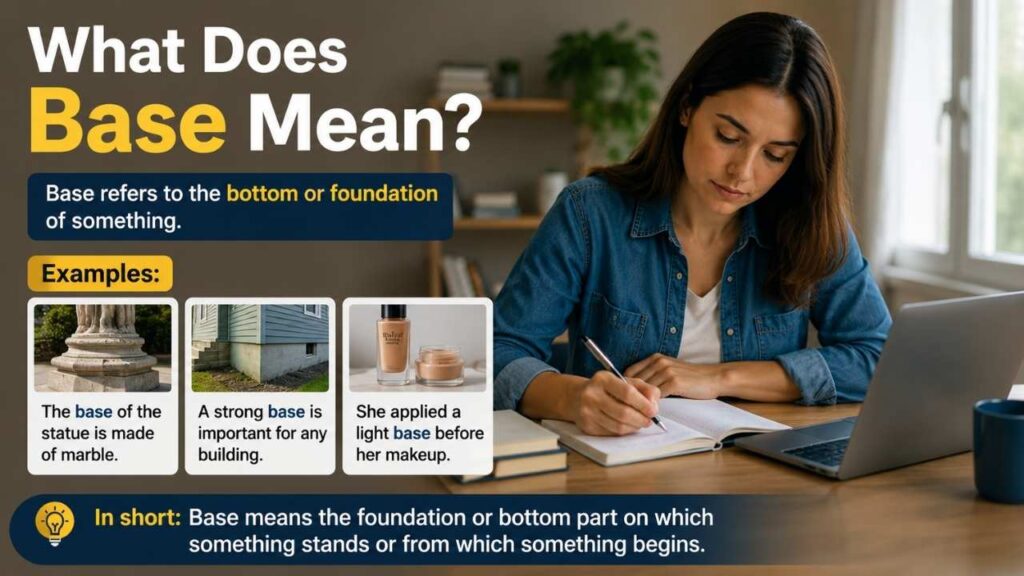
The word base has several meanings, but it usually refers to a foundation, starting point, or support for something. In everyday language, people use base to describe the bottom part of an object or the structure that holds everything together. For example, the base of a building supports the entire structure.
The base meaning can also change depending on the situation. In sports, a base is one of the stations a player reaches in baseball. In the military, a base is a place where soldiers work and live. In chemistry, a base is a substance that reacts with acids.
Because base has many uses, understanding the context is important. When learning base vs bass, remember that base often relates to support, location, or a starting point. This simple rule can help you avoid common word usage mistakes and improve your English vocabulary.
What Does Bass Mean?
The word bass has several meanings, but they all connect to music, sound, or a type of fish. Many people get confused about the bass meaning because the same spelling can describe different things.
In music, a bass guitar is an instrument that produces low notes. The term bass can also describe a deep singing voice, often heard in choirs and musical performances. In audio systems, bass refers to low-frequency sound, which creates the deep beats you hear in music.
Bass can also refer to a popular freshwater fish. Anglers often catch largemouth bass and smallmouth bass in lakes and rivers. Although these meanings seem unrelated, context makes the correct usage clear.
When comparing base vs bass, remember that bass usually relates to music, sound, or fish. Knowing this distinction makes it easier to choose the correct word and avoid common grammar mistakes.
Base vs Bass at a Glance
Understanding the difference between base and bass becomes much easier when you compare them side by side. Although the words look similar, their meanings, pronunciation, and usage are very different.
| Feature | Base | Bass |
| Meaning | Foundation, support, starting point | Fish, musical instrument, deep sound |
| Pronunciation | Sounds like “bays” | Can sound like “base” or “bass” depending on meaning |
| Common Use | Buildings, sports, military, science | Music, audio, singing, fishing |
| Part of Speech | Noun, adjective, verb | Noun |
A quick comparison helps people understand base or bass without confusion. If you are talking about a foundation, support, or location, use base. If you are discussing music, sound, a bass guitar, or a fish, use bass. Learning these differences improves your writing and helps you use both words correctly in everyday conversations.
Why Do People Confuse Base and Bass?
Many people confuse base and bass because the words look almost identical. At first glance, the only difference is one letter, which makes spelling and reading more challenging. This is why they often appear on lists of commonly confused words.
Pronunciation adds another layer of confusion. The musical term bass is pronounced like “base,” while many English learners expect it to rhyme with words like “class.” This difference often leads people to ask, “Why is bass pronounced like base?”
Another reason for confusion is that both words appear frequently in everyday language. You might read about a military base, a baseball base, a bass guitar, or a bass fish within the same day.
The good news is that context usually provides the answer. Once you understand the meanings and usage patterns, distinguishing between base vs bass becomes much easier.
How to Pronounce Bass Correctly
One of the biggest reasons people search for base vs bass is pronunciation. The word base is always pronounced like “bays.” However, bass pronunciation depends on its meaning.
When bass refers to music, sound, or a singing voice, it is pronounced exactly like base. For example, people say “bass guitar” and “bass singer” with the same sound as base. This often surprises English learners because the spelling suggests a different pronunciation.
When bass refers to a fish, many speakers pronounce it to rhyme with “class.” Because of this, some people wonder if there are two correct ways to say bass. The answer depends on the context.
If you are discussing music or audio, pronounce bass like base. If you are talking about fishing, many speakers use the shorter “ass” sound. Understanding the context helps you avoid pronunciation mistakes and speak with confidence.
Why Is Bass Pronounced Like Base?
Many people ask, “Why is bass pronounced like base?” because the spelling does not seem to match the sound. English contains many words that follow unusual pronunciation patterns, and bass is one of them.
The musical meaning of bass comes from older European languages and music traditions. Over time, English speakers kept the pronunciation but continued using the same spelling. As a result, the musical term bass sounds like base even though many people expect it to sound different.
This difference often confuses students, writers, and language learners. Some people even assume that the pronunciation is incorrect when they hear it for the first time. However, musicians, singers, and audio professionals have used this pronunciation for generations.
When learning base vs bass, it helps to remember one simple rule: musical bass sounds like base. This memory trick can prevent mistakes and make conversations easier to follow.
Base vs Bass in Sentences
Looking at examples is one of the easiest ways to understand how to use base correctly and how to use bass correctly. Sentence examples show the meaning of each word in a real situation.
Examples Using Base
- The workers built the house on a strong base.
- The player ran to first base before the ball arrived.
- The soldiers returned to their military base after the mission.
- This recipe uses yogurt as the base ingredient.
Examples Using Bass
- She plays the bass guitar in a local band.
- The singer has a deep bass voice.
- I increased the bass on my speakers to improve the sound.
- They caught a large bass while fishing at the lake.
These examples make the difference between base and bass easier to understand. The more you see the words in context, the easier it becomes to choose the correct one.
Easy Memory Trick to Remember Base vs Bass
If you often forget the difference between base and bass, a simple memory trick can help. Instead of trying to memorize every definition, focus on the main idea behind each word.
Think of base as the word connected to a foundation. A building stands on a base, a baseball player runs to a base, and many things begin with a base. The letter “e” in base can remind you of words like “establish” and “entry point.”
For bass, think about music and fish. When you see bass, picture a bass guitar, a deep voice, or a fish swimming in a lake. This visual connection makes the meaning easier to remember.
Another useful trick is to remember that musical bass sounds like base when spoken. These simple associations help you avoid confusion and improve your English vocabulary over time.
Base vs Bass for English Learners
Many English learners find base vs bass difficult because English contains many words with unusual spelling and pronunciation patterns. At first, these words may seem confusing, but practice makes them easier to understand.
The best approach is to focus on meaning before pronunciation. Ask yourself whether the sentence talks about a foundation, support, music, sound, or fish. The answer usually reveals which word you should use.
Reading example sentences can also improve understanding. When you regularly see base used in sports, military terms, and everyday situations, the meaning becomes familiar. The same applies to bass in music, audio, and fishing topics.
Listening to native speakers can help as well. Hearing how people pronounce bass in different situations makes the distinction clearer.
Over time, these small habits reduce mistakes and improve your confidence when using commonly confused words in English writing and conversation.
FAQs
What is the difference between base and bass?
The main difference between base and bass is their meaning. Base refers to a foundation, support, starting point, or location. Bass refers to a type of fish, a musical instrument, a deep singing voice, or low-frequency sound.
Is it base or bass?
The correct word depends on the context. Use base when talking about a foundation, baseball, military locations, or starting points. Use bass when discussing music, sound, voices, or fish.
Why is bass pronounced like base?
The musical term bass comes from older language influences and music traditions. Over time, English kept the pronunciation, so musical bass sounds like base even though the spelling may suggest otherwise.
How do you pronounce bass correctly?
When talking about music, sound systems, or singing voices, bass is pronounced like base. When referring to the fish, many speakers pronounce it to rhyme with “class.”
What does base mean?
The base meaning usually refers to a foundation, support structure, starting point, or bottom part of something. It can also refer to a military base, a baseball base, or a chemical base.
What does bass mean?
The bass meaning can vary depending on the context. It may refer to a fish, a bass guitar, a deep voice, or low-frequency sounds in music and audio systems.
Are base and bass homophones?
Not always. Base and musical bass are homophones because they sound the same. However, bass as a fish may have a different pronunciation depending on the speaker and region.
How can I remember the difference between base and bass?
A simple memory trick is to connect base with a foundation and bass with music or fish. Visualizing these meanings makes it easier to choose the correct word.
Is bass always related to music?
No. While bass often refers to music and sound, it can also refer to a popular freshwater fish, including largemouth bass and smallmouth bass.
Can base and bass be used in the same sentence?
Yes. For example: “The musician placed his bass guitar near the base of the stage before the performance began.” This sentence shows how both words can appear together while keeping different meanings.
Conclusion
Understanding base vs bass becomes simple once you focus on meaning and context instead of spelling. Although these words look similar, they serve very different purposes in English. Base usually refers to a foundation, support, starting point, or location, while bass refers to music, sound, voice, or fish.
Many learners struggle with this pair because it is one of the most commonly confused words in English. However, once you learn the base meaning and bass meaning, the confusion quickly disappears. Paying attention to context helps you choose the correct word in writing and speaking.
Remember the simple rule: use base for structure and support, and use bass for music or fish. With practice, reading examples, and using memory tricks, you can avoid grammar mistakes and improve your confidence.
Mastering small differences like base vs bass will make your English clearer and more accurate in everyday communication.

Fahad is a seasoned English language trainer with a focus on IELTS and TEFL preparation.
He holds a Ph.D. in Applied Linguistics and has over 10 years of teaching experience.
Fahad is passionate about helping students achieve fluency and global opportunities.
His classes combine practical techniques with a supportive, student-first approach.