
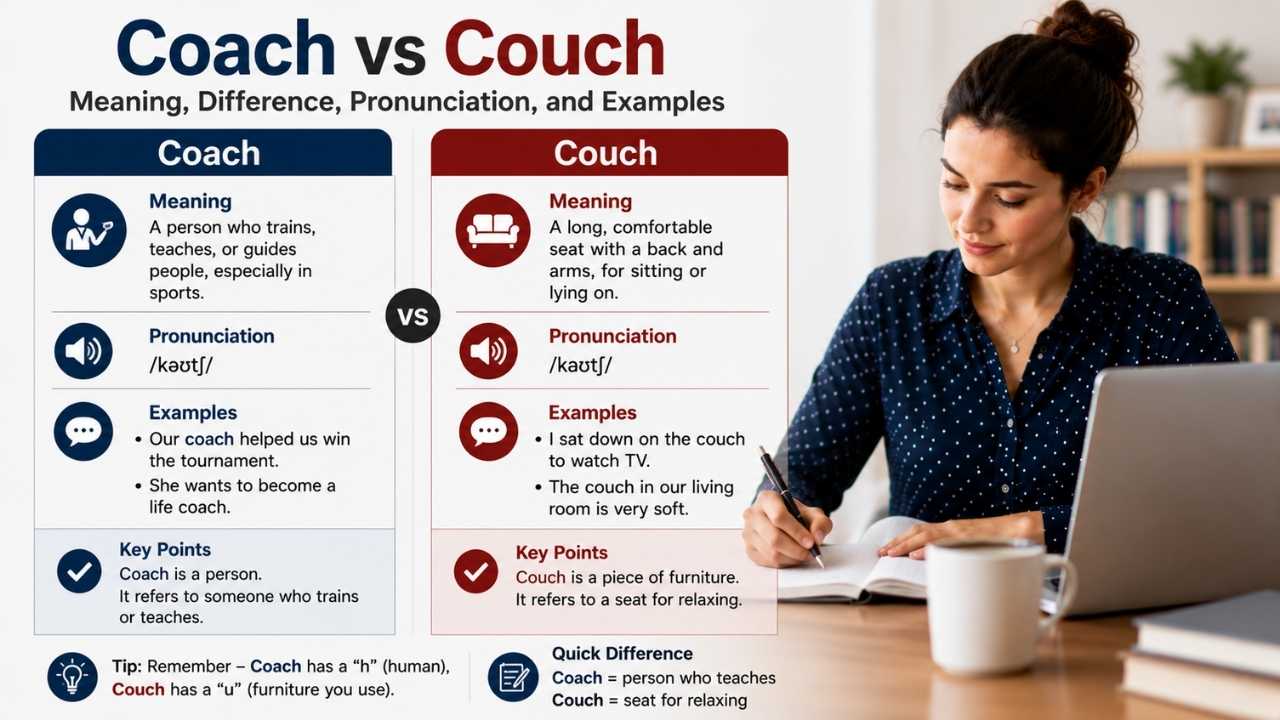
Many English learners get confused between “coach” and “couch” because they look and sound very similar. This creates a common problem in English vocabulary confusion words and often leads to spelling or speaking mistakes. However, both words have completely different meanings and uses.
A coach usually refers to a trainer, mentor, or guide, while a couch refers to a piece of furniture used for sitting or lying down. This difference is simple once you understand the context, but beginners often mix them due to similar pronunciation and spelling patterns.
In this guide, you will clearly learn the difference between Coach vs Couch, their meanings, pronunciation, and real-life examples. You will also see why people confuse them and how to remember them easily. This will help you improve your English and avoid common mistakes in both writing and speaking.
Quick Answer
The difference between coach and couch is simple. A coach is a person who trains, teaches, or guides someone in sports or skills. In some regions, it can also mean a type of bus. A couch, on the other hand, is a soft piece of furniture used for sitting or relaxing at home, similar to a sofa. Although the words look similar, their meanings are completely different. The confusion usually happens due to similar spelling and pronunciation.
So, coach vs couch meaning depends fully on context, not similarity. Remember: coach = trainer or guide, and couch = sofa or seating furniture.
What Does “Coach” Mean in English?
The word coach meaning in English mainly refers to a trainer, mentor, or instructor who helps people improve skills. For example, a football coach trains players, and a life coach helps people achieve personal goals. The coach guides, motivates, and teaches step-by-step improvement. In some British English usage, a coach can also mean a long-distance bus or train compartment.
When we look at coach definition in English, it works mostly as a noun, but sometimes also as a verb when someone “coaches” another person. Example sentences include: “The coach trained the team daily” or “She coaches young students in math.” These coach usage in sentence examples show how flexible the word can be. Understanding how to use coach in a sentence helps avoid confusion with similar-sounding words like couch.
What Does “Couch” Mean in English?
The word couch meaning refers to a comfortable piece of furniture used for sitting, resting, or lying down. It is commonly found in living rooms and is similar to a sofa. When people ask for the couch definition in English, it simply means a soft seating object used at home for relaxation.
Unlike “coach,” the word couch is always a noun and never used as a verb. Example sentences include: “I sat on the couch after work” or “They bought a new couch for their living room.” These couch usage in sentence examples make its meaning very clear. Learning how to use couch in a sentence helps beginners avoid mistakes like mixing it with “coach,” especially in spoken English or typing errors. The coach vs couch meaning difference becomes easy once you connect couch with comfort and furniture.
Coach vs Couch – Key Differences
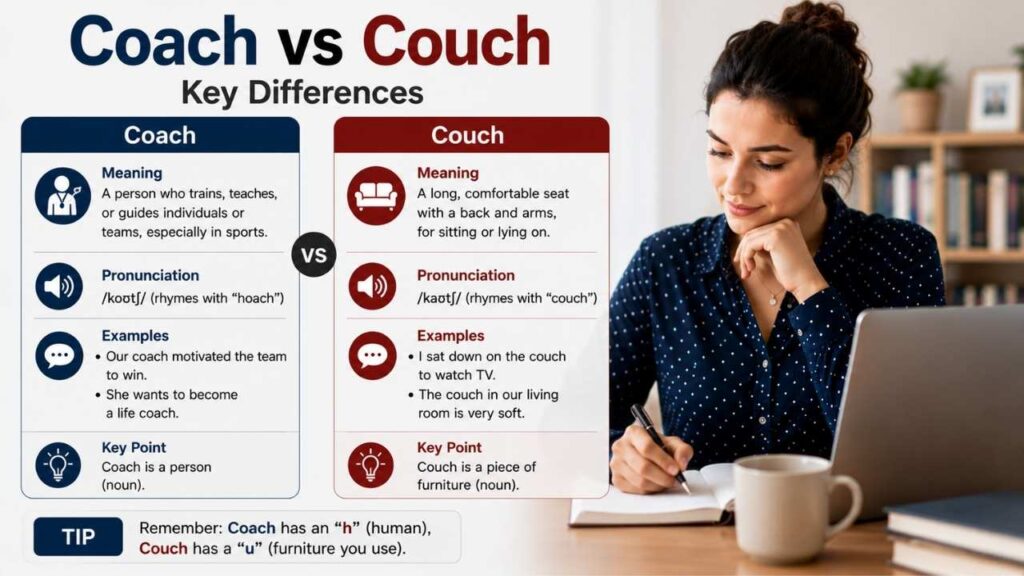
Understanding the difference between coach and couch becomes easier when you compare them side by side. A coach is usually a person or guide, while a couch is an object used for sitting. The coach and couch difference is not just spelling but full meaning and usage.
A coach works in sports, education, or personal development, while a couch belongs to home furniture. In grammar terms, coach can be both a noun and verb, but couch is only a noun. The coach vs couch usage examples also show different contexts: “The coach trained the team” versus “The couch is very comfortable.”
Many learners search for coach vs couch difference with examples for students, and this table helps simplify it. Always remember: coach involves action and guidance, while couch involves rest and comfort.
Pronunciation Difference
The coach pronunciation is /koʊtʃ/, while the couch pronunciation is /kaʊtʃ/. Even though they sound similar, the vowel sound is different. This small difference often causes confusion in spoken English and leads to mistakes in listening and speech recognition.
Many learners ask about the phonetic difference coach couch, and the key is the vowel sound: “oa” in coach sounds like “o,” while “ou” in couch sounds like “ow.” Learning how to pronounce coach and couch correctly improves both speaking and listening skills.
The coach vs couch pronunciation difference is important because English learners often mix them in fast conversation. Practicing slowly and repeating examples like “The coach trains players” and “I sit on the couch” can help reduce confusion and build confidence in pronunciation.
Why Do People Confuse Coach and Couch?
People often confuse coach vs couch because the words look similar and sound almost alike. This happens due to their similar spelling patterns, which makes them part of common English word confusion examples. Many learners also face difficulty with commonly confused English words coach couch because both words use the same ending sound “-ch.”
Another reason is voice typing and autocorrect errors, where speech recognition systems mishear the words. In spoken English, fast pronunciation also increases confusion, especially for ESL learners. Some people even type “coach” when they mean “couch,” which leads to spelling mistakes coach couch.
Understanding the context is the best way to avoid confusion. If the sentence talks about training or guiding, it is “coach.” If it talks about sitting or furniture, it is “couch.” This simple rule helps solve most confusion instantly.
Common Mistakes with Coach and Couch
One of the most common mistakes is using the wrong word in a sentence. For example, saying “I sat on the coach” is incorrect because you actually sit on a couch, not a coach. This is a typical example of coach vs couch spelling mistake in English learning.
Another mistake happens in writing when learners mix meanings due to similar pronunciation. Many ESL learners struggle with English vocabulary confusion words and often write the wrong word during exams or messaging.
Voice typing tools also create errors like “couch trained the team,” which is incorrect because a coach trains the team. These mistakes show why understanding commonly confused words coach couch is important. Always double-check context before using either word. If it involves training or teaching, use coach. If it involves furniture, use couch.
Quick Memory Trick to Remember the Difference
A simple way to remember the coach vs couch difference is to use a memory trick. Think of coach = “O” for Organization or Outdoor training, because a coach organizes teams and helps people improve skills. On the other hand, think of couch = “U” for “You relax on it,” because you sit or lie down on a couch at home.
This simple association helps beginners quickly remember the correct usage. Many learners forget grammar rules, but memory tricks make learning easier and more natural. When you see or hear the word, just think about context: training vs relaxing.
This method is especially useful for ESL students who struggle with coach vs couch meaning explained simply. With practice, this trick helps you avoid mistakes and improves your confidence in both speaking and writing English.
FAQ
What is the meaning of coach vs couch in simple English?
The coach vs couch meaning is very simple. A coach is a person who trains, teaches, or guides others in sports or skills. A couch is a soft piece of furniture used for sitting or relaxing at home. Both words look similar, but their meanings are completely different.
What is the difference between coach and couch with examples?
The difference between coach and couch is based on usage.
- Coach: “The coach helped the players improve.”
- Couch: “I relaxed on the couch after work.”
One shows training or guidance, while the other shows comfort and seating.
Is coach a noun or verb in English?
The word coach can be both a noun and a verb. As a noun, it means a trainer or guide. As a verb, it means to teach or train someone, like “She coaches students in English.” This makes coach usage in sentence very flexible.
Is couch only a noun in English?
Yes, couch is only a noun. It always refers to furniture used for sitting or lying down. It is not used as a verb in modern English. Example: “The couch is very comfortable.”
Why is coach vs couch confusing for learners?
Learners confuse coach vs couch because both words:
- Sound similar in fast speech
- Have close spelling patterns
- Are common in everyday English
- Cause voice typing and autocorrect errors
This leads to English vocabulary confusion words mistakes.
What is the pronunciation of coach and couch?
The coach pronunciation is /koʊtʃ/ and the couch pronunciation is /kaʊtʃ/. The main difference is the vowel sound. This small change often creates confusion in listening and speaking.
Can couch mean coach in any situation?
No, couch cannot mean coach in any context. They are completely different words. A couch is always furniture, while a coach is a trainer or guide. The coach vs couch difference depends fully on meaning, not similarity.
What are common mistakes with coach and couch?
Common mistakes include:
- “I sat on the coach”
- “The couch trained the team”
These errors happen due to similar pronunciation and spelling confusion. Correct usage depends on context.
How can I easily remember coach vs couch?
A simple trick is:
- Coach = O for Organization (training, guidance)
- Couch = U for You relax on it (furniture)
This memory trick helps learners avoid coach vs couch spelling mistakes.
Are coach and couch commonly confused English words?
Yes, coach and couch are commonly confused English words. They appear in many ESL learning lists because they sound similar but have totally different meanings and usage in English.
Conclusion
The confusion between coach vs couch is very common in English, especially for beginners and ESL learners. Even though both words look similar and are often mixed in spelling or pronunciation, their meanings are completely different. A coach meaning refers to a trainer, mentor, or guide, while a couch meaning refers to a comfortable piece of furniture used for sitting or relaxing at home.
Understanding the difference between coach and couch becomes easy when you focus on context. If the sentence involves teaching, training, or guiding, it is always coach. If it involves resting, sitting, or home furniture, it is always couch. This simple rule helps avoid most mistakes in writing and speaking.
By practicing examples, pronunciation, and memory tricks, you can easily master this commonly confused English words coach couch pair. With consistent learning, you will improve your vocabulary, reduce errors, and feel more confident using English in real-life situations.

Fahad is a seasoned English language trainer with a focus on IELTS and TEFL preparation.
He holds a Ph.D. in Applied Linguistics and has over 10 years of teaching experience.
Fahad is passionate about helping students achieve fluency and global opportunities.
His classes combine practical techniques with a supportive, student-first approach.