
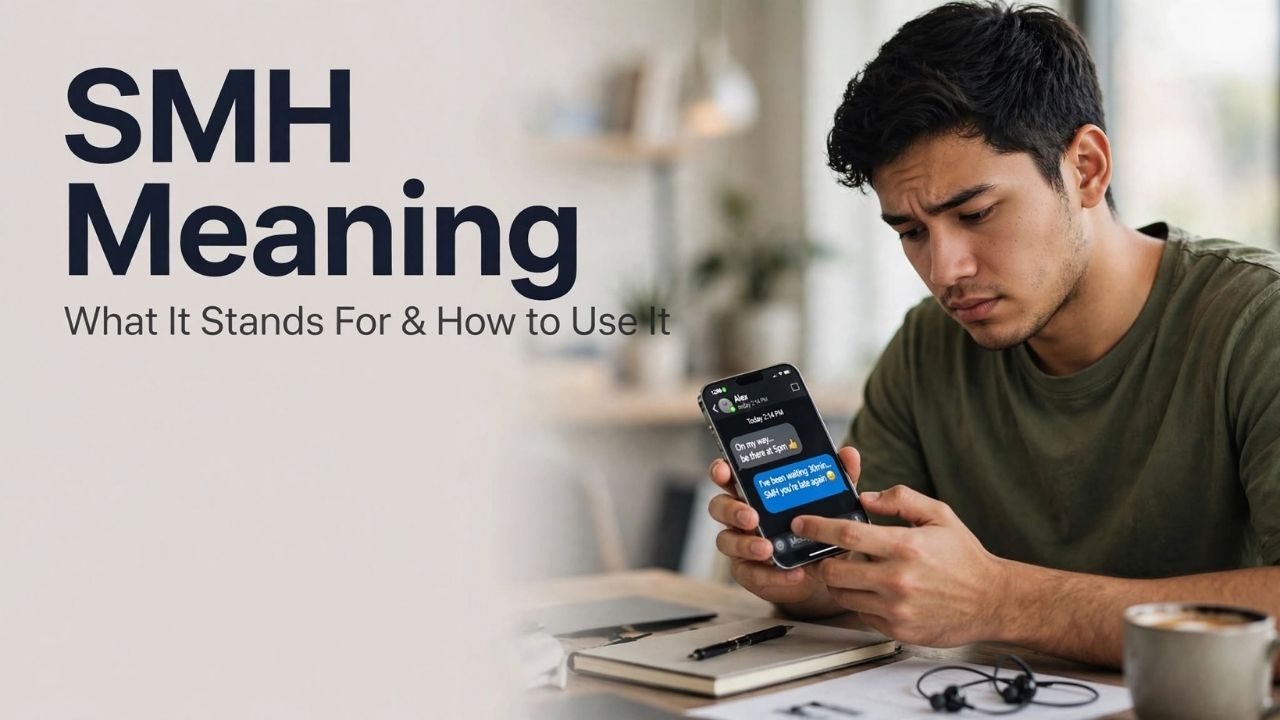
If you’ve seen “smh” at the end of a text and wondered about the SMH meaning, you’re not alone. SMH meaning simply refers to “shaking my head,” and people type it to react to something disappointing, unbelievable, or mildly frustrating — without writing out a full sentence.
This guide breaks down the real SMH meaning in detail: where it came from, how to use it correctly, and whether it’s considered rude. You’ll also learn how the SMH meaning differs from SMDH and SMFH, and see real example sentences you can use with confidence.
Quick Answer
SMH meaning: it stands for “shaking my head,” an internet abbreviation people type to express disbelief, disapproval, frustration, or mild embarrassment about something they just read, saw, or experienced. Instead of writing “I can’t believe this,” someone simply adds “smh” to a sentence and lets the abbreviation carry the reaction.
This meaning stays the same everywhere — texts, tweets, or comments — though the tone can shift from playful to genuinely annoyed depending on the situation and who’s reading it.
TL;DR
- SMH meaning = “shaking my head” — people use it to show disbelief, disappointment, or frustration
- Lowercase (smh) dominates casual texting, though uppercase SMH is equally correct
- SMDH (“shaking my damn head”) and SMFH intensify the same core SMH meaning
- It’s generally not offensive, but it can feel dismissive in serious or emotional conversations
- SMH fits casual texting and social media — save formal language for professional emails
What Does SMH Meaning Mean in Simple Terms?
SMH is an initialism — an abbreviation people pronounce letter by letter rather than as a word — that takes its first letters from “shaking my head.” According to Merriam-Webster, SMH offers the reader a gesture, a shaking head, the way abbreviations like brb or FWIW capture an action instead of a full phrase. In other words, the SMH meaning doesn’t just report an emotion; it recreates a physical reaction in text form, which explains why it has stayed so widely used.
People type SMH when something strikes them as ridiculous, disappointing, frustrating, embarrassing, or mildly amusing in a “can’t believe this happened” way. Example: “He forgot his own birthday. smh.” That one word instantly communicates disbelief without needing an extra sentence of explanation.
Where Did SMH Meaning Come From? Origin and History
The exact birth of the SMH meaning is genuinely hard to pin down, but the documented trail stretches back further than social media itself, evolving across three distinct eras of internet culture.
Early Digital Roots (1990s)
Merriam-Webster documents the abbreviation from at least 1994, when a Usenet post defined “SMH: shaking my head” alongside other early shorthand terms like SOSO.
Urban Dictionary and Twitter Era (2000s)
Dictionary.com notes that Urban Dictionary first listed SMH in 2004, and the term spread widely on Twitter by 2007, possibly originating within Black internet communities.
Mainstream Adoption (2010s–Today)
By the 2010s, SMH appeared unexplained in headlines, and it now holds a recognized slang entry in both Merriam-Webster and Cambridge Dictionary.
Is SMH an Abbreviation, Acronym, or Initialism?
Grammatically, SMH is an initialism, not an acronym, and the distinction actually matters if you want to describe it accurately. Acronyms function as pronounceable words, like NASA or scuba, while initialisms spell out letter by letter, the way people say S-M-H rather than treating it as a single pronounceable word.
SMH functions like an interjection within a sentence. It stands alone or tags onto the end of a statement to express a reaction, rather than acting as a noun, verb, or adjective that could take on different grammatical roles. That’s also why people never conjugate or pluralize it — you’ll never see “smhs” or “smhed” in standard usage, because the term exists purely to convey tone.
Is SMH Written in Capital or Lowercase Letters?
Both SMH and smh count as correct forms, and neither one breaks any grammar rule — this comes down to style, not something formal English conventions dictate. In practice, lowercase smh dominates casual texting and social media, where people often drop capitalization for speed and keep a more relaxed, conversational tone throughout the message.
Uppercase SMH tends to appear more often in headlines, dictionary entries, and formal references, including Merriam-Webster’s own listing, which lists the term as SMH, or smh. If you’re texting a friend, lowercase feels natural; if you’re writing for a publication or a language guide, uppercase is usually the safer, more legible choice.
How to Use SMH in a Sentence
SMH usually appears at the start or end of a sentence, often trailing a comma or period, or standing entirely on its own as a one-word reaction. Getting this placement right is one of the simplest ways to make your casual writing feel natural rather than forced.
Correct Examples
- “Traffic was backed up for two hours because of a fender bender. SMH.”
- “smh, I can’t believe they canceled the show again.”
- “He studied all week and still forgot his notes. Smh.”
Incorrect Examples
- ❌ “I am smh about your decision.” (SMH doesn’t function as a verb phrase this way)
- ❌ “The report was smh.” (SMH doesn’t function as an adjective describing a noun)
SMH expresses a reaction; it doesn’t modify or replace a specific noun or verb inside the sentence structure itself.
SMH Meaning in Texting vs. Social Media
The core SMH meaning stays the same across every platform, but the tone behind it can shift depending on where you see it and who’s reading. In a private text thread between friends, SMH usually signals light exasperation or amusement, since the audience already understands the relationship and context.
On public platforms like Twitter/X, the same three letters often carry a sharper, more critical edge, since strangers reading the post don’t share that personal context. Instagram and TikTok comments tend to land somewhere in between — reaction-based and often lighthearted. Group chats, meanwhile, usually treat SMH as harmless teasing rather than genuine disapproval, since the people in them have already set that relaxed tone.
| Platform | Common Tone |
|---|---|
| Text messages | Personal, often exasperated or amused |
| Twitter/X | Public commentary, often sarcastic or critical |
| Instagram/TikTok comments | Playful, reaction-based |
| Group chats | Light teasing among friends |
SMH Meaning Variations: SMDH and SMFH
SMH has two well-known intensified variants that carry the same underlying SMH meaning but add extra emphasis. SMDH stands for “shaking my damn head,” a slightly stronger version people use when frustration goes beyond the mild, everyday kind. SMFH goes a step further, standing in for a more vulgar word before “head,” and people generally reserve it for genuinely angry or exasperated reactions rather than casual commentary.
Merriam-Webster confirms the SMDH variant directly, and it also occasionally glosses SMH as “scratching my head” in a smaller number of uses, though the “shaking” meaning remains the standard, everyday interpretation across nearly all contexts today.
| Term | Full Meaning | Formality | When to Use |
|---|---|---|---|
| SMH | Shaking my head | Casual | General disbelief or mild disappointment |
| SMDH | Shaking my damn head | Very casual | Stronger frustration, still relatively mild profanity |
| SMFH | Shaking my [expletive] head | Very casual/coarse | Strong frustration or anger; contains profanity |
Is SMH Rude or Disrespectful?
Context decides this one more than the abbreviation itself. SMH carries no inherent insult on its own, but it can land as dismissive because it ends a conversation with a bare reaction instead of an explanation or a genuine response to what the other person actually said.
Generally, it’s fine when reacting to news, memes, minor mishaps, or casual banter among friends and family who already share an established tone. It can feel rude, though, when someone directs it at a serious personal problem, aims it at a stranger’s mistake online, or uses it as a substitute for actually addressing a real concern. If you’re ever unsure how the other person will take it, writing out a full sentence is always the safer choice.
Should You Use SMH in Professional or Work Communication?
Avoid SMH in formal emails, official reports, or professional messaging that targets clients, managers, or people outside your immediate team. It reads as too casual for those settings and can come across as dismissive to a colleague or client, even when that was never the intent behind typing it.
SMH fits better in internal, informal chats with coworkers who already share the same relaxed communication style and understand the tone you’re going for. If your workplace culture leans casual and your team regularly uses similar shorthand, an occasional SMH in a quick Slack message probably won’t raise eyebrows — but a client-facing email is never the place to use it.
Can SMH Be Sarcastic or Self-Deprecating?
Yes, and this is one of the more flexible sides of the SMH meaning that people often overlook. SMH doesn’t limit itself to criticizing others — plenty of people use it to poke fun at their own choices and habits instead. Example: “Stayed up until 3 a.m. watching one more episode. smh at myself.”
Here, SMH signals lighthearted self-awareness rather than genuine disapproval directed outward, which explains why the term has stayed so flexible for well over two decades of internet culture. This self-deprecating usage tends to appear most often among close friends, where everyone already understands the tone and nobody reads it as harsh criticism.
Common Mistakes People Make with SMH
People misuse or misunderstand SMH in a few predictable ways worth knowing before you use it yourself. Assuming it’s always negative or angry is the most common one — most uses actually signal mild disappointment rather than real anger or hostility toward anyone. Using it in serious emotional conversations is another misstep, since it can undercut empathy exactly when someone needs a genuine, thoughtful response instead of a quick reaction.
Overusing it within a single message also weakens its impact; one SMH communicates the reaction clearly, and repeating it adds very little extra meaning. Finally, don’t confuse SMH with the Sydney Morning Herald abbreviation or other unrelated three-letter acronyms that happen to share the same initials.
SMH vs. Similar Expressions
SMH belongs to a wider family of short, reaction-based internet slang that developed around the same era of texting and early social media. It pairs conceptually with terms like LOL, which people use for humor and amusement rather than disapproval, and ICL (“I can’t lie”), which prefaces an honest opinion rather than a reaction to someone else’s behavior.
Unlike LOL, the SMH meaning centers on frustration, disbelief, or disappointment rather than genuine amusement, which is why swapping the two in a sentence usually changes the entire tone of the message. Recognizing these small distinctions helps you choose the abbreviation that actually matches what you’re trying to say.
Synonyms and Alternatives to SMH
SMH doesn’t have a perfect one-to-one substitute, but several phrases carry a similar spirit depending on how formal your writing needs to be.
Informal Alternatives
- “I can’t even”
- “Wow, really?”
- “Unbelievable”
Formal Alternatives (for professional writing)
- “That’s disappointing to hear.”
- “I find that hard to believe.”
- “This is concerning.”
These aren’t perfect substitutes — SMH’s brevity and gesture-like quality don’t fully translate into longer phrases — but they preserve the underlying sentiment in more formal contexts where the abbreviation itself wouldn’t fit. Choosing the right one usually comes down to your audience: casual alternatives work in group chats, while the formal options belong in emails and reports.
How to Respond When Someone Sends You SMH
There’s no single fixed reply when someone sends you SMH, since the right response depends heavily on context and on your relationship with that person. A few reasonable options exist depending on the situation:
- Ask what specifically triggered the reaction, especially if the message arrived without explanation.
- Agree with a short “I know, right?” when you already understand exactly what they mean.
- Explain your side calmly if their SMH was about you, to clear up any misunderstanding.
- Match their tone with humor when the context is clearly lighthearted rather than genuinely upset.
Reading the tone of the original message usually makes the right response fairly obvious.
Regional and Generational Usage
English speakers widely recognize SMH across regions and generations who stay active online, from casual texters to professional social media managers. That said, usage clearly skews toward younger, more digitally native users who grew up texting in shorthand rather than full sentences from the start.
Older generations may recognize the term when they see it, but they typically use it less frequently in their own writing, which can occasionally create small gaps in tone when texting across age groups. This difference matters most in mixed-age group chats or family threads, where a well-placed SMH might land differently than you intend, depending on who’s reading it.
FAQs
What does SMH mean in a text message?
SMH means “shaking my head.” People use it to show disbelief, disappointment, or mild frustration about something in the conversation.
Is SMH the same as “scratching my head”?
Not usually. SMH almost always means “shaking my head,” though Merriam-Webster occasionally glosses it as “scratching my head” in a small number of uses.
What’s the difference between SMH and SMDH?
SMDH means “shaking my damn head” and expresses stronger frustration than plain SMH, which is milder and more general.
Is it okay to use SMH at work?
Generally no. SMH is too casual for formal emails or professional messaging, though it may work in very informal internal team chats.
Can SMH be used in a nice or playful way?
Yes. People often use it affectionately or humorously among friends, especially when reacting to a harmless mistake or funny situation.
Should SMH be capitalized?
No fixed rule requires it. Both “SMH” and “smh” are correct; lowercase dominates casual texting.
Test Your Understanding
1. What does SMH stand for?
A. Show me how
B. Shaking my head
C. So much hype
D. Send me home
2. Which variant of SMH includes a stronger, more informal word for emphasis?
A. SMH
B. SMDH
C. LOL
D. ICL
3. Which sentence uses SMH correctly?
A. “The meeting was smh.”
B. “I am very smh today.”
C. “He missed the flight again. SMH.”
D. “Smh is a noun in this sentence.”
4. According to research, SMH has been in documented use since at least:
A. 2015
B. The early 1990s
C. 2020
D. The 1980s
5. Is SMH generally appropriate for formal business emails?
A. Yes, always
B. No, it’s too casual
C. Only in legal documents
D. Only when addressed to a manager
Answer Key:
1. B — SMH stands for “shaking my head.”
2. B — SMDH (“shaking my damn head”) adds emphasis to the base term.
3. C — SMH works as a standalone reaction, not as a noun or descriptive adjective.
4. B — Merriam-Webster traces documented use to at least the early 1990s.
5. B — SMH is too informal for professional or business writing.
Conclusion
The SMH meaning is simple but expressive: people type “shaking my head” to signal disbelief, disappointment, or mild frustration without writing out a full reaction. It rarely offends on its own, but tone, relationship, and context decide whether it lands as playful or dismissive.
Stick to casual texts and social media, skip it in professional writing, and pay attention to who you’re talking to before you use it. Master these small distinctions, and you’ll use SMH the way most people actually intend it — as a quick, honest gesture rather than a careless jab.
Related Grammar and Language Guides
What Does LOL Meaning and LOL Stands For with Clear Examples
ICL Meaning | What Does ICL Mean in Text, Slang & More
LWK Meaning: What “Lowkey” Really Means Today
Ama Meaning in English Explained: Simple Guide
PMO Meaning Texting Hidden Slang Explained Clearly

Fahad is a seasoned English language trainer with a focus on IELTS and TEFL preparation.
He holds a Ph.D. in Applied Linguistics and has over 10 years of teaching experience.
Fahad is passionate about helping students achieve fluency and global opportunities.
His classes combine practical techniques with a supportive, student-first approach.