

Many English learners get confused when they see the verb “panic” and try to use it in the past tense. The question often arises: what is the past tense of panic? The correct form is “panicked”, not “panic” or any other variation. This follows normal English grammar rules for regular verbs, even though the spelling changes slightly.
In everyday writing and speech, people often wonder whether it is panic or panicked, especially when describing sudden fear or stress. The verb panic conjugation is simple once you understand the pattern: panic, panicked, panicked, panicking.
This topic is important because learners often make mistakes with similar verbs. Understanding the panic verb forms helps you write correctly and sound natural in English. In this article, you will learn the correct past form, usage rules, and simple examples to clear all confusion quickly and easily.
Quick Answer
The past tense of panic is panicked. It follows a simple English grammar rule where we add -ed with a slight spelling change. The verb forms are: panic (base), panicked (past), panicked (past participle), and panicking (present participle). You can use panicked to describe a completed action in the past, such as sudden fear or stress.
Verb Forms of “Panic” (Complete Table)
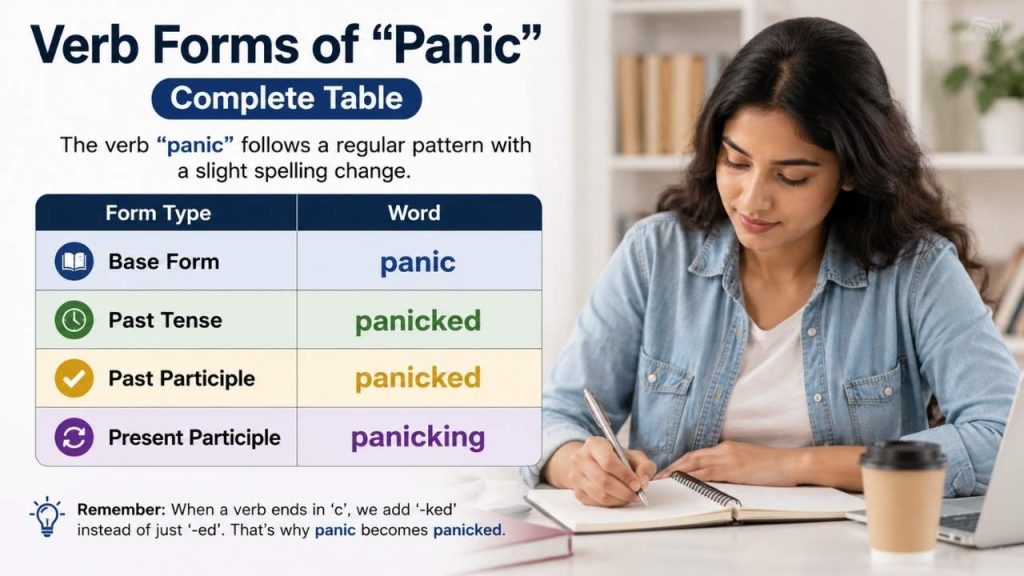
The verb panic conjugation is simple once you see all forms together. The base form is panic, and the past tense becomes panicked. The past participle is also panicked, while the present participle is panicking. This pattern helps learners understand the full structure of the verb.
| Form Type | Word |
| Base Form | panic |
| Past Tense | panicked |
| Past Participle | panicked |
| Present Participle | panicking |
Many learners search for panic verb forms or panic tense table to memorize quickly. This table gives a clear view of how the verb changes in different tenses. It also helps when you compare panic vs panicked in real usage. Once you learn this table, you can easily use the verb correctly in both writing and speaking.
Why “Panic” Becomes “Panicked” (Grammar Rule Explained)
The verb panic follows a spelling rule in English grammar. When a verb ends in “c”, we often add “-ked” instead of just “-ed”. That is why panic changes to panicked in the past tense. This rule helps keep pronunciation clear and natural.
This change is part of a common pattern in English called the CVC-style spelling adjustment, where letters change slightly to match correct sound. Many learners ask why we do not write “panic-ed,” but that form is incorrect.
Understanding this rule helps you avoid mistakes and makes it easier to remember and apply similar verb patterns in other words. This improves your overall English spelling and usage.
How to Use “Panicked” in Sentences
You can use panicked when someone shows sudden fear or stress in the past. It describes a completed action, so it always works as past tense of panic. This makes it useful in daily conversations and storytelling.
For example, you can say, “He panicked when he saw the fire.” Another example is, “They panicked during the loud noise.” These sentences show clear and simple usage of panicked meaning in real life.
You can also use it in questions or reports. For example, “Why did she panic and then panic again?” But the correct form in past actions is always panicked.
Practicing these examples helps you understand how “panic” changes in real contexts, making it easier to use correctly in both speaking and writing.
Common Mistakes Learners Make
Many learners make simple mistakes when using the past tense of panic. The most common error is writing “panic-ed” instead of panicked. This spelling is incorrect and does not follow English grammar rules.
Another mistake is using “panic” as the past tense, which is also wrong. Some learners also confuse panicked vs panicking, especially when describing past events. These errors happen because English spelling changes can look unusual.
You should remember that the correct form is always panicked for past actions. For example, “She panicked during the exam” is correct, while “She panic during the exam” is incorrect.
Learning these mistakes helps you improve your grammar quickly. Once you understand the correct panic verb forms, you can avoid confusion and write more clearly in everyday English.
Panic vs Panicked vs Panicking (Clear Comparison Table)
It is important to understand the difference between panic, panicked, and panicking. Each form has a different use in English grammar, and learners often mix them up.
| Word | Tense | Usage |
| panic | base form | present or general action |
| panicked | past tense | completed action |
| panicking | present participle | ongoing action |
You use panic when talking generally, like “People panic easily.” You use panicked for past events, like “He panicked yesterday.” You use panicking when something is happening now, like “She is panicking.”
This comparison helps you clearly understand panic verb forms and avoid mistakes. Once you learn the difference, you can easily use panic past tense correctly in sentences without confusion.
Is “Panicked” a Regular or Irregular Verb?
The verb panic is mostly treated as a regular verb in English grammar. It follows the normal rule of adding “-ed” to form the past tense, which gives us panicked. This makes it easier for learners to remember.
However, it also includes a small spelling change. The letter “c” changes to “ck” before adding “-ed.” This is why we write panicked instead of “panic-ed.” This rule helps maintain correct pronunciation and spelling.
Because it follows a regular pattern, panic verb conjugation is simple compared to irregular verbs. You can quickly learn its forms: panic, panicked, panicked, and panicking.
This simple rule makes the past tense easy to remember and helps you use similar verbs correctly in daily English.
Quick Memory Trick to Remember the Past Tense
You can easily remember the past tense of panic with a simple trick. Think of the rule: “Add -ed, but change c to ck.” This helps you form panicked correctly every time.
This pattern works because English often adjusts spelling for smoother pronunciation. So instead of writing “panic-ed,” we combine the letters to make panicked.
Remember this by linking it with fear situations. When someone is scared, they “panic,” and when it already happened, they “panicked.” This connection makes the panic verb forms easier to recall.
Practice helps a lot. Try writing a few sentences using panic past tense and repeat them daily. This simple memory trick will help you avoid mistakes and use the verb naturally in real English conversations.
FAQs
What is the past tense of panic?
The past tense of panic is panicked. It describes a completed action in the past.
Is it panic or panicked?
“Panic” is present tense, while panicked is the correct past tense form.
What is the past participle of panic?
The past participle is also panicked, used in perfect tenses.
Why is it panicked and not panic-ed?
English spelling rules change “c” to “ck” before adding “-ed,” making panicked correct.
Can we use panic in past tense sentences?
No, you should use panicked when talking about past actions.
Conclusion
Understanding the past tense of panic becomes easy once you learn the simple rule: panic → panicked. This small spelling change follows normal English grammar and helps you use the verb correctly in past situations.
You should remember that panicked is used for completed actions, while panic is present and panicking shows ongoing action. This clear difference helps you avoid common mistakes and improves your overall grammar accuracy.
By practicing panic verb forms in real sentences, you can build confidence in both writing and speaking. Simple examples like “He panicked” or “They panicked quickly” make the rule easy to remember.
In the end, learning this verb is not difficult. Once you understand the pattern, you can apply it to many similar words. This will make your English more natural, correct, and fluent in everyday use.

Fahad is a seasoned English language trainer with a focus on IELTS and TEFL preparation.
He holds a Ph.D. in Applied Linguistics and has over 10 years of teaching experience.
Fahad is passionate about helping students achieve fluency and global opportunities.
His classes combine practical techniques with a supportive, student-first approach.