
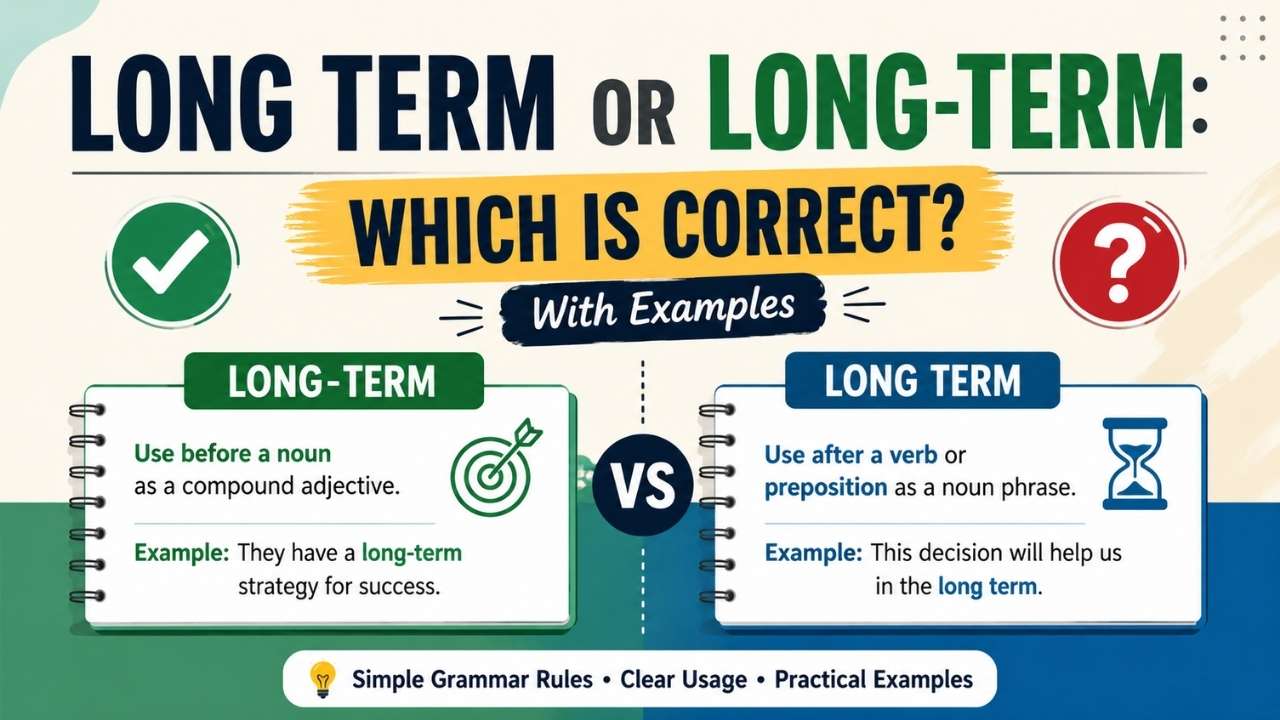
Many writers feel confused about long term or long-term because both forms appear in everyday writing. The truth is simple. Both are correct, but each follows a different grammar rule. You should use long-term with a hyphen when it works as a compound adjective before a noun. For example, “a long-term strategy” is correct. On the other hand, use long term without a hyphen when it acts as a noun phrase after a verb or preposition, such as “in the long term.”
Understanding this small hyphenation rule can improve your English writing and make your sentences clearer. Many style guides, including AP Style, follow this rule to maintain proper grammar usage and readability. In this guide, you will learn the difference between long-term vs long term, when to use each form, and how to avoid common writing mistakes with easy examples.
Quick answer
Long-term is a hyphenated adjective used before nouns, like ‘long-term plan.’ Long term is a noun phrase used after verbs or prepositions, like ‘in the long term.’ The difference depends on sentence position and grammar function. Use hyphenation for clarity before nouns and avoid it when describing time in general usage in English writing. Always follow context rules carefully apply.
What Is the Difference Between Long Term and Long-Term?
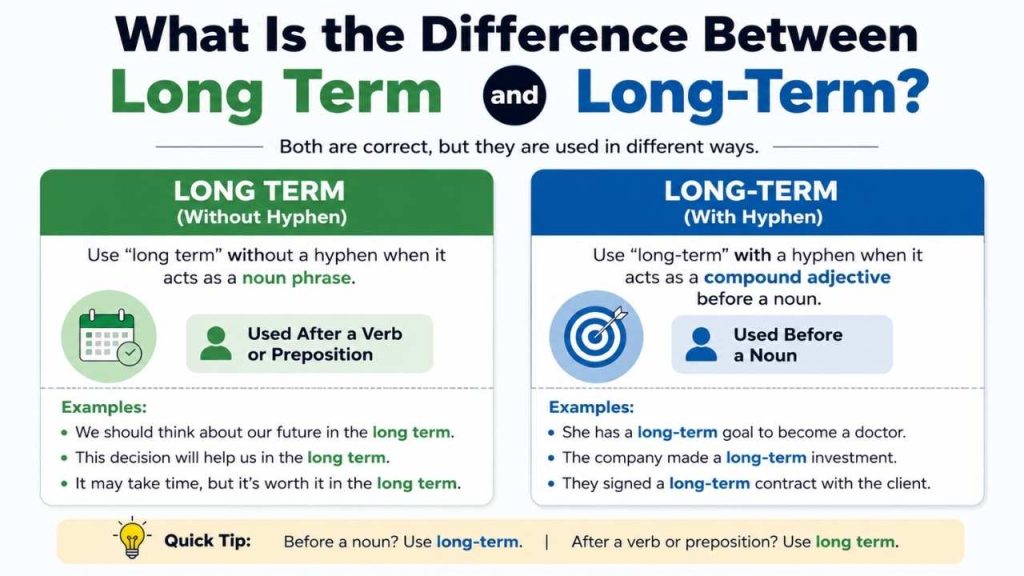
The difference between long term and long-term depends on how the phrase works in a sentence. Writers use long-term with a hyphen when it acts as a compound adjective before a noun. For example, “a long-term investment” describes the noun directly. The hyphen connects the words and improves sentence clarity. Many grammar rules and style guides recommend this form in professional writing.
Use long term without a hyphen when the phrase works as a noun phrase. It usually appears after a verb or preposition. For instance, “This plan will help us in the long term” follows the correct structure. Understanding long-term vs long term helps you avoid common hyphenation mistakes in English writing. A simple rule can make your sentences clearer, smoother, and easier to read in both formal and casual communication.
| Form | Usage | Example |
| long-term | Compound adjective | a long-term goal |
| long term | Noun phrase | in the long term |
When to Use “Long-Term”
Use long-term with a hyphen when the phrase works as a compound adjective before a noun. In this position, the hyphen connects both words and shows that they describe one idea together. Many writers follow this hyphenation rule to improve sentence clarity and avoid confusion. Style guides like AP Style also support this structure in professional and academic writing.
For example, phrases like long-term goals, long-term planning, and long-term strategy all need a hyphen because they modify a noun. Without the hyphen, the sentence may look incomplete or unclear. This form appears often in business writing, education, healthcare, and finance. Understanding when to use long-term can strengthen your grammar usage and make your writing more polished. If the phrase comes directly before a noun, the hyphenated form is usually the correct choice in English grammar.
Why Compound Adjectives Need Hyphens
A compound adjective uses two or more words together to describe a noun. Writers add hyphens to connect those words and make the meaning clear. In phrases like long-term investment or long-term relationship, the hyphen shows that both words work as one adjective. Without the hyphen, readers may pause or misunderstand the sentence.
Hyphens also improve readability in professional writing. Many editors use proper hyphenation rules to keep sentences smooth and easy to understand. This small punctuation mark prevents confusion and creates better sentence flow. For example, “long term project” may look awkward, while long-term project reads naturally. Understanding why compound adjectives need hyphens can help you avoid common grammar mistakes. It also improves your English writing in emails, essays, reports, and online content. Clear punctuation makes your message stronger and more professional.
When to Use “Long Term”
Use long term without a hyphen when the phrase acts as a noun phrase instead of a compound adjective. This form usually appears after a verb or preposition in a sentence. Writers often use it in phrases like “in the long term” or “over the long term.” In these examples, the phrase does not directly describe a noun, so it does not need a hyphen.
Many learners ask, “Should long term be hyphenated?” The answer depends on sentence structure. If the phrase comes after the noun or verb, the open form is correct. For example, “This decision will help us in the long term” follows standard English grammar rules. Understanding when to use long term can improve sentence clarity and reduce punctuation mistakes. This simple grammar rule helps your writing sound natural, polished, and easier to read.
Why “Long Term” Does Not Need a Hyphen Here
The phrase long term does not need a hyphen when it works alone as a noun phrase. In this structure, the words do not combine to describe another noun directly. Instead, they express a general idea about time or duration. That is why sentences like “The company will benefit in the long term” follow correct grammar rules without a hyphen.
Many writers make the mistake of adding unnecessary punctuation in these situations. However, proper hyphen usage depends on word placement in the sentence. If the phrase comes after the noun or verb, writers usually leave it open. This rule appears often in business writing, academic content, and daily communication. Learning how to use long term correctly can improve readability and sentence flow. It also helps you avoid common hyphenation mistakes in professional and casual English writing.
Is “Longterm” One Word?
Many people wonder if longterm is one word, but this spelling is incorrect in standard English. Writers should use either long-term with a hyphen or long term without a hyphen, depending on the sentence structure. Most dictionaries and style guides do not accept longterm as a correct form. That is why professional writers avoid using it in formal communication.
The confusion often happens because some English words become closed compounds over time. However, long-term still follows standard hyphenation rules in modern writing. For example, “a long-term solution” needs a hyphen because it acts as a compound adjective. On the other hand, “thinking in the long term” uses the open form correctly. Understanding the difference between longterm vs long-term can improve your grammar and prevent spelling mistakes in essays, articles, emails, and business writing.
Quick Grammar Rule to Remember
A simple grammar trick can help you remember the difference between long term and long-term. Use long-term with a hyphen when the phrase comes before a noun and describes it directly. For example, “a long-term plan” follows the correct compound adjective rule. The hyphen connects both words and creates one clear meaning.
Use long term without a hyphen when the phrase appears after a verb or preposition. In sentences like “This choice will help in the long term,” the phrase acts as a noun phrase instead of an adjective. This structure does not need a hyphen. Many writers follow this easy pattern to avoid grammar mistakes and improve readability. Learning this quick hyphenation rule can make your English writing smoother, clearer, and more professional in both formal and everyday communication.
| Position | Correct Form | Example |
| Before a noun | long-term | a long-term project |
| After a verb/preposition | long term | helpful in the long term |
Examples of “Long-Term” in Sentences
Writers often use long-term before a noun to describe plans, goals, or effects that continue for a long time. This form works as a compound adjective, so it needs a hyphen to connect both words clearly. Many professional writers follow this grammar rule to improve readability and sentence flow.
Here are some correct examples of long-term in sentences:
- The company created a long-term strategy for growth.
- She focused on her long-term goals after graduation.
- Doctors studied the long-term effects of the medicine.
- We need a long-term solution to solve this issue.
- They made a long-term investment in technology.
These examples show how the hyphenated form appears before nouns in formal and casual writing. Understanding long-term grammar examples can help you avoid punctuation mistakes and improve your English writing in reports, essays, emails, and online content.
Examples of “Long Term” in Sentences
Use long term without a hyphen when the phrase acts as a noun phrase in a sentence. This structure often appears after verbs or prepositions instead of directly before a noun. Many writers use this form in conversations, business communication, and academic writing.
Here are some correct examples of long term in sentences:
- This policy will help the company in the long term.
- We should think about the results over the long term.
- The project may seem costly now, but it will benefit us in the long term.
- Good habits often create success in the long term.
- They focused on stability for the long term.
These examples follow standard English grammar and proper hyphen usage. Learning how to use long term correctly can make your sentences sound more natural, polished, and easier to understand in everyday and professional writing.
Common Mistakes Writers Make
Many writers make small mistakes when using long term and long-term because the rules look confusing at first. One common error is forgetting the hyphen before a noun. For example, writing “long term plan” instead of long-term plan breaks the standard compound adjective rule.
Another mistake involves adding a hyphen where it is not needed. Sentences like “This helps in the long-term” use incorrect punctuation because the phrase acts as a noun phrase there. Some people also write longterm as one word, but dictionaries and style guides do not accept this spelling.
These mistakes can reduce clarity and make writing look less professional. Understanding proper hyphenation rules helps improve sentence flow and readability. Careful punctuation also strengthens your grammar usage in essays, business writing, emails, and online articles.
Is “Long-Term” Hyphenated in AP Style and Chicago Style?
Both AP Style and the Chicago Manual of Style support using long-term with a hyphen when the phrase appears before a noun. These style guides follow the standard compound adjective rule in English grammar. For example, phrases like long-term project and long-term planning need a hyphen because they describe a noun directly.
However, both guides usually remove the hyphen when the phrase appears after the noun or verb. For instance, “The benefits will appear in the long term” follows correct punctuation rules. Editors and professional writers use this pattern to improve readability and avoid confusion. Understanding how style guides treat long-term vs long term can help you write more clearly in academic, business, and journalistic content. Following trusted grammar standards also improves consistency and creates cleaner, more professional writing across different formats.
Similar Hyphenated Word Pairs
The rule for long-term also applies to many other English word pairs. Writers often use hyphens when two words work together as a compound adjective before a noun. However, they usually remove the hyphen when the phrase appears after the noun or verb.
Here are some common examples:
| Hyphenated Form | Open Form |
| up-to-date report | up to date |
| full-time job | work full time |
| well-known author | widely well known |
| high-quality product | quality is high |
| decision-making process | decision making matters |
These patterns follow standard hyphenation rules in English grammar. Learning similar word pairs can help you understand how hyphenation changes meaning in sentences. It also improves sentence clarity and prevents common punctuation mistakes in formal and casual writing.
Does Hyphenation Change Meaning?
Yes, hyphenation can change the meaning and clarity of a sentence. A hyphen connects words and shows that they work together as one idea. Without the hyphen, readers may misunderstand the sentence or pause while reading. That is why proper punctuation matters in clear English writing.
For example, “a long-term goal” clearly describes one type of goal. Without the hyphen, “long term goal” may look incomplete or confusing. The same rule applies to many compound adjectives in grammar. Hyphens help readers understand relationships between words quickly and naturally. Writers use this punctuation mark to improve readability and avoid awkward sentence structure. Understanding why long-term is hyphenated can strengthen your grammar skills and make your writing smoother. Correct hyphen usage also creates a more professional tone in articles, essays, business communication, and online content.
Conclusion
Both long term and long-term are correct, but writers use them in different ways. Use long-term with a hyphen when the phrase acts as a compound adjective before a noun. For example, “a long-term solution” follows the correct grammar rule. The hyphen connects both words and improves sentence clarity.
Use long term without a hyphen when the phrase works as a noun phrase after a verb or preposition. Sentences like “This will help in the long term” follow standard English grammar rules. Avoid writing longterm as one word because dictionaries and style guides do not accept that spelling. Understanding the difference between long-term vs long term can improve your punctuation, readability, and writing quality. Once you learn this simple rule, using the correct form becomes much easier in everyday and professional communication.
FAQs
Is long term hyphenated?
Use long-term with a hyphen before a noun, such as “a long-term goal.” Use long term without a hyphen after a verb or preposition.
Is longterm correct?
No, longterm is not a correct spelling in standard English grammar. Writers should use long-term or long term instead.
Why is long-term hyphenated?
The hyphen connects two words that work together as a compound adjective before a noun.
Can long term be used as an adjective?
Usually, writers use the hyphenated form long-term as the adjective before a noun.
Is long-term always hyphenated?
No. Writers remove the hyphen when the phrase acts as a noun phrase, such as “in the long term.”
What does “in the long term” mean?
The phrase means something will happen or matter over a long period of time.

Fahad is a seasoned English language trainer with a focus on IELTS and TEFL preparation.
He holds a Ph.D. in Applied Linguistics and has over 10 years of teaching experience.
Fahad is passionate about helping students achieve fluency and global opportunities.
His classes combine practical techniques with a supportive, student-first approach.