

The past tense of “tear” often confuses English learners because this verb has more than one meaning and an irregular form. Many people search for answers like what is the past tense of tear, tear past tense, or even is it teared or tore, because the rules are not as simple as adding “-ed”.
In English grammar, tear is an irregular verb, so it does not follow the regular pattern. The correct simple past form is tore, while the past participle is torn. Learners often mix it up with “teared,” but that form is incorrect in most cases.
This guide explains the verb forms of tear, clears common confusion, and gives easy examples. You will also learn how to use tore and torn correctly in real sentences for both meanings: ripping something and crying emotionally.
Quick Answer
The past tense of tear is tore, and the past participle is torn. Tear is an irregular verb, so it does not follow the “-ed” rule. You use tore for simple past actions like “She tore the paper.” You use torn in perfect tenses like “The paper has been torn.” The form “teared” is generally incorrect.
Verb Forms of Tear
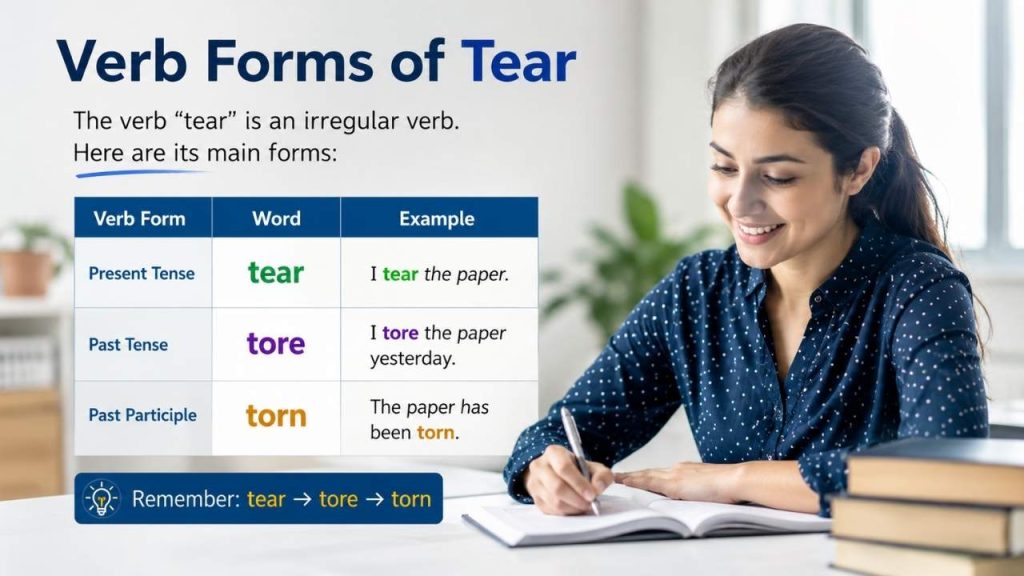
The verb tear is an irregular verb, so it changes form instead of taking “-ed”. Many learners search for the past tense of tear verb forms to understand its structure clearly.
Here is the simple form pattern:
Present: tear
Past: tore
Past participle: torn
This table answers the most common question, what is the simple past of tear. The correct answer is tore, not “teared”. The past participle torn is used in perfect tenses like “has torn” or “had torn”.
Learners often search for tear conjugation or verb forms of tear because they want a quick rule. This pattern stays the same for both meanings of tear. Whether you talk about ripping paper or tearing up emotionally, the verb forms do not change. Understanding this structure helps you avoid common grammar mistakes and improves your English writing accuracy.
Why “Tear” Is an Irregular Verb
The verb tear does not follow normal grammar rules, so it is called an irregular verb. Most verbs in English form the past tense by adding “-ed”, but tear behaves differently. That is why learners often search for past tense of tear irregular verb or ask why it becomes tore instead of “teared”.
In English, irregular verbs come from older language patterns. These forms changed over time and stayed fixed in modern English. The verb tear → tore → torn follows this historical structure.
This pattern is important in English grammar verb rules, especially for beginners. You cannot guess the past form by spelling alone. You must memorize it as a set.
Understanding irregular verbs helps you avoid mistakes in writing and speaking. It also improves your ability to use correct verb forms in English sentences naturally and confidently.
Tear vs Teared vs Tore (Common Mistake Breakdown)
Many learners get confused between tear, teared, and tore when they study the past tense of tear. The correct form is tore, not “teared”. The word “teared” is usually incorrect in standard English grammar.
The verb tear (meaning rip) becomes tore in the past tense. For example, “She tore the paper.” The past participle is torn, as in “The paper has been torn.”
People often add “-ed” because they think tear is a regular verb. This mistake leads to incorrect usage like “He teared the shirt,” which is wrong.
However, “teared” can sometimes appear when talking about crying, such as “Her eyes teared up,” but this is different from the main verb form.
Understanding teared vs tore helps you avoid common grammar errors. Always remember the correct pattern: tear → tore → torn for accurate English usage.
Meaning of “Tear” (Two Different Meanings Explained Clearly)
The word tear has two main meanings in English, and this often creates confusion when learning its past tense forms.
First, tear means to rip or break something. For example, you can tear paper, cloth, or fabric. In this meaning, the past tense becomes tore, and the past participle is torn.
Second, tear also means to cry or produce tears from the eyes. People use it when emotions are strong. For example, someone may tear up while watching a sad movie.
Both meanings use the same verb forms: tear → tore → torn. The structure does not change, even if the meaning is different.
Many learners search for tear meaning in English grammar because they want to understand this difference clearly. Once you learn both meanings, it becomes easier to use the verb correctly in sentences and avoid confusion in writing and speaking.
Example Sentences Using “Tore” and “Torn”
Learning example sentences of the past tense of tear helps you understand real usage. The verb changes to tore in the past and torn in perfect forms.
For the meaning of ripping, you can say: “She tore the letter in anger.” Another example is: “He tore his shirt while playing football.” These show simple past actions.
For the past participle, you can say: “The book has been torn.” or “The paper was already torn when I found it.”
For emotional meaning, you can say: “She tears up when she hears that song.” or “He tore up during the speech.”
These past tense of tear examples help you learn both meanings clearly. Practice these sentences to improve your grammar. Using tore and torn correctly makes your English sound more natural and accurate in everyday communication.
Advanced Usage Patterns
The verb tear is not only used in simple past form tore, but also in advanced grammar structures. These patterns help you improve your English writing and speaking skills.
In perfect tenses, we use torn. For example, “She has torn the paper” shows a recent action. Another example is “He had torn the letter before I arrived.” These forms show completed actions.
In passive voice, we also use torn. For example, “The page was torn by the child.” This structure is common in formal writing and reports.
You can also use collocations like tear apart or tear down. These expressions extend the meaning of the verb.
Many learners search for past participle of tear examples to understand these forms better. Learning these patterns helps you use the verb naturally in both simple and advanced English grammar situations.
What Is the Past Participle of Tear?
The past participle of tear is torn. This form is very important in English grammar because it is used in perfect tenses and passive voice sentences.
Many learners confuse it with “teared,” but that form is incorrect for standard usage. The correct structure is always tear → tore → torn. This pattern stays the same for both meanings of the verb.
You use torn with helping verbs like has, have, or had. For example, “The paper has torn easily” or “She had torn the letter before leaving.”
This form also appears in passive voice, such as “The clothes were torn during the fight.”
People often search for past participle of tear examples because they want clear usage. Once you understand that torn is the third form, it becomes easier to build correct and natural English sentences in both writing and speaking.
Mini Comparison Table: Tear vs Tear Up vs Tear Down
The verbs tear, tear up, and tear down are often confused because they look similar but have different meanings and past forms.
Tear means to rip something or cry. Its past tense is tore, and past participle is torn. Example: “She tore the paper.”
Tear up has two meanings: to rip into pieces or to become emotional. Its past form is tore up, and past participle is torn up. Example: “He tore up the letter.”
Tear down means to destroy or demolish something like a building. Its past form is tore down, and past participle is torn down. Example: “They tore down the old house.”
This comparison helps you understand tear vs tear up past tense difference clearly. Learning these forms improves your grammar accuracy and helps you avoid common mistakes in everyday English writing and speaking.
Common Learner Mistakes
Many English learners make mistakes when using the past tense of tear. The most common error is using “teared”, but this is usually incorrect in standard grammar.
The correct past tense is tore, and the past participle is torn. The full pattern is tear → tore → torn. People often forget this irregular structure and apply regular verb rules.
Another mistake is mixing meanings. Learners sometimes confuse tear (rip) with tear (cry), but both still follow the same verb forms.
Some also misuse expressions like “torned” or incorrect sentence structures in writing.
Understanding these common mistakes with tear verb helps improve accuracy. Always remember the correct forms and practice with examples. This will make your English clearer and more natural in both speaking and writing.
FAQs
What is the past tense of tear?
The past tense of tear is tore. It is the correct simple past form used in sentences like “She tore the paper.”
What is the past participle of tear?
The past participle is torn. It is used in perfect tenses like “The letter has been torn.”
Is “teared” correct English?
No, teared is usually incorrect. The correct form is tore or torn depending on the sentence.
Is tear a regular or irregular verb?
Tear is an irregular verb, so it does not follow the “-ed” rule.
Why is the past tense of tear not “teared”?
Because English irregular verbs follow historical patterns, so tear becomes tore, not “teared.”
What is the verb form of tear?
The forms are: tear (present), tore (past), torn (past participle).
What is the difference between tore and torn?
Tore is simple past, while torn is used with helping verbs like has, have, had.
Can “tear” mean cry?
Yes, tear can also mean to cry emotionally, but the verb forms remain the same.
What is an example of “tore” in a sentence?
“He tore the paper into pieces.”
What is an example of “torn” in a sentence?
“The book has been torn badly.”
What is the past tense of tear up?
the past tense of tear up is tore up, and past participle is torn up.
How can I remember tear, tore, torn easily?
hink of it as a pattern: tear → tore → torn. Practice with daily examples to memorize it easily.
Conclusion
The past tense of tear is tore, and the past participle is torn. This verb is an irregular verb, so it does not follow the normal “-ed” rule that many English verbs use.
You use tore in simple past sentences like “She tore the letter.” You use torn in perfect tenses and passive voice, such as “The letter has been torn.” Both forms are important for correct English grammar.
The verb tear also has two meanings: it can mean to rip something or to cry emotionally. Even with different meanings, the verb forms stay the same: tear → tore → torn.
Many learners mistakenly use “teared,” but that is incorrect in standard English. Remembering the correct pattern helps you avoid grammar errors and improves your writing and speaking accuracy.

Fahad is a seasoned English language trainer with a focus on IELTS and TEFL preparation.
He holds a Ph.D. in Applied Linguistics and has over 10 years of teaching experience.
Fahad is passionate about helping students achieve fluency and global opportunities.
His classes combine practical techniques with a supportive, student-first approach.