
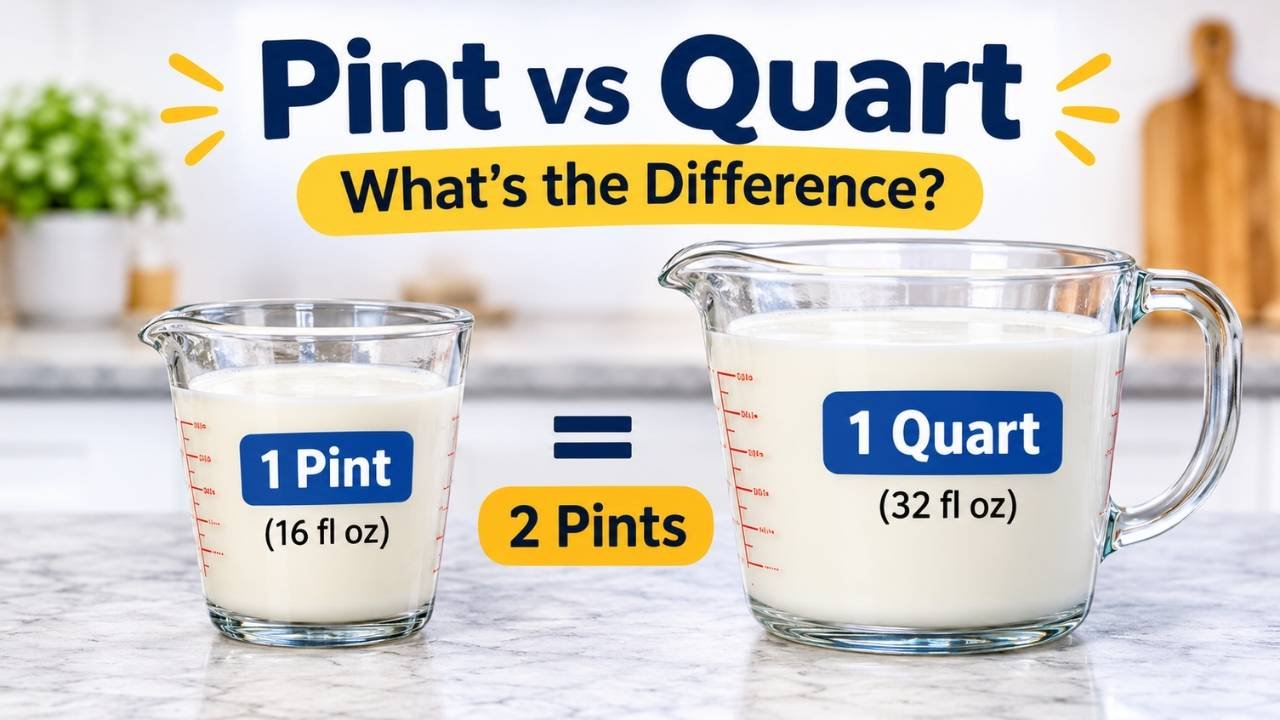
When comparing pint vs quart measurements, the main difference is their volume: a quart holds twice as much as a pint. In the U.S. customary system, 1 quart equals 2 pints, 4 cups, or 32 fluid ounces, while 1 pint equals 2 cups or 16 fluid ounces.
Understanding these measurements makes cooking, grocery shopping, and adjusting recipes easier. Whether you’re measuring milk, preparing soup, or choosing a food container, knowing how to convert pints to quarts and quarts to pints helps you get accurate results.
This guide explains their sizes, provides a simple conversion chart, and clarifies the differences between U.S. and Imperial measurements.
Pint vs quart conversion chart
These are the most useful U.S. liquid volume equivalents:
| Pints | Quarts | Cups | Fluid ounces | Approx. milliliters |
| ½ | ¼ | 1 | 8 | 118 |
| 1 | ½ | 2 | 16 | 237 |
| 2 | 1 | 4 | 32 | 946 |
| 4 | 2 | 8 | 64 | 1,893 |
| 8 | 4 | 16 | 128 | 3,785 |
The U.S. customary relationships are 2 pints per quart, 2 cups per pint, and 16 U.S. fluid ounces per pint. Metric equivalents are rounded for convenient everyday use.
NIST+1
What is a pint?
A pint (pt) is a unit of volume used in the U.S. customary and Imperial measurement systems. A U.S. liquid pint equals 2 cups or 16 U.S. fluid ounces, approximately 473 milliliters.
Pints are commonly used to measure:
- Milk, cream, and other beverages
- Ice cream and other grocery products
- Smaller quantities of soup, sauces, and ingredients
A pint is a convenient measure when a recipe calls for a moderate amount of liquid or when a product is sold in a smaller container.
What is a quart?
A quart (qt) is a unit of volume equal to 2 U.S. liquid pints, 4 cups, or 32 U.S. fluid ounces. One U.S. liquid quart is approximately 946 milliliters, just under 1 liter.
NIST+1
Quarts are commonly used for:
- Soup, broth, and sauces
- Milk and other liquids
- Larger recipe batches
- Food storage and packaging
A quart is useful when you need twice the volume of a pint.
How to convert pints to quarts and quarts to pints
The conversion is simple because one quart contains exactly two pints.
Pints to quarts
Quarts = Pints ÷ 2
Example: 6 pints ÷ 2 = 3 quarts
Quarts to pints
Pints = Quarts × 2
Example: 3 quarts × 2 = 6 pints
Worked examples
- 4 pints to quarts: 4 ÷ 2 = 2 quarts.
- 10 pints to quarts: 10 ÷ 2 = 5 quarts.
- 3 quarts to pints: 3 × 2 = 6 pints.
- ½ quart to pints: ½ × 2 = 1 pint.
For quick mental conversions, remember that every pair of pints makes one quart.
U.S. pint vs. Imperial pint
A U.S. pint and an Imperial pint are not the same size. The Imperial pint, used in the UK, is larger than the U.S. liquid pint.
| Measurement | U.S. customary | Imperial |
| 1 pint | 473 mL | 568 mL |
| 1 quart | 946 mL | 1,136 mL |
| Pints per quart | 2 | 2 |
The relationship of two pints to one quart remains the same in both systems, but the actual volume differs. The U.S. liquid quart is approximately 0.946 liters, while the Imperial quart is approximately 1.136 liters.
When following a recipe from another country, check which measurement system it uses before converting ingredients.
When to use pints vs. quarts
Choose the unit that best matches the amount you need to measure.
- Use pints for smaller quantities, such as a pint of cream or a smaller batch of soup.
- Use quarts for larger quantities, such as a quart of broth or a larger batch of sauce.
- Convert between them when scaling a recipe: double the pints to get quarts, or halve the quarts to get pints.
For example, if a soup recipe calls for 2 quarts of broth but you only want half the recipe, use 1 quart, or 2 pints.
A note about dry and liquid measurements
Dry pints and dry quarts are volume units used for dry ingredients and produce. They are not identical in volume to U.S. liquid pints and quarts. A U.S. dry pint is approximately 551 mL, while a U.S. liquid pint is approximately 473 mL.
Also, volume and weight are different: a pint of flour and a pint of water occupy the same volume, but they do not weigh the same. For baking, use the measurement type specified by the recipe.
FAQs
Is a quart bigger than a pint?
Yes. A U.S. liquid quart is twice as large as a U.S. liquid pint. Two pints equal one quart.
How many pints are in 2 quarts?
There are 4 pints in 2 U.S. liquid quarts. Multiply the number of quarts by 2 to convert to pints.
How many cups are in a pint?
One U.S. liquid pint contains 2 U.S. cups, or 16 U.S. fluid ounces.
Is a U.S. pint the same as a UK pint?
No. A U.S. liquid pint is approximately 473 mL, while a UK Imperial pint is approximately 568 mL.
Is a dry pint the same as a liquid pint?
No. A U.S. dry pint is larger than a U.S. liquid pint. Both measure volume, but they are used in different contexts.
Conclusion
Understanding the difference between a pint and a quart makes cooking, shopping, and measuring liquids easier. A U.S. liquid quart contains 2 pints, 4 cups, or 32 fluid ounces, while a pint contains half that amount.
To convert pints to quarts, divide by 2; to convert quarts to pints, multiply by 2. Keep in mind that U.S. and Imperial measurements differ, and dry and liquid measurements are not always interchangeable.
With these simple relationships and the conversion chart above, you can confidently adjust recipes, measure ingredients, and choose the right container for the quantity you need.

Fahad is a seasoned English language trainer with a focus on IELTS and TEFL preparation.
He holds a Ph.D. in Applied Linguistics and has over 10 years of teaching experience.
Fahad is passionate about helping students achieve fluency and global opportunities.
His classes combine practical techniques with a supportive, student-first approach.