

Many writers confuse pickup vs pick up because both forms look similar but serve different purposes in English grammar. The phrase pick up works as a verb phrase that describes an action, while pickup usually acts as a compound noun or adjective. For example, you might pick up groceries after work, but drive a pickup truck home. This small spelling change can affect sentence structure, writing clarity, and overall grammar usage.
People often search for pickup or pick up, is pickup one word, or when to use pickup because compound words follow different grammar rules in modern English. Understanding these spelling differences helps you avoid common writing mistakes in both formal and informal writing. In this guide, you’ll learn the correct usage, simple grammar rules, and real examples of each form.
Quick Answer
The difference between pickup and pick up depends on how the phrase works in a sentence. Pick up is a verb phrase that shows action, such as “pick up the phone.” Pickup is a noun or adjective, such as “pickup truck” or “pickup location.” The hyphenated form pick-up appears less often in modern English writing.
What Is the Difference Between Pickup and Pick Up?
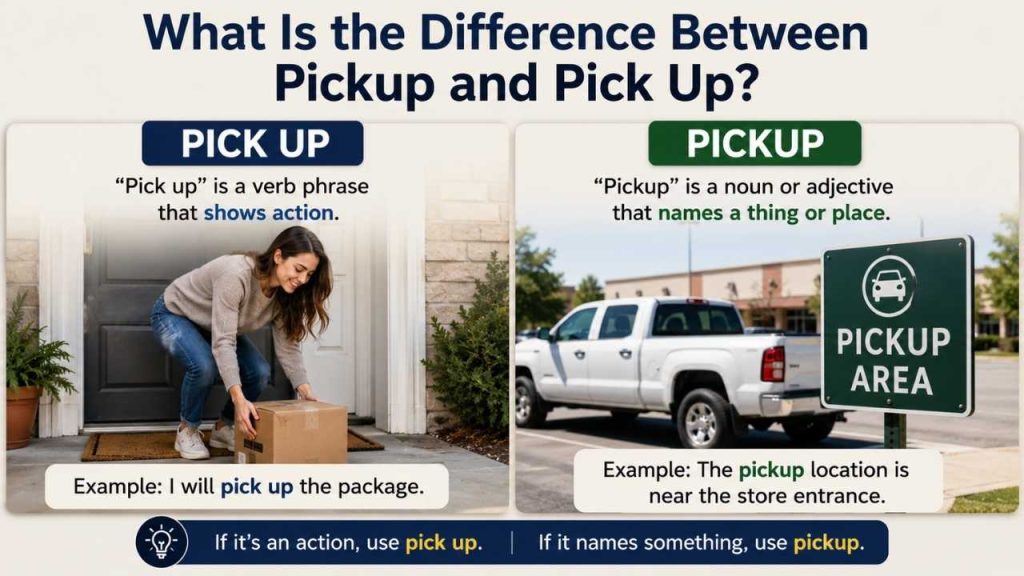
The main difference between pickup and pick up depends on how the word works in a sentence. The phrase pick up acts as a phrasal verb that shows action. You use it when someone collects, lifts, or retrieves something. For example, “I will pick up the package after lunch.” In this sentence, the phrase describes an action.
The word pickup works as a noun or adjective. It names a thing instead of showing action. You might talk about a pickup truck, a pickup location, or a pickup order. This form is a closed compound word in modern English grammar.
Many writers confuse these forms because the spelling looks similar. Still, knowing the correct grammar usage improves writing clarity and helps you avoid common spelling mistakes in formal and casual writing.
Definition of “Pick Up”
The phrase pick up is a phrasal verb in English grammar. It describes an action such as lifting, collecting, gathering, or receiving something. Writers use this two-word form when someone performs an activity in a sentence. For example, you can pick up groceries, pick up a package, or pick up the phone. In each example, the phrase shows action and works as a verb.
English uses many open compound words like this in everyday communication. The meaning often depends on sentence structure and context. Many learners search for what does pick up mean because the phrase appears in both formal and informal writing. Understanding this grammar rule improves word usage, spelling accuracy, and writing clarity. It also helps writers avoid common grammar mistakes in emails, articles, and professional communication.
Definition of “Pickup”
The word pickup is a compound noun or adjective in English grammar. Unlike pick up, this form does not show action. Instead, it names a thing, place, service, or idea. Writers commonly use pickup in phrases like pickup truck, pickup location, pickup order, and pickup service.
This one-word form is called a closed compound word because two separate words join together to create a new meaning. English grammar includes many compound nouns that follow the same pattern. Over time, frequent usage causes some open compounds to become closed compounds in modern writing.
Many people search for is pickup one word or what does pickup mean because the spelling can feel confusing. Learning the difference between pickup and pick up improves sentence structure, grammar usage, and overall writing clarity in everyday English communication.
Understanding “Pick Up” as a Verb Phrase
The phrase pick up works as a verb phrase in English grammar. It describes an action someone performs. Writers use this form when talking about collecting, lifting, gathering, or receiving something. For example, you can pick up groceries, pick up the phone, or pick up your children after school.
This two-word form stays open because it functions as a phrasal verb. In many sentences, the word “pick” acts as the main verb, while “up” completes the meaning. Together, they create a clear action phrase.
Many people search for when to use pick up because compound words often confuse English learners. A simple trick can help. If the phrase shows action, you usually need pick up instead of pickup. This grammar rule improves sentence structure, word usage, and overall writing quality in everyday English.
Understanding “Pickup” as a Noun or Adjective
The word pickup acts as a compound noun or adjective in English writing. Unlike pick up, this form does not describe an action. Instead, it names a person, object, place, or idea. For example, people often say pickup truck, pickup basketball game, or pickup service.
Writers also use pickup as an adjective before another noun. You may see phrases like pickup location or pickup point in business writing and delivery services. In these examples, the word describes the type of service or place.
English grammar uses many closed compound words like this. Over time, some two-word phrases combine into one word because people use them often. That explains why many writers ask, is pickup one word or pickup or pick up. Learning this difference improves grammar usage, spelling, and writing clarity in both formal and informal communication.
Is “Pick-Up” With a Hyphen Correct?
The form pick-up with a hyphen appears less often in modern English, but some writers still use it. In most cases, style guides now prefer either pick up or pickup instead of the hyphenated version. Still, you may notice pick-up in older books, newspapers, or compound modifiers before nouns.
For example, someone might write pick-up game or pick-up service. These phrases use a hyphenated compound to connect related words. Modern writing, however, usually drops the hyphen and uses pickup game or pickup service instead.
Many people search for is pick-up correct because English compound words follow changing language rules. Different publishers also follow different style guides. Understanding these spelling conventions helps writers choose the correct form for formal writing, editing, and professional communication.
Pickup vs. Pick Up: Side-by-Side Grammar Comparison
Understanding pickup vs pick up becomes easier when you compare both forms directly. The phrase pick up acts as a verb phrase, while pickup works as a noun or adjective. Each form serves a different purpose in English grammar and sentence construction.
| Form | Part of Speech | Example |
| pick up | Verb phrase | Please pick up the laundry. |
| pickup | Noun | The pickup arrived early. |
| pickup | Adjective | We changed the pickup location. |
| pick-up | Hyphenated modifier | They joined a pick-up game. |
Many grammar mistakes happen because writers confuse open compounds and closed compounds. A simple rule can help. If the phrase shows action, use pick up. If it names something, use pickup. This quick comparison improves grammar clarity, spelling accuracy, and everyday writing skills.
Common Mistakes Writers Make
Many writers make small grammar mistakes when using pickup and pick up. The most common problem happens when people use pickup as a verb. For example, writing “Please pickup the package” is incorrect because the sentence needs the verb phrase pick up instead.
Another mistake involves unnecessary hyphens. Some writers use pick-up in every situation, even when modern English prefers pickup or pick up. This confusion often appears in emails, blog posts, and business writing.
Writers also struggle with compound words because English grammar changes over time. Some words stay separate, while others combine into one word. Understanding the difference between open compounds, closed compounds, and hyphenated compounds improves writing clarity. Careful proofreading can help you avoid spelling errors, grammar issues, and awkward sentence structure in professional and casual writing.
Why Compound Words Change Meaning in English
English uses many compound words, and their meaning often changes based on spacing or punctuation. The difference between pickup and pick up shows how grammar structure affects meaning. The phrase pick up acts as a verb phrase that shows action, while pickup becomes a noun or adjective.
English also includes open compounds, closed compounds, and hyphenated compounds. An open compound uses two separate words, such as pick up. A closed compound combines both words into one, like pickup. A hyphenated compound joins words with a hyphen, such as pick-up game.
Language changes over time because people simplify common expressions in everyday speech and writing. Many two-word phrases eventually become single words after years of repeated use. Learning these grammar patterns improves word usage, spelling, and sentence clarity in modern English writing.
Pickup vs. Pick Up in American vs British English
Both American English and British English use pickup and pick up, but small style differences can appear. In most cases, American writing prefers the closed compound pickup for nouns and adjectives. You will often see phrases like pickup truck or pickup location in newspapers, websites, and business writing.
British English sometimes keeps hyphenated forms longer than American English. Because of this, some British publications may still use pick-up in certain situations. However, modern English writing in both regions now favors simpler spelling styles.
Different style guides also influence grammar usage. For example, professional editors may follow AP Style or the Chicago Manual of Style when choosing between pickup, pick up, and pick-up. Understanding these regional spelling conventions helps writers create clear content for international readers and professional communication.
Quick Memory Trick to Remember the Difference
A simple memory trick can help you understand pickup vs pick up without confusion. Ask yourself one question: Does the phrase show an action or name a thing? If the sentence shows action, use pick up. If the sentence names something, use pickup.
For example, “I will pick up the order” uses a verb phrase because someone performs an action. In contrast, “The pickup location changed today” uses a noun or adjective because it names a place.
This easy grammar shortcut works well in both formal and informal writing. Many writers remember the rule by thinking: Action equals two words. Thing equals one word. This method improves spelling, sentence structure, and overall writing clarity. It also helps writers avoid common grammar mistakes when using English compound words in daily communication.
Words Similar to Pickup vs Pick Up
English contains many word pairs that follow the same grammar pattern as pickup vs pick up. These words change meaning based on spacing and sentence function. For example, setup works as a noun, while set up acts as a verb phrase. The same rule applies to workout vs work out, login vs log in, and shutdown vs shut down.
These examples show how compound words develop in English grammar. Writers often confuse them because the spelling difference looks small. Still, each form serves a different role in sentence structure and writing clarity.
Learning related grammar patterns improves your understanding of word usage, spelling, and sentence construction. It also helps you avoid common editing mistakes in business writing, academic work, and casual communication. Paying attention to grammar details creates cleaner and more professional content.
Examples of Pickup and Pick Up in Everyday English
People use pickup and pick up often in daily conversations, business communication, and online writing. The phrase pick up usually describes an action. For example, someone may pick up groceries, pick up the kids, or pick up the phone during a busy day.
The word pickup appears when naming a thing or service. You may hear phrases like pickup truck, pickup order, or pickup area at stores and restaurants. Delivery companies also use terms like pickup service and pickup location in customer instructions.
These examples show how grammar changes based on sentence purpose. Understanding the difference between pickup and pick up improves writing clarity and helps readers understand your message quickly. Correct grammar usage also creates stronger communication in emails, websites, school assignments, and professional writing.
FAQs
Is pickup one word or two?
The answer depends on the sentence. Use pick up as a verb phrase that shows action. Use pickup as a noun or adjective.
Is pick up a verb?
Yes. Pick up works as a phrasal verb in English grammar. It describes actions like collecting or lifting something.
Can pickup be an adjective?
Yes. Writers often use pickup before another noun, such as pickup location or pickup service.
Is pick-up outdated?
Modern English uses pick-up less often today. Most style guides now prefer pickup or pick up instead.
Which form is grammatically correct?
All three forms can be correct in different situations. The sentence structure and grammar function determine the proper spelling. Learning these grammar rules improves writing clarity and reduces common spelling mistakes in everyday English.
Conclusion
Understanding pickup vs pick up becomes much easier once you learn their grammar roles. The phrase pick up works as a verb phrase that shows action, while pickup acts as a noun or adjective that names something. Although the spelling difference looks small, the meaning changes based on sentence structure and grammar usage.
Writers often confuse these forms because English uses many compound words with similar patterns. Still, a simple rule can help you remember the difference. If the phrase shows action, use pick up. If it names an object, service, or place, use pickup.
Learning these grammar rules improves writing clarity, spelling accuracy, and communication skills. It also helps you avoid common grammar mistakes in formal writing, business communication, and everyday English. With regular practice, using the correct form will soon feel natural and easy.

Fahad is a seasoned English language trainer with a focus on IELTS and TEFL preparation.
He holds a Ph.D. in Applied Linguistics and has over 10 years of teaching experience.
Fahad is passionate about helping students achieve fluency and global opportunities.
His classes combine practical techniques with a supportive, student-first approach.