

When people write about a cancelled event, a refunded ticket, or a stopped subscription, they often pause at one word: cancelation. Is it spelled with one “l” or two?
This question Cancelation or Cancellation matters because English spelling often changes between regions and writing styles. In daily American English, many people see both forms online. However, only one spelling is widely accepted in modern standard usage.
Today, spelling differences spread quickly through emails, texting, social media, and online publishing. Because of that, older spellings sometimes continue appearing beside newer standard forms.
Quick Answer
In modern American English, cancellation is the standard and preferred spelling. The form cancelation exists, but most dictionaries and style guides now treat it as a less common variant.
TL;DR
- Cancellation is the standard American spelling today.
- Cancelation is an older or less common variant.
- Both forms come from the verb cancel.
- Professional and academic writing usually prefers cancellation.
- The double “l” follows common English word-building patterns.
- Many spell-checkers automatically change cancelation to cancellation.
What Does Cancellation Mean?
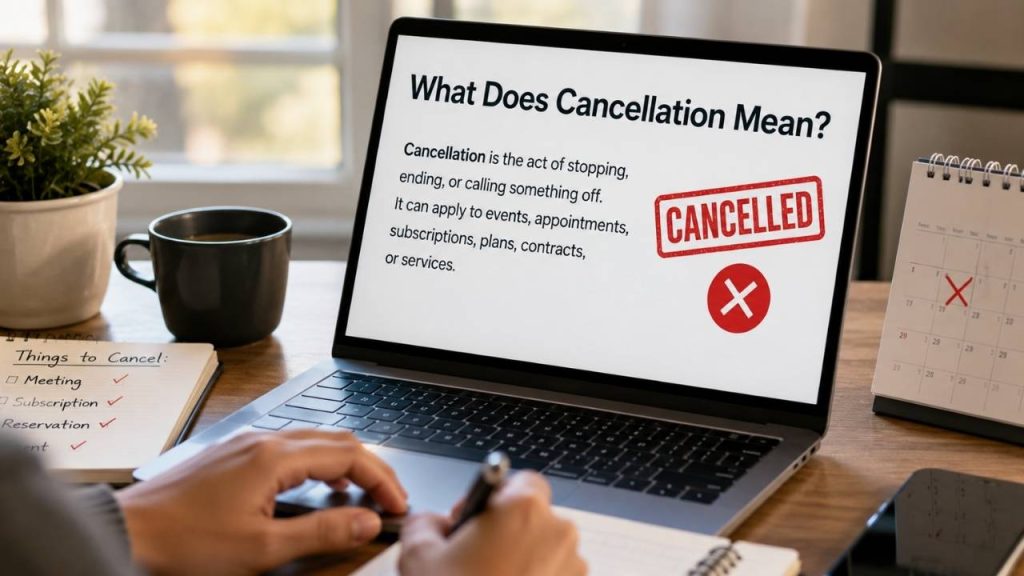
The word cancellation refers to the act of stopping, ending, or calling something off. It can describe events, subscriptions, appointments, reservations, contracts, or plans.
In grammar terms, it is a noun formed from the verb cancel. English often creates nouns by adding endings like “-ation” to verbs. Because of that, cancellation follows a familiar English pattern.
For example, people may say:
| Context | Correct Usage | Example | Notes |
| Travel | Cancellation | “The flight cancellation caused delays.” | Common in airlines |
| Business | Cancellation | “Your cancellation request was approved.” | Formal usage |
| Streaming services | Cancellation | “Subscription cancellation takes effect tomorrow.” | Everyday digital English |
| School events | Cancellation | “Weather caused the cancellation.” | Common spoken usage |
Today, Americans almost always use cancellation in formal and informal writing.
How the Word Is Formed
The base verb is cancel. When English adds “-ation,” the final consonant often doubles. That is why the accepted noun became cancellation rather than cancelation.
This doubling pattern also appears in words like:
- permit → permission
- submit → submission
- commit → commission
English spelling is not perfectly consistent, but this pattern influenced the standard form strongly.
The History of Cancelation and Cancellation
The spelling story is older than many people realize. Both forms appeared in English for centuries.
Early English spelling was less standardized than modern spelling. Writers often spelled words differently, even in the same document. Because of that, both cancelation and cancellation circulated in books and newspapers.
Why Two Spellings Existed
Historically, English borrowed heavily from Latin and French. The verb cancel came through Old French and Latin roots connected to crossing out written marks.
As English developed, writers disagreed on whether the noun should keep a single “l” or adopt a doubled consonant. Over time, publishers and dictionaries increasingly favored cancellation.
By the late twentieth century, the double-“l” version dominated standard American publishing.
How Standardization Changed Usage
Modern dictionaries, educational systems, and digital spell-checkers helped settle the issue. Because schools and publishers consistently taught cancellation, that spelling became the norm.
However, the older variant never disappeared completely. That is why people still encounter cancelation online today.
Cancellation in American English
In the United States, cancellation is considered the standard spelling in nearly every context.
You will see it in:
- news articles
- legal contracts
- customer service policies
- airline notices
- banking documents
- universities
- government forms
American English strongly prefers the double “l” form because it aligns with current dictionary standards and major style guides.
Formal vs Informal Writing
In formal writing, using cancellation is the safest choice. Employers, teachers, editors, and publishers expect it.
In informal texting or social media, some people still write cancelation. Usually, this happens because the spelling feels simpler or more logical to them.
However, readers may still view the single-“l” version as a mistake.
Digital Communication and Autocorrect
Modern technology also shaped usage. Many spell-check systems automatically replace cancelation with cancellation.
Because people type quickly online, they often trust autocorrect tools. As a result, the standard spelling spreads even further through digital writing.
British vs American Spelling Differences
Interestingly, this spelling issue differs from many other British-American spelling changes.
Usually, British English keeps double consonants more often than American English. For example:
- travelling vs traveling
- cancelled vs canceled
However, the noun cancellation commonly uses two “l” letters in both American and British English.
That surprises many learners because Americans usually simplify doubled consonants. In this case, though, both varieties largely agree.
Related Verb Forms
Confusion increases because the verb forms vary more clearly between regions.
In American English:
- canceled
- canceling
In British English:
- cancelled
- cancelling
Yet the noun remains mostly stable as cancellation across both systems.
Why People Still Use Cancelation
Even though cancellation dominates modern usage, the shorter variant still appears regularly.
Some writers prefer cancelation because it looks more consistent with the American verb form canceled. Since Americans often use one “l” in verbs, people naturally assume the noun should also use one.
This reasoning feels logical, but English spelling does not always follow perfect patterns.
Influence of Simplified Spelling
American English has a long history of spelling simplification. Words like color replaced colour, and center replaced centre.
Because of that tradition, some writers expect cancelation to become standard eventually. However, current dictionaries still favor cancellation overwhelmingly.
Internet Usage and Search Trends
Online searches reveal that many people actively question the spelling. That uncertainty keeps both forms visible.
Social media posts, blog comments, and casual writing often preserve uncommon spellings longer than printed publishing once did.
Common Mistakes With Cancellation
Many spelling mistakes happen because people mix verb forms and noun forms incorrectly.
One common error is assuming that canceled automatically creates cancelation. English morphology does not always work that way.
Another mistake is switching spellings within the same document. For example, a business email may contain both versions accidentally.
Professional Writing Errors
In resumes, contracts, or workplace communication, spelling consistency matters. Using the nonstandard form can make writing appear less polished.
For example:
- “Membership cancellation policy” looks standard.
- “Membership cancelation policy” may appear questionable to readers.
Even if readers understand the meaning, inconsistent spelling distracts attention.
Confusion With Similar Words
People also compare the word to nouns like:
- education
- operation
- celebration
These words do not double consonants before “-ation,” which can make cancellation feel unusual.
However, English spelling developed from many language influences, so patterns are not always perfectly predictable.
Real-Life Usage in Everyday English
The word appears constantly in modern communication. Americans use it in business, technology, entertainment, and daily conversation.
Someone might discuss:
- a doctor appointment cancellation
- a gym membership cancellation
- a school cancellation
- a travel cancellation
- a cancellation fee
Because modern life depends heavily on subscriptions and scheduling, the word became extremely common.
Usage in Emails and Customer Service
Businesses use the term frequently because customers often stop services or reservations.
For example:
“Your cancellation request has been processed.”
This phrasing sounds professional, clear, and neutral. That is one reason companies consistently prefer the standard spelling.
Social Media and Informal Speech
People also use the term casually online:
“My flight cancellation ruined the weekend.”
“Cancellation fees are ridiculous.”
In spoken English, listeners obviously cannot hear spelling differences. The confusion exists almost entirely in writing.
Is Cancelation Wrong?
This question creates debate among writers and editors.
Technically, cancelation is not completely invented or historically false. Some dictionaries still list it as a variant spelling.
However, modern American usage strongly favors cancellation. Because of that, many readers interpret the single-“l” form as incorrect.
What Dictionaries Say Today
Most major dictionaries place cancellation first or identify it as the preferred form.
The variant survives mainly because it appeared historically and still occurs occasionally in modern writing.
Still, preference matters in language. When one form becomes dominant, it usually becomes the safer choice for schools and professional communication.
Language Change Over Time
English constantly evolves. Some spellings once considered incorrect later became accepted.
That means language experts avoid making absolute predictions forever. Still, as of January 1, 2026, cancellation remains the standard spelling in American English.
How Usage Has Changed Over Time
Older English tolerated wider spelling variation than modern English does today.
Before dictionaries became widely influential, writers often spelled words based on pronunciation or personal habit. Because of that, spelling inconsistencies appeared everywhere.
Modern publishing changed those habits dramatically.
The Role of Education and Publishing
Schools taught standardized spelling more aggressively during the twentieth century. Newspapers, universities, and publishers reinforced those standards.
As a result, uncommon spellings gradually declined.
Digital communication later strengthened this trend because spell-check software now guides millions of writers daily.
Will Cancelation Become Standard Again?
Probably not soon. Current publishing trends overwhelmingly support cancellation.
Still, English never stops changing completely. If enough writers adopted the shorter spelling over many decades, standards could eventually shift again.
For now, though, professional American English clearly prefers the double-“l” form.
FAQs
Is cancelation a real word?
Yes, it has existed historically and still appears occasionally. However, cancellation is the preferred modern spelling in American English.
Which spelling do dictionaries recommend?
Most modern dictionaries recommend cancellation first. Some also include cancelation as a variant.
Why does cancellation use two “l” letters?
The spelling developed through historical English word formation patterns. Over time, publishers standardized the double-“l” form.
Do Americans use cancellation or cancelation more?
Americans overwhelmingly use cancellation today. It appears far more often in professional and academic writing.
Is cancelation acceptable in formal writing?
It is usually better to avoid it. Most editors and teachers expect cancellation instead.
Does British English use a different noun spelling?
Not usually. Both British and American English commonly use cancellation.
Why is the verb canceled spelled differently?
American English often simplifies verb endings. That is why Americans write canceled, but still use cancellation as the noun.
Will spell-check flag cancelation?
Many spell-check systems do flag it or suggest replacing it with cancellation.
Conclusion
The debate over cancelation versus cancellation shows how English spelling evolves over time. Both forms existed historically, but modern American English strongly favors the double-“l” version.
Today, cancellation appears in schools, business writing, publishing, and everyday communication across the United States. Although the shorter spelling still appears occasionally, it is far less common and may look incorrect to many readers.
When in doubt, choose cancellation. It matches current American standards and works naturally in both formal and casual writing.

Fahad is a seasoned English language trainer with a focus on IELTS and TEFL preparation.
He holds a Ph.D. in Applied Linguistics and has over 10 years of teaching experience.
Fahad is passionate about helping students achieve fluency and global opportunities.
His classes combine practical techniques with a supportive, student-first approach.