
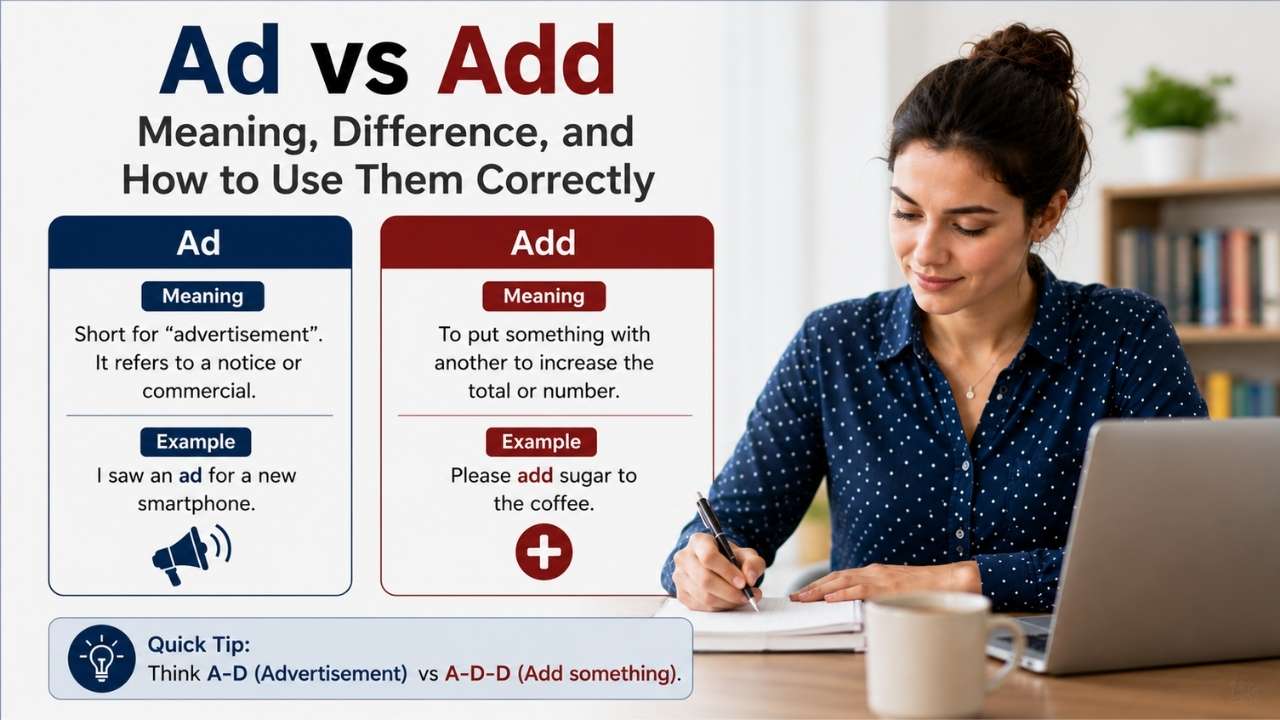
The confusion between ad vs add is very common in English writing. Many learners and even native speakers mix these two words because they sound the same but have very different meanings. This often leads to spelling mistakes in English and unclear sentences.
In simple terms, “ad” means advertisement, while “add” means to include or combine something. Even though they are short words, their usage is completely different in daily communication, marketing, and grammar.
This guide explains the difference between ad and add, their meanings, and how to use them correctly with easy examples. You will also see why people confuse them and how to avoid mistakes. By the end, you will clearly understand ad vs add meaning, usage, and examples in a simple and practical way.
Quick Answer
Ad vs Add: Ad means advertisement, used in marketing like Google ads or TV ads. Add means to include or combine something, like add sugar or add numbers. They are homophones, so they sound the same but have different meanings. People often confuse them, but context clearly shows the correct usage in writing and speech.
What Does “Ad” Mean in English?
The word “ad” is a short form of advertisement. People use it in marketing, business, and digital platforms. When companies promote products or services, they create an ad meaning advertisement to attract customers.
You will often see terms like social media ad, Google ad, or TV ad. These all refer to paid promotional content. In simple words, an ad is something designed to sell or promote.
Many learners search for ad definition and confuse it with “add,” but both are different. The word “ad” is a noun, not a verb. It always relates to promotion or marketing.
Example sentences:
- I saw a YouTube ad before the video started.
- The company launched a new digital ad campaign.
- This is a paid advertisement ad for a mobile app.
Understanding this helps reduce confusing words in English and improves writing clarity.
What Does “Add” Mean in English?
The word “add” is a verb that means to include, join, or increase something. It is widely used in daily English, especially in math, instructions, and conversations.
For example, when you combine numbers, you add meaning verb action in mathematics. When you include something extra, you also use “add.”
People often search add definition or add meaning in English, and the answer is simple—it always shows an action of combining or increasing.
Example sentences:
- Please add sugar to my tea.
- Can you add these numbers for me?
- I will add you to the group chat.
Unlike “ad,” this word is always an action word. It is one of the most common verbs in English grammar, and mastering it helps reduce English grammar mistakes.
Ad vs Add — Key Differences
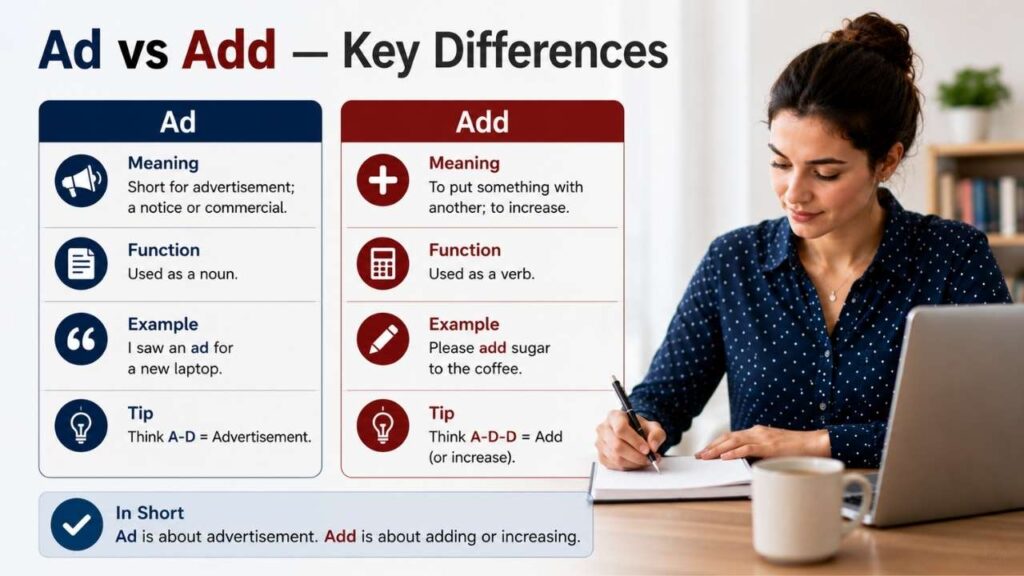
The confusion between ad vs add difference becomes clear when we compare them side by side.
| Feature | Ad | Add |
| Meaning | Advertisement | To include or combine |
| Part of Speech | Noun | Verb |
| Usage | Marketing, promotion | Math, action, daily use |
| Example | TV ad | Add sugar |
The difference between ad and add in English mainly lies in meaning and usage. One belongs to advertising, while the other belongs to action and calculation.
Many learners confuse them because they are homophones in English, meaning they sound the same but have different meanings. This table helps clearly separate ad and add usage in sentences and avoids common writing mistakes.
Why Do People Confuse Ad and Add?
People often confuse ad vs add spelling mistakes because both words sound exactly the same when spoken. This is called a homophone confusion in English.
Another reason is fast typing. When writing quickly, people may accidentally type “add” instead of “ad” or vice versa. Autocorrect tools can also increase confusion.
English learners also struggle because both words are short and appear in different contexts. This leads to common spelling mistakes like ad vs add in writing and social media posts.
In simple terms, the confusion happens due to:
- Similar pronunciation
- Fast typing errors
- Lack of grammar awareness
- ESL learning challenges
Understanding this helps learners avoid mistakes and improve English vocabulary clarity in daily writing.
Are “Ad” and “Add” Homophones?
Yes, ad and add are homophones, which means they sound the same but have different meanings and spellings.
Homophones are very common in English and often create confusion for learners. For example:
- their / there
- to / too
- ad / add
The ad vs add homophones explanation helps learners understand why English spelling can be tricky. Even though both words sound identical, their meanings are completely unrelated.
“Ad” refers to advertisement, while “add” refers to an action of including something. This is why context is very important when using them in sentences.
Learning homophones helps improve English grammar accuracy and reduces everyday writing errors.
Ad vs Add in Real-Life Contexts
The difference between ad vs add usage in real life becomes clear when we see them in different situations.
In marketing, companies use ads meaning advertisements to promote products. You may see Facebook ads, Instagram ads, or YouTube ads every day.
In contrast, add is used in everyday actions. You might add ingredients while cooking or add friends on social media.
Examples:
- The company ran a Google ad campaign.
- Please add my email to your contact list.
- I saw a funny online ad today.
- Don’t forget to add salt to the soup.
These examples show how context changes meaning completely. Understanding real-life usage helps reduce confusion in both writing and speaking.
Common Mistakes with Ad and Add
Many learners make common mistakes with ad vs add in writing, especially in fast communication like texting or social media.
Some incorrect examples include:
- I will ad you to the group
- Click here to add campaign (when meaning advertisement)
Correct usage:
- I will add you to the group
- Click here to view the ad campaign
These mistakes often happen because people mix up ad meaning advertisement and add meaning verb action.
To avoid errors, always check the context. If you are talking about promotion, use ad. If you are talking about including something, use add.
This simple rule improves writing accuracy and reduces English grammar mistakes significantly.
How to Remember the Difference Easily
A simple trick can help you remember ad vs add difference easily.
Think of it like this:
- Ad = Advertisement = short message used for selling
- Add = Adding something = doing an action
Another memory trick is:
- “Ad” is short, just like advertisements are short messages.
- “Add” has two “d’s,” just like you are adding something extra.
These small tricks help learners quickly understand ad vs add meaning and usage without confusion.
Using memory techniques is one of the easiest ways to avoid confusing words in English and improve writing fluency over time.
Ad vs Add Examples in Sentences
Here are simple examples to clearly understand ad vs add examples sentences:
Using “Ad”:
- I saw a YouTube ad today.
- The company placed a TV ad for promotion.
- This is a paid advertisement ad.
Using “Add”:
- Please add milk to the coffee.
- I will add your name to the list.
- Can you add these numbers?
These examples show the clear difference between both words. Practicing such sentences helps improve grammar and avoids confusion in real writing situations.
FAQs
What is the difference between ad and add?
Ad means advertisement, while add means to include or combine something.
Is ad short for advertisement?
Yes, ad is short for advertisement in marketing and media.
Why do people confuse ad and add?
They confuse them because they are homophones and sound the same.
Are ad and add the same word?
No, they have completely different meanings and uses.
What does add mean in English?
Add means to join, include, or increase something.
What does ad mean in English?
Ad refers to a paid promotion or advertisement.
How do you use add in a sentence?
Example: Please add sugar to my tea.
How do you use ad in a sentence?
Example: I saw a YouTube ad today.
Are ad and add homophones?
Yes, they sound the same but have different meanings.
How can I remember ad vs add easily?
Think: ad = advertisement (selling), add = adding something (action).
Conclusion
The confusion between ad vs add is common, but the difference is very simple. “Ad” means advertisement, used in marketing and promotion, while “add” means to include or combine something, used in daily actions and grammar.
Both words are homophones, so they sound the same but carry completely different meanings. By understanding their definitions, examples, and usage in real sentences, you can easily avoid common English grammar mistakes.
Always check the context before writing—if it is about promotion, use ad; if it is about combining or increasing something, use add. This small habit will improve your writing clarity and accuracy.

Fahad is a seasoned English language trainer with a focus on IELTS and TEFL preparation.
He holds a Ph.D. in Applied Linguistics and has over 10 years of teaching experience.
Fahad is passionate about helping students achieve fluency and global opportunities.
His classes combine practical techniques with a supportive, student-first approach.