

Many English learners confuse since vs sense because the two words sound similar in conversation. However, their meanings and grammar usage are completely different. Since usually relates to time or reason, while sense connects to understanding, awareness, or human perception. This common grammar confusion often creates writing mistakes, especially for ESL learners and students.
Understanding the difference between since and sense can improve your English writing and help you avoid common grammar errors. For example, you might say, “I have lived here since 2020,” but “That makes sense to me.” Even though the words look and sound close, they work differently in sentences.
In this guide, you will learn the meaning of since and sense, their grammar rules, sentence examples, pronunciation differences, and easy tricks to remember the correct usage in everyday English.
Quick Answer: Since vs Sense
Since and sense sound similar, but they have different meanings in English grammar. Since usually refers to time or gives a reason for something. In contrast, sense relates to understanding, awareness, or human perception. For example, “I have lived here since 2020,” but “That explanation makes sense to me.
Since vs Sense Comparison Table
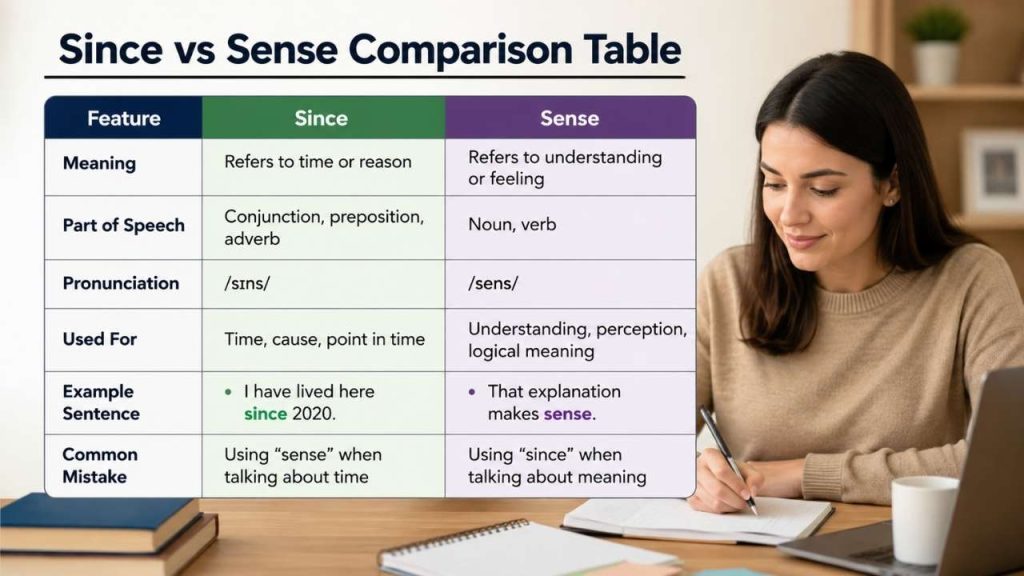
Understanding since vs sense becomes easier when you compare them side by side. These confusing English words may sound alike, but they have very different meanings and grammar roles. The table below shows their usage, pronunciation, and sentence examples in a simple format.
| Word | Meaning | Part of Speech | Example Sentence |
| Since | Refers to time or reason | Conjunction, preposition, adverb | I have studied here since 2022. |
| Sense | Refers to understanding or feeling | Noun, verb | Your explanation makes sense. |
People often confuse these words because of their similar pronunciation. However, their contextual meaning changes completely in sentences. Since usually explains time or cause, while sense relates to perception, awareness, or logic. This grammar comparison helps ESL learners and students avoid common writing mistakes in everyday English communication.
What Does “Since” Mean?
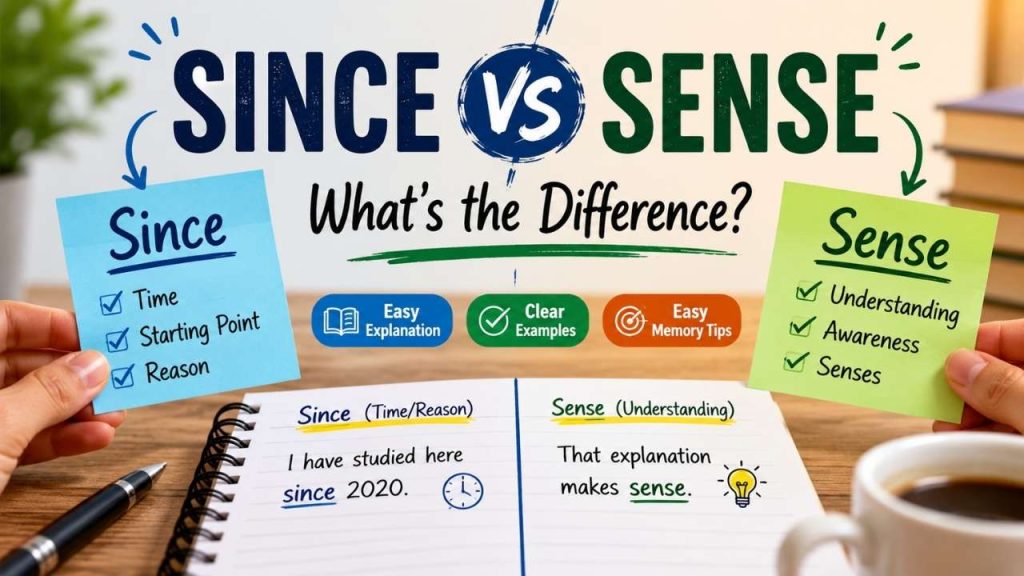
The word since has several meanings in English grammar. Most often, it refers to time or gives a reason for something. You can use since when talking about a starting point in the past that continues until now. For example, “She has lived here since 2020.” In this sentence, the word connects to time.
People also use since to explain causes or situations. For example, “Since you were busy, I finished the work myself.” Here, the word means “because.” This usage appears often in both speaking and writing.
In grammar, since can work as a conjunction, preposition, or adverb depending on the sentence structure. Many English learners confuse its usage, especially when comparing since vs sense. Learning sentence examples and grammar rules helps improve understanding and prevents common writing mistakes.
“Since” as a Time Expression
One common use of since is to show time in English grammar. It points to a specific moment in the past when an action started. The action usually continues into the present. This grammar rule appears often in conversations, writing, and everyday communication.
For example, you can say, “I have known her since childhood,” or “They have worked here since January.” In both examples, since introduces a starting point in time. Many students and ESL learners use this structure when talking about experiences or ongoing situations.
People often compare since vs sense because the words sound similar, but their meanings differ completely. The word since never relates to understanding or perception. Instead, it focuses on time, duration, or sequence. Learning this usage helps you build clearer sentences and avoid common grammar mistakes in English writing and speech.
“Since” Meaning “Because”
The word since can also mean because in English sentences. Writers and speakers often use it to explain a reason or cause. This grammar usage appears commonly in both formal and casual communication. Understanding this meaning helps learners avoid confusion when comparing since vs sense.
For example, you can say, “Since the store was closed, we went home early.” In this sentence, since explains why the action happened. Another example is, “Since you already finished the project, you can relax now.” Here, the word introduces a reason instead of a time expression.
Many English learners focus only on the time-related meaning of since and forget this important grammar rule. However, context usually makes the meaning clear. When since introduces a cause or explanation, it works similarly to the word “because.” Using this structure correctly improves sentence clarity and overall writing skills.
What Does “Sense” Mean?
The word sense relates to understanding, awareness, feelings, or human perception. People often use it when talking about logic, judgment, or the five physical senses. Unlike since, the word sense does not connect to time or reason. Understanding this difference helps learners avoid common grammar mistakes.
For example, you can say, “Your explanation makes sense,” which means the idea feels logical or clear. Another sentence might be, “Humans use their sense of hearing every day.” In this example, the word relates to physical perception.
In English grammar, sense can work as both a noun and a verb. Many ESL learners confuse since vs sense because the pronunciation sounds similar in fast speech. However, their contextual meaning changes completely. Learning sentence examples and grammar usage makes communication easier and improves English writing skills.
“Sense” Related to Understanding
People often use sense to describe understanding, logic, or clear thinking. This meaning appears frequently in everyday English conversations and writing. When something feels reasonable or easy to understand, it usually “makes sense.” Many students and ESL learners hear this phrase often while learning English grammar.
For example, you might say, “Your idea makes sense,” or “That explanation finally makes sense to me.” In both sentences, the word shows understanding or logical thinking. This usage differs completely from since, which usually relates to time or reason.
Understanding the difference between since vs sense helps improve communication and sentence clarity. Many people confuse these words because they sound alike, but context changes their meaning. The word sense focuses on awareness, comprehension, or judgment instead of time expressions. Learning these grammar differences can help you avoid writing mistakes and build stronger English vocabulary skills.
“Sense” Related to Human Perception
The word sense also relates to the body’s ability to experience the world. Humans use their five senses every day to understand their surroundings. These include sight, hearing, smell, taste, and touch. This meaning of sense connects to physical perception and awareness.
For example, you can say, “Dogs have a strong sense of smell,” or “Her sense of hearing improved after treatment.” In both examples, the word describes one of the human or animal senses. This usage differs greatly from since, which never relates to physical feelings or perception.
Many English learners struggle with since vs sense because the pronunciation sounds similar. However, the meanings remain very different in context. Learning how sense works in everyday communication helps improve vocabulary and grammar understanding. It also allows students and ESL learners to use the correct word naturally in speaking and writing.
Since vs Sense in Sentences
Learning through sentence examples makes the difference between since vs sense much easier to understand. These commonly confused words have different meanings, so context plays an important role in choosing the correct one. Reading real examples helps learners avoid grammar mistakes in writing and speaking.
Here are some examples using since:
- I have studied English since 2021.
- Since it was late, we decided to leave.
- She has worked here since Monday.
Now look at examples using sense:
- Your answer makes sense to me.
- Cats have a strong sense of hearing.
- He sensed danger before anyone else noticed it.
These examples show that since usually relates to time or reason, while sense connects to understanding, awareness, or perception. Practicing sentence structures regularly improves grammar usage and helps English learners communicate more clearly and confidently.
Why Do People Confuse Since and Sense?
Many people confuse since vs sense because the words sound very similar in spoken English. Their pronunciation can seem almost identical during fast conversations. This similarity creates spelling confusion, especially for ESL learners and students who are still improving their English vocabulary and grammar skills.
Another reason for the confusion comes from writing mistakes. Some learners hear the word first and choose the wrong spelling without understanding the contextual meaning. For example, a person might incorrectly write, “That idea makes since,” instead of using sense.
The meanings of these words are also completely different, which makes the confusion more noticeable. Since usually refers to time or reason, while sense relates to understanding, awareness, or physical perception. Learning grammar rules, pronunciation differences, and sentence examples helps students recognize the correct usage more easily in everyday English communication.
Pronunciation Difference Between Since and Sense
The pronunciation of since vs sense sounds very close, which is why many learners confuse these words in speaking and writing. However, there is still a small sound difference between them. Understanding pronunciation helps improve communication and reduces common grammar mistakes.
The word since is pronounced as /sɪns/. It uses a short “i” sound, similar to the word “sit.” On the other hand, sense is pronounced as /sens/. It uses a short “e” sound, like the word “bed.”
Although the difference seems small, careful listening makes it easier to recognize each word correctly. Many ESL learners struggle with these sounds at first because they appear similar in fast speech. Practicing pronunciation with sentence examples can improve speaking skills and listening comprehension. Learning these sound patterns also helps students avoid spelling confusion in everyday English writing.
Easy Trick to Remember Since vs Sense
A simple memory trick can help you remember the difference between since vs sense more easily. Associating each word with its meaning makes grammar usage clearer and reduces writing mistakes. This method works well for students, beginners, and ESL learners.
You can connect since with time because people often use it when talking about dates, years, or starting points. For example, “I have lived here since 2019.” The word usually explains when something began or gives a reason for an action.
You can connect sense with the five senses or understanding. Think about phrases like “That makes sense” or “sense of smell.” These examples relate to awareness, logic, or perception instead of time.
Using simple word associations helps learners remember grammar differences faster. Practicing sentence examples regularly also improves vocabulary, communication skills, and overall English writing confidence.
Since vs Sense for ESL Learners
Many ESL learners struggle with since vs sense because English contains many confusing words with similar pronunciation. Understanding grammar rules and contextual meaning can make learning much easier. Students often improve faster when they practice with simple sentence examples and everyday communication.
One helpful strategy is to focus on the meaning first. Use since when talking about time or reasons. Use sense when discussing understanding, awareness, or physical perception. Reading short examples aloud can also improve pronunciation and listening skills.
ESL learners should avoid memorizing grammar rules without context. Instead, they should practice using these words naturally in conversations and writing exercises. For example, write sentences like, “I have studied here since March,” and “Your explanation makes sense.” Repeating these structures regularly improves vocabulary and builds confidence in spoken and written English communication over time.
Common Grammar Rules for Since and Sense
Learning the grammar rules for since vs sense helps students avoid common writing mistakes and improve sentence clarity. Although the words sound similar, they follow very different grammar patterns in English communication. Understanding these rules makes it easier to choose the correct word naturally.
The word since usually works as a conjunction, preposition, or adverb. It often connects to time or explains a reason. For example, “I have worked here since 2020,” or “Since you called early, we started on time.”
The word sense usually works as a noun or verb. It relates to understanding, awareness, or human perception. For example, “That answer makes sense,” or “She sensed something unusual.”
Practicing grammar usage with sentence examples helps ESL learners improve communication skills. It also strengthens vocabulary understanding and makes English writing feel more natural and confident over time.
Since vs Sense Quiz
Test your understanding of since vs sense with these simple grammar questions. Practice exercises help learners remember word usage and improve sentence structure in everyday English communication. Try answering each question before checking the correct answer.
- I have lived here ___ 2021.
- Your explanation makes ___ to me.
- ___ it was raining, we stayed home.
- Dogs have a strong ___ of smell.
- She has worked there ___ Monday.
Answers
- since
- sense
- Since
- sense
- since
These exercises show how context changes the meaning of each word. Since usually refers to time or reason, while sense relates to understanding or perception. Regular grammar practice helps students, writers, and ESL learners avoid spelling confusion and improve English writing skills more confidently.
FAQs
Is it since or sense?
Use since for time or reasons. Use sense for understanding, awareness, or physical perception.
What is the difference between since and sense?
The word since relates to time or cause, while sense relates to logic, feelings, or the five human senses.
How do you use since in a sentence?
You can say, “I have lived here since 2020,” or “Since you were late, we started without you.”
How do you use sense in a sentence?
You can say, “That makes sense,” or “Cats have a strong sense of hearing.”
Are since and sense homophones?
They are not perfect homophones, but they sound very similar in spoken English.
Can since mean because?
Yes, since can introduce a reason or explanation in a sentence.
Conclusion
Understanding since vs sense becomes easier once you learn their meanings and grammar usage. The word since usually refers to time or reason, while sense relates to understanding, awareness, or physical perception. Although these words sound similar, their contextual meanings differ completely in English communication.
Using sentence examples, grammar rules, and pronunciation practice can help learners avoid common writing mistakes. You can remember the difference by connecting since with time and sense with the five senses or logical understanding. This simple memory trick works well for students and ESL learners.
Improving your vocabulary takes regular practice and careful reading. When you understand how these confusing English words work in context, writing and speaking become more natural. Practicing correct usage daily will strengthen your grammar skills and improve overall communication confidence.

Fahad is a seasoned English language trainer with a focus on IELTS and TEFL preparation.
He holds a Ph.D. in Applied Linguistics and has over 10 years of teaching experience.
Fahad is passionate about helping students achieve fluency and global opportunities.
His classes combine practical techniques with a supportive, student-first approach.