
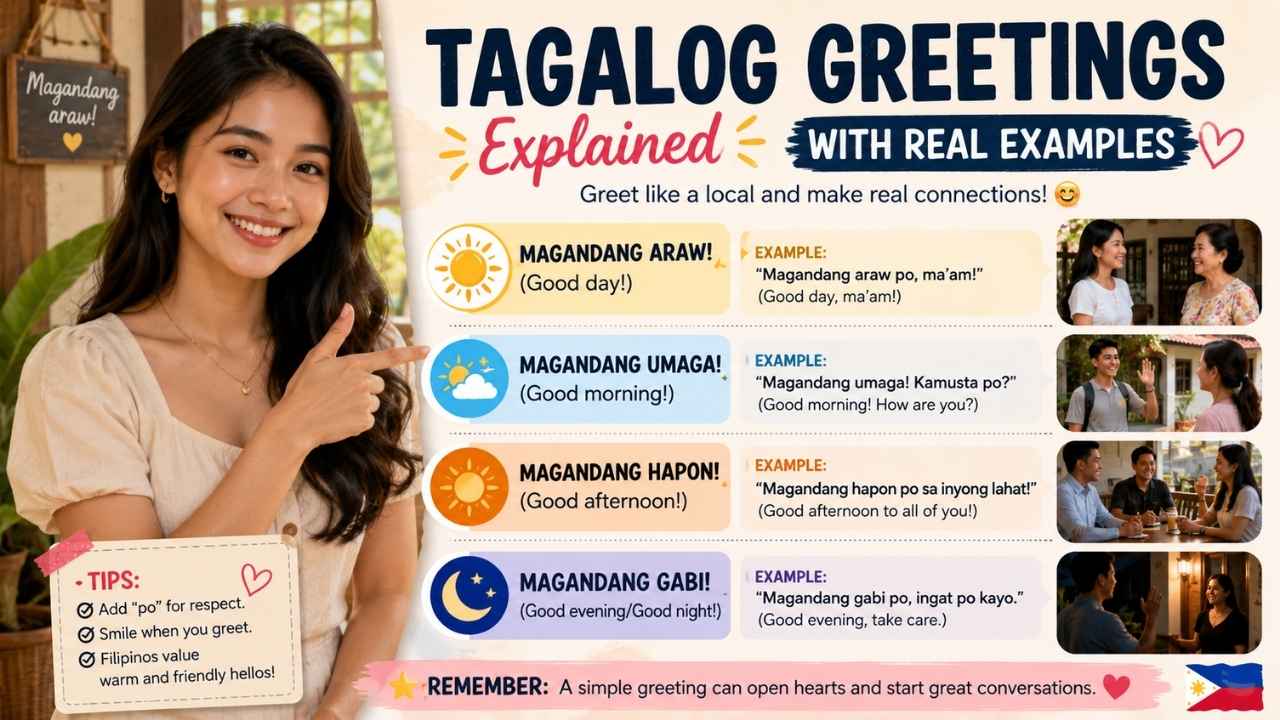
Tagalog greetings are simple words and phrases used by people in the Philippines to say hello, show respect, and start conversations. The most common greeting is “Kamusta” or “Kumusta,” which means how are you in English. Learning these Filipino greetings is helpful for travelers, students, and anyone interested in the language.
These basic Tagalog phrases are used in daily life, whether you are meeting friends, speaking to elders, or visiting the Philippines. Greetings also reflect Filipino culture, where being polite and respectful is very important. You will often hear words like “po” and “opo,” which add respect in conversation.
In this guide, you will learn common Tagalog greetings, their meanings, pronunciation, and when to use them. This will help you understand how to say hello in Tagalog and use it naturally in real conversations.
Quick Answer
Tagalog greetings are simple phrases used in Filipino language to say hello, show respect, and start conversations. The most common greeting is “Kamusta” or “Kumusta,” meaning how are you. Other basic Filipino greetings include “Magandang umaga” (good morning), “Magandang hapon” (good afternoon), and “Magandang gabi” (good evening). These Tagalog phrases are widely used daily.
Most Common Tagalog Greetings

Here are the most common Tagalog greetings you will hear in daily life. The simplest one is “Kamusta” or “Kumusta,” which means hello or how are you. For time-based greetings, Filipinos say “Magandang umaga” for good morning, “Magandang hapon” for good afternoon, and “Magandang gabi” for good evening. To say goodbye, you can use “Paalam.” These are part of basic Filipino greetings that every learner should know.
These common Tagalog phrases are used in schools, homes, and workplaces. They are easy to learn and very useful for beginners. Many learners search for how to say hello in Tagalog, and this list is the first step. You can also use these Tagalog phrases for beginners when traveling or meeting new people. Practicing them daily will help you speak more naturally and understand real conversations in Filipino culture.
Formal vs Informal Tagalog Greetings
In Tagalog greetings, there are two main types: formal and informal. Informal greetings are used with friends, classmates, or people your age. The most common informal word is “Kamusta.” It is simple and friendly. You can also use short casual phrases when talking to people you know well.
Formal Filipino greetings are used when speaking to elders, teachers, or in workplaces. In these situations, respect is very important. You should use full phrases like “Magandang umaga po” or “Magandang hapon po.” The word “po” shows politeness and respect.
Knowing the difference between formal and informal Tagalog phrases is important. Using the wrong tone may sound rude in Filipino culture. Many learners searching for formal vs informal Tagalog greetings want to understand when to use each type. Practicing both helps you speak naturally and respectfully in real-life situations.
“Kamusta vs Kumusta” — What’s the Difference?
Many learners notice two spellings: “Kamusta” and “Kumusta.” Both are used as Tagalog greetings and mean how are you or hello. There is no big difference in meaning, but there is a small difference in usage and spelling style.
“Kumusta” is closer to the original Spanish word “cómo está.” It is often seen in formal writing or older texts. “Kamusta” is the modern and more common version used in daily Filipino greetings and texting. Both are correct and widely understood in the Philippines.
When people search kumusta meaning or kamusta vs kumusta, they want to know which one to use. The simple answer is: you can use either one. In casual conversation, most Filipinos prefer “Kamusta.” It is friendly, natural, and widely used in everyday Tagalog phrases. Both forms are part of basic Filipino language greetings.
Pronunciation Guide for Tagalog Greetings
Learning how to pronounce Tagalog greetings correctly helps you sound more natural. The word “Kamusta” is pronounced as ka-mus-ta. It is simple and easy for beginners. Most Filipino greetings are read the way they are written, which makes learning easier.
For “Magandang umaga,” say ma-gan-dang u-ma-ga. For “Magandang hapon,” say ma-gan-dang ha-pon. And for “Magandang gabi,” say ma-gan-dang ga-bi. These are common Tagalog phrases used every day in the Philippines.
Many learners search for tagalog greetings pronunciation guide because they want to avoid mistakes. The key is to speak slowly and clearly at first. Do not rush the words. With practice, your pronunciation will improve naturally.
Understanding pronunciation is very helpful when learning how to say hello in Tagalog. It builds confidence and helps you use greetings correctly in real conversations with native speakers.
Tagalog Greeting Conversations
To understand Tagalog greetings, it helps to see real conversations. In daily life, Filipinos often use simple exchanges. For example, when meeting a friend:
A: Kamusta ka?
B: Mabuti, salamat!
This means How are you? and I’m fine, thank you. These are basic Filipino greetings used in everyday life.
In formal situations, you can say:
A: Magandang umaga po.
B: Magandang umaga rin po.
These Tagalog phrases for beginners show respect and politeness. Many learners search for common Tagalog phrases for conversation because real examples are easier to remember than rules.
Practicing these dialogues helps you understand how to greet in Tagalog naturally. You can use them at school, work, or while traveling in the Philippines. Simple practice every day will make your Filipino greetings sound more natural and confident.
Cultural Meaning Behind Filipino Greetings
Tagalog greetings are not just words. They also show respect and kindness in Filipino culture. When people say “Kamusta,” they are not only asking how you are, but also showing care and friendliness. This makes Filipino greetings very warm and personal.
One important part of Tagalog phrases is the use of “po” and “opo.” These words are added when speaking to elders or people in higher positions. They show respect and good manners. For example, “Magandang umaga po” sounds more polite than just “Magandang umaga.”
Many learners searching for filipino greeting etiquette want to understand this respect system. In the Philippines, greetings are a big part of social life. People often smile, nod, or shake hands while greeting.
Understanding the cultural meaning behind Tagalog greetings for beginners helps you speak politely and build better connections with native speakers in real situations.
Greeting Elders in Filipino Culture
In the Philippines, greeting elders is very important. Tagalog greetings become more formal when you speak to older people. You should always show respect using polite words and a calm tone. For example, saying “Magandang umaga po” is the correct way to greet an elder in the morning.
Filipinos also use gestures like the “mano po” tradition, where younger people take the hand of an elder and gently touch it to their forehead. This shows deep respect in Filipino culture greetings.
Adding “po” and “opo” is also very important. These words make your Tagalog phrases sound polite and respectful. Without them, your greeting may sound too casual.
Many learners search for how to greet elders in Filipino culture because it is an important social rule. Learning this helps you avoid mistakes and shows that you understand proper Filipino greetings etiquette in real-life situations.
Tagalog Greetings in Different Situations
Tagalog greetings change depending on where you are and who you are speaking to. At home, people often use simple Filipino greetings like “Kamusta” or “Magandang umaga.” These are friendly and casual.
In schools or workplaces, more formal Tagalog phrases are used. For example, “Magandang umaga po” is common when speaking to teachers or managers. In public places like markets or shops, greetings are short but polite.
During travel, knowing basic Tagalog phrases for beginners is very helpful. You may say “Kamusta po” when meeting someone new or asking for help. These simple words make communication easier.
Many learners search for Tagalog greetings for everyday conversation because usage depends on the situation. Understanding context is key. Using the right greeting helps you sound natural and respectful in Filipino culture.
Time-Based Greetings Explained
In Tagalog greetings, time plays an important role. Filipinos use different greetings depending on the time of day. In the morning, they say “Magandang umaga,” which means good morning. This is one of the most common Filipino greetings.
In the afternoon, people use “Magandang hapon,” and in the evening, they say “Magandang gabi.” These Tagalog phrases are simple but very important in daily communication.
Many learners search for how to say good morning in Tagalog because it is often the first greeting used in conversations. These time-based greetings are polite and show respect.
Adding “po” makes them more formal, such as “Magandang umaga po.” This is common in schools, offices, and formal settings. Learning these Tagalog greetings for beginners helps you speak correctly in different parts of the day and understand Filipino culture better.
Common Mistakes Learners Make
When learning Tagalog greetings, beginners often make simple mistakes. One common mistake is using informal words in formal situations. For example, saying only “Kamusta” to an elder may sound too casual. Instead, you should use “Magandang umaga po” or similar polite Filipino greetings.
Another mistake is mispronouncing Tagalog phrases like Kamusta or Magandang hapon. Speaking too fast can also make your greeting unclear.
Some learners forget to use “po” and “opo,” which are very important in Filipino culture. Without them, your greeting may sound less respectful.
People searching for common Tagalog greetings mistakes usually want to avoid these errors. The key is to practice slowly and focus on correct usage.
By learning the right way, your Tagalog greetings for beginners will sound natural and respectful in real conversations.
Useful Tagalog Greeting Responses
Knowing how to respond is just as important as knowing Tagalog greetings. When someone says “Kamusta ka?”, a common reply is “Mabuti, salamat,” which means I’m fine, thank you. These simple Filipino greetings responses are used every day.
For formal situations, you can reply using polite Tagalog phrases like “Mabuti po, salamat po.” Adding “po” shows respect, especially when talking to elders or teachers.
Many learners search for how to respond to Kamusta because it is a very common question in conversations. The good news is that responses are simple and easy to remember.
You can also ask back by saying “Ikaw?” which means and you? This keeps the conversation natural.
Practicing these Tagalog phrases for beginners helps you speak more confidently in real-life Filipino conversations.
Bonus: Romantic & Friendly Greetings in Tagalog
Besides basic Tagalog greetings, there are also friendly and romantic ways to greet someone. With friends, you can use casual Filipino greetings like “Kamusta ka na?” which feels warmer and more personal.
In romantic situations, people may use soft Tagalog phrases like “Mahal kita” (I love you) or gentle greetings that show care. These are not used in formal settings but are common in personal conversations.
Many learners search for common Tagalog phrases for beginners that include emotional expressions. These greetings help build closer relationships.
Friendly greetings in the Philippines are often warm and expressive. People smile, joke, and use light language when talking to close friends.
Learning these Tagalog greetings for beginners helps you understand not only language but also emotions behind Filipino communication.
FAQs
What are Tagalog greetings?
Tagalog greetings are common Filipino greetings used to say hello, show respect, and start conversations in daily life.
How do you say hello in Tagalog?
You say hello in Tagalog as “Kamusta” or “Kumusta.”
What does Kamusta mean in English?
Kamusta means how are you or hello in English.
What is the difference between Kamusta and Kumusta?
Both mean the same. Kamusta is more modern, while Kumusta is older and more traditional.
What are common Tagalog greetings?
Common Tagalog phrases include “Magandang umaga,” “Magandang hapon,” and “Magandang gabi.”
How do you greet someone formally in Tagalog?
You can say “Magandang umaga po” or use “po” to show respect.
Why do Filipinos use “po” and “opo”?
They are polite words used in Filipino culture greetings to show respect.
How do you respond to Kamusta?
You can reply with “Mabuti, salamat.”
Is Tagalog hard to learn for greetings?
No, Tagalog greetings for beginners are simple and easy to remember.
When should I use formal Tagalog greetings?
Use formal greetings when speaking to elders, teachers, or in professional situations.
Conclusion
Tagalog greetings are simple but very important in everyday Filipino communication. They help you say hello, show respect, and connect with people in a friendly way. Basic Filipino greetings like “Kamusta,” “Magandang umaga,” “Magandang hapon,” and “Magandang gabi” are used in many daily situations.
Learning these Tagalog phrases also helps you understand Filipino culture better, especially the importance of politeness through words like “po” and “opo.” Whether you are traveling, studying, or just curious, knowing how to say hello in Tagalog makes conversations easier and more natural.
With regular practice, these Tagalog greetings for beginners will become easy to remember and use.

Fahad is a seasoned English language trainer with a focus on IELTS and TEFL preparation.
He holds a Ph.D. in Applied Linguistics and has over 10 years of teaching experience.
Fahad is passionate about helping students achieve fluency and global opportunities.
His classes combine practical techniques with a supportive, student-first approach.