

Many English learners wonder, what is the past tense of arise? This question is common because arise is an irregular verb, which means it does not follow the usual “-ed” pattern used by regular verbs. The correct past tense of arise is arose, while the past participle of arise is arisen.
Understanding the difference between arose and arisen can help you avoid common grammar mistakes and use the verb correctly in everyday writing and speech. The three main verb forms of arise are arise, arose, and arisen, while arising is the present participle form.
In this guide, you will learn the correct arise verb forms, how to use them in sentences, and why many people mistakenly write arised instead of arose. By the end, you’ll feel more confident using this important English grammar verb correctly.
Quick Answer
The past tense of arise is arose, while the past participle of arise is arisen. Since arise is an irregular verb, it does not follow the regular “-ed” pattern. The correct verb forms are arise, arose, arisen, and arising. For example, “A problem arose yesterday” and “Several issues have arisen recently.”
What Is the Past Tense of Arise?
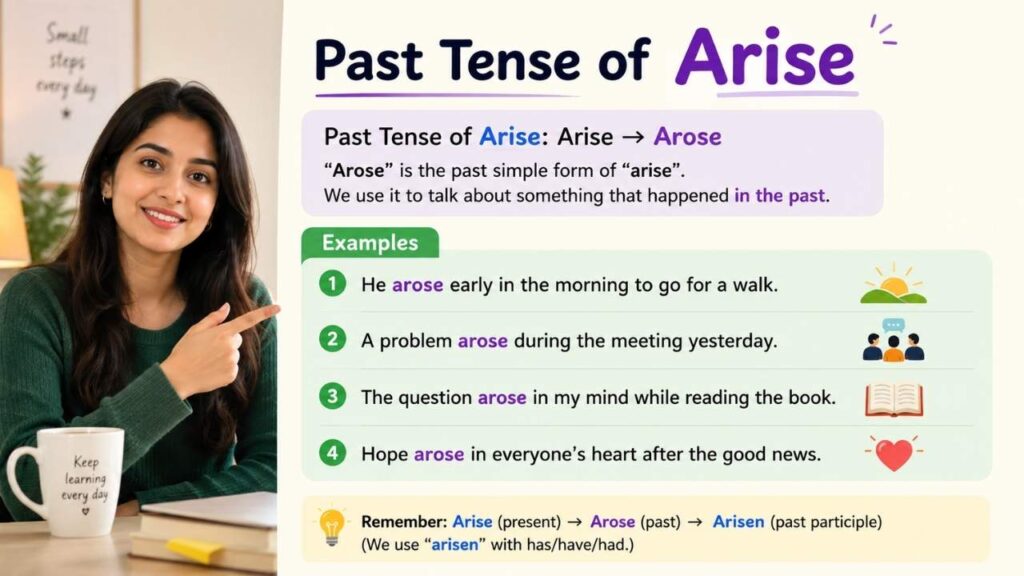
If you are asking, what is the past tense of arise, the answer is simple: arose. The verb arise is an irregular verb, so it does not follow the standard pattern of adding “-ed” to form the past tense. Instead, the verb changes from arise to arose.
For example:
- A problem arose during the meeting.
- Several questions arose after the presentation.
Many learners confuse arose and arisen, but they have different uses. Arose is the simple past tense, while arisen is the past participle of arise. This is why understanding the different verb forms of arise is important.
When discussing something that happened in the past, arose is the correct form to use. Learning this rule will help you avoid common grammar mistakes and improve your English writing.
Verb Forms of Arise
Learning the arise verb forms makes it easier to use this verb correctly in different tenses. Like many irregular verbs, the word changes form depending on how it is used in a sentence.
The main verb forms of arise are:
| Verb Form | Word |
| Base Form | Arise |
| Past Tense | Arose |
| Past Participle | Arisen |
| Present Participle | Arising |
The base form arise is used in the present tense. The past tense of arise is arose, while arisen is used with helping verbs such as has, have, or had. The form arising is used in continuous tenses.
Remembering the pattern arise, arose, arisen will help you use the verb naturally. It is also useful when studying English grammar, verb conjugation, and other common irregular verb patterns.
Is Arise an Irregular Verb?
Yes, arise is an irregular verb. In English grammar, regular verbs form the past tense by adding “-ed.” For example, “walk” becomes “walked.” However, arise does not follow this rule. Instead, it changes to arose in the simple past and arisen as the past participle.
This irregular pattern is why many learners ask questions such as is arose the past tense of arise or what are the forms of arise. The correct sequence is arise, arose, arisen.
Many common English verbs follow a similar pattern. For example:
- Rise → Rose → Risen
- Drive → Drove → Driven
- Write → Wrote → Written
Because arise is an irregular verb, it must be memorized rather than formed by a simple rule. Once you learn its forms, using it becomes much easier.
How to Use Arose Correctly
The word arose is the simple past tense of arise. You use it when talking about something that happened or began in the past. If an issue, question, or opportunity happened earlier, arose is usually the correct choice.
Here are some examples:
- A disagreement arose between the two teams.
- Several concerns arose during the discussion.
- An unexpected opportunity arose last year.
A helpful tip is to remember that arose can stand alone in a sentence without a helping verb. This is one of the main differences between arose vs arisen.
When learners ask how to use arose in a sentence, the answer is simple: use it when describing a completed event in the past. This makes arose an important part of understanding the past tense of arise.
How to Use Arisen Correctly
The word arisen is the past participle of arise. Unlike arose, it cannot usually stand alone. Instead, it is used with helping verbs such as has, have, or had.
Examples:
- A problem has arisen.
- Several questions have arisen recently.
- New challenges had arisen before the project started.
Many learners struggle with how to use arisen in a sentence because they forget the helping verb. Saying “A problem arisen” is incorrect. The correct form is “A problem has arisen.”
Understanding the difference between arose and arisen is important because both forms refer to past events but serve different grammar functions. Once you know when to use helping verbs, the past participle of arise becomes much easier to understand and use correctly.
Arose vs Arisen: What Is the Difference?
Many English learners wonder whether they should use arose or arisen. Although both come from the verb arise, they are used differently.
| Form | Usage |
| Arose | Simple Past Tense |
| Arisen | Past Participle |
For example:
- A problem arose yesterday.
- A problem has arisen recently.
The first sentence uses the past tense of arise, while the second uses the past participle of arise with a helping verb.
A simple memory trick is this: if there is a helping verb such as has, have, or had, use arisen. If there is no helping verb and you are talking about the past, use arose.
Understanding arose vs arisen will help you write more accurately and avoid one of the most common grammar mistakes.
Is “Arised” a Word?
One common question is is arised correct? The answer is no. Arised is not considered the standard past tense form of arise in modern English.
Many learners assume that every verb forms the past tense by adding “-ed.” While this works for regular verbs, it does not work for irregular verbs like arise. The correct forms are:
- Arise
- Arose
- Arisen
Because of this, arised or arose is not a difficult choice once you know the rule. Arose is always the correct simple past form.
Using arised may sound natural to some learners, but it is generally treated as a grammar mistake. To write correctly and confidently, remember the pattern arise, arose, arisen and avoid using arised in formal or everyday writing.
Arise vs Rise
Although arise and rise look similar, they have different meanings. This is why many learners confuse them.
Generally, arise means something happens, develops, or appears. Rise usually means moving upward.
Examples:
- Problems may arise during a project.
- The sun will rise tomorrow morning.
Their forms are also different:
| Verb | Past | Past Participle |
| Arise | Arose | Arisen |
| Rise | Rose | Risen |
Understanding arise vs rise helps you choose the right word in different situations. While both are common in English, they are not interchangeable. Knowing the difference improves both grammar and vocabulary skills.
Common Mistakes When Using Arise
Many learners make a few common mistakes when using arise and its different forms. The most frequent error is using arised instead of arose. Remember that arise is an irregular verb.
Another mistake is using arisen without a helping verb. For example, “A problem arisen” is incorrect. The correct sentence is “A problem has arisen.”
Some learners also confuse arise and rise because the words look similar. However, they have different meanings and should be used in different situations.
To avoid these mistakes, remember the correct sequence: arise, arose, arisen. Practice using each form in sentences and pay attention to whether a helping verb is needed. A little practice can make your grammar much stronger and more natural.
Example Sentences Using Arise, Arose, and Arisen
Looking at examples is one of the best ways to understand the verb forms of arise.
Present Tense:
- New opportunities arise every year.
- Questions often arise during training.
Past Tense:
- A problem arose during the meeting.
- Several issues arose last month.
Past Participle:
- A concern has arisen about safety.
- New challenges have arisen recently.
These examples show how arise, arose, and arisen are used in different situations. Understanding these patterns will help you answer questions such as what is the past tense of arise, what is the past participle of arise, and how to use arose in a sentence.
FAQs
What is the past tense of arise?
The past tense of arise is arose. It is used to describe something that happened or developed in the past.
What is the past participle of arise?
The past participle of arise is arisen. It is commonly used with helping verbs such as has, have, and had.
Is arise an irregular verb?
Yes, arise is an irregular verb because it does not form its past tense by adding “-ed.” Its forms are arise, arose, arisen.
Is it arose or arisen?
Both are correct, but they have different uses. Arose is the simple past tense, while arisen is the past participle.
What are the three forms of arise?
The three main forms are arise (base form), arose (past tense), and arisen (past participle).
Is arised a word?
No, arised is not the standard form in modern English. The correct past tense is arose.
How do you use arose in a sentence?
Example: “A serious issue arose during the project.” Here, arose describes an event that happened in the past.
How do you use arisen in a sentence?
Example: “Several questions have arisen since the meeting.” The word arisen is used with a helping verb.
What is the difference between arise and rise?
Arise usually means “to happen” or “to develop,” while rise means “to move upward.” They have different meanings and verb forms.
What is the second form of arise?
The second form of arise is arose, which is the simple past tense form of the verb.
Conclusion
Understanding the past tense of arise is simple once you learn its forms. The correct verb pattern is arise, arose, arisen, making arise an irregular verb. Remember that arose is used as the simple past tense, while arisen is the past participle of arise and requires a helping verb such as has, have, or had.
By learning the difference between arose and arisen, avoiding mistakes like arised, and practicing with example sentences, you can use this verb with confidence. Keep the pattern arise, arose, arisen in mind, and you’ll be able to use it correctly in both speaking and writing.

Fahad is a seasoned English language trainer with a focus on IELTS and TEFL preparation.
He holds a Ph.D. in Applied Linguistics and has over 10 years of teaching experience.
Fahad is passionate about helping students achieve fluency and global opportunities.
His classes combine practical techniques with a supportive, student-first approach.