
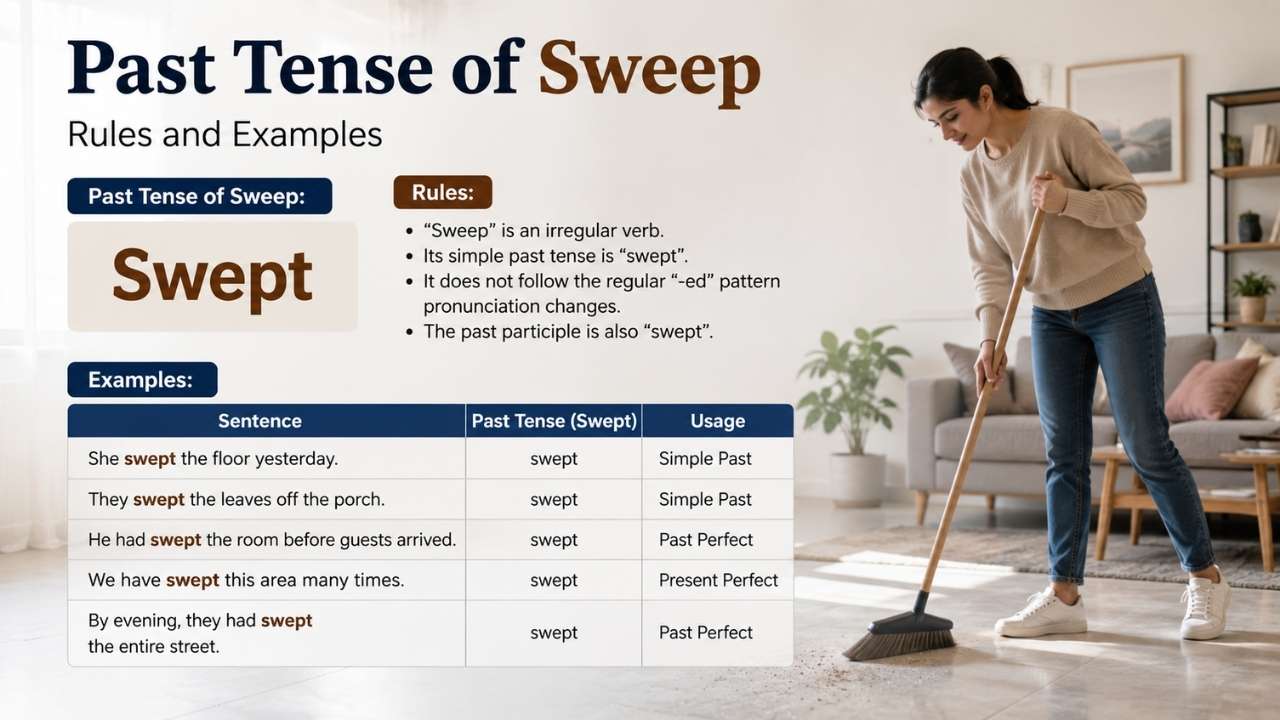
The past tense of “sweep” is “swept.” It is an irregular verb, which means it does not follow the normal “-ed” rule. So we do not say “sweeped”—that is incorrect in English grammar. Instead, the correct form changes completely to swept, which is used in both the past tense and past participle.
Many learners search for the past tense of sweep, the sweep past tense, or even ask “is sweeped correct?” The answer is always the same: swept. For example, “She swept the floor yesterday.”
This guide will clearly explain the verb forms of sweep, its meaning, usage in sentences, and common mistakes. You will also learn why English uses this irregular form and how to remember it easily. By the end, you will fully understand the past tense and past participle of sweep in a simple and practical way.
Quick Answer
The past tense of “sweep” is “swept.” It is an irregular verb, so it does not follow the normal “-ed” rule. The word “sweeped” is incorrect in English grammar. For example, “She swept the floor yesterday.” Both the past tense and past participle of sweep are swept, making it easy to remember in everyday usage.
Verb Forms of Sweep
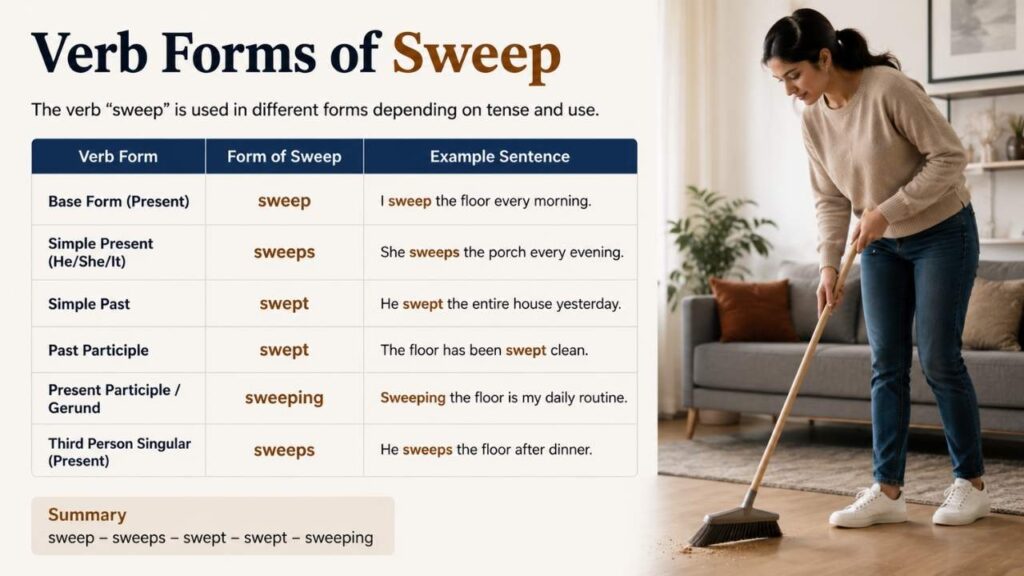
The verb “sweep” has three main forms in English grammar. These forms help you use the word correctly in different tenses. The verb forms of sweep are simple once you learn the pattern.
Here is the correct table:
- Present tense: sweep
- Past tense: swept
- Past participle: swept
This means both the past tense and past participle use the same word: swept. Many learners confuse this and try to say “sweeped,” but that is wrong.
For example:
- Present: “I sweep the floor every day.”
- Past: “I swept the floor yesterday.”
- Past participle: “I have swept the floor.”
This structure is important in English grammar past tense rules and helps you build correct sentences. The word swept meaning stays the same, but its form changes depending on time. Learning this table makes the verb sweep conjugation very easy.
Is “Sweeped” Correct?
Many English learners ask if “sweeped” is correct, but the answer is simple: it is wrong. The correct past tense of sweep is “swept.” The word “sweeped” is not used in proper English grammar.
This mistake happens because many verbs take “-ed” in the past tense, like “clean → cleaned” or “work → worked.” So learners try to apply the same rule to “sweep.” But “sweep” is an irregular verb, so it does not follow this pattern.
Correct examples:
- “She swept the floor.”
- “He has swept the room.”
Incorrect example:
- “She sweeped the floor.”
This confusion is common in English irregular verbs like sweep, sleep, and keep. You just need to remember that sweep changes to swept, not “sweeped.” Understanding this rule helps you avoid mistakes in writing and speaking and improves your grammar accuracy.
How to Use “Swept” in Sentences (Real Examples)
The word “swept” is used when talking about actions completed in the past. It is the correct past tense of sweep and is used in everyday English.
Here are simple examples to understand usage:
- “She swept the floor yesterday.”
- “He swept the dust from the room.”
- “They swept the garden after the storm.”
- “I have swept the kitchen already.”
- “The wind swept across the field.”
These examples show how swept meaning changes slightly depending on context, but it always refers to cleaning or moving something away.
You can also use it in emotional or strong descriptions:
- “The crowd was swept with excitement.”
Learning these examples helps you understand sweep verb forms in real life. It also improves your ability to use the word correctly in both writing and speaking without confusion.
Grammar Rule Behind “Sweep → Swept”
The verb “sweep” changes to “swept” because it is an irregular verb in English grammar. This means it does not follow the normal rule of adding “-ed” for past tense verbs.
Instead, it changes its spelling completely. This happens in many English verbs, especially short ones. The pattern here is a vowel change: “ee” becomes “e” and the ending becomes “-pt.”
Examples of similar patterns:
- keep → kept
- sleep → slept
- weep → wept
This shows that English grammar past tense rules are not always regular. You must learn these forms as vocabulary, not rules.
There is no rule to form “sweeped,” so it is always wrong. The correct form is swept, used for both past tense and past participle.
Understanding this rule helps you master irregular verb sweep and improves your overall English grammar skills in a simple and natural way.
Quick Memory Trick
A simple way to remember the past tense of sweep is to think of a pattern. Many verbs that end in “-eep” change to “-ept” in the past tense. So, sweep becomes swept.
You can remember it like this:
“EE turns into EPT”
Examples:
- sweep → swept
- keep → kept
- sleep → slept
This small pattern helps you avoid the mistake of saying “sweeped,” which is incorrect.
Another easy trick is to connect it with daily life. Imagine cleaning your room: “Yesterday, I swept my room.” Repeating this sentence helps your brain remember the correct form.
This method is useful for students learning irregular verb sweep in English grammar. It makes the word easier to recall during writing or speaking. With practice, you will naturally use swept meaning correctly without thinking too much.
FAQs
What is the past tense of sweep?
The past tense is swept.
Is “sweeped” correct?
No, sweeped is incorrect in English grammar.
Is sweep a regular verb?
No, it is an irregular verb.
What is the past participle of sweep?
It is swept.
How do you use swept in a sentence?
Example: “She swept the floor.”
Why is sweep not sweeped?
Because it follows an irregular verb pattern.
Can swept be used in present tense?
No, swept is only past form.
What does swept mean?
It means to clean or move something away.
Conclusion
In conclusion, the past tense of “sweep” is “swept.” It is an irregular verb, so it does not follow the normal “-ed” rule. The form “sweeped” is always incorrect in English grammar. You should only use swept for both past tense and past participle.
For example, “She swept the floor” is correct and commonly used in daily English. Understanding this helps you avoid mistakes and improve your grammar. The sweep verb forms are simple: sweep → swept → swept.
By remembering this pattern, you can confidently use the word in writing and speaking.

Fahad is a seasoned English language trainer with a focus on IELTS and TEFL preparation.
He holds a Ph.D. in Applied Linguistics and has over 10 years of teaching experience.
Fahad is passionate about helping students achieve fluency and global opportunities.
His classes combine practical techniques with a supportive, student-first approach.