
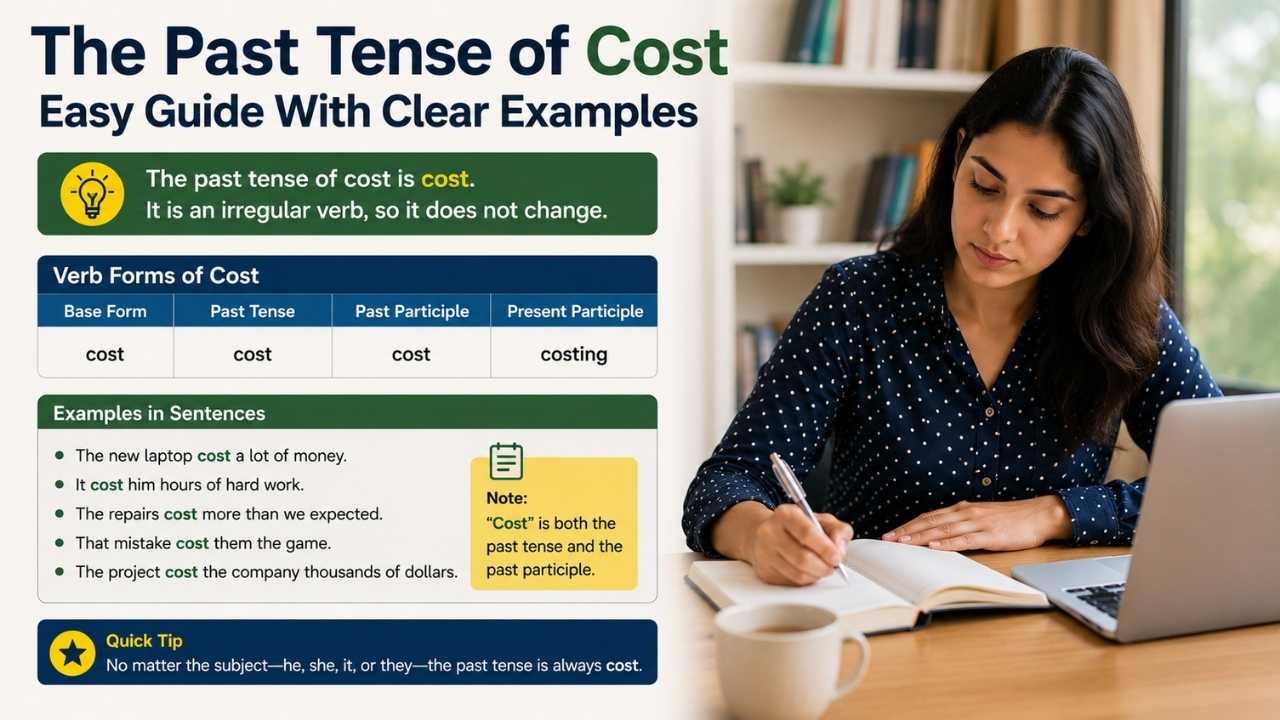
The past tense of cost often confuses English learners because it does not follow the usual grammar rule of adding “-ed” to make the past form. Many people naturally expect the correct form to be “costed,” but in most cases, this is incorrect. The simple rule is that the past tense of cost is cost, and the word stays the same in both present and past situations.
This confusion usually comes from comparing cost vs costed, where learners try to apply regular verb patterns to an irregular verb. In English grammar, some verbs do not change form, and “cost” is one of them. This makes it part of a small but important group of verbs that stay the same across tenses.
In this guide, you will clearly understand the past tense of cost, learn why it remains unchanged, and see when “costed” is used in rare cases. You will also get simple examples and common mistakes to avoid.
Quick Answer
The past tense of cost is cost. It does not change form because it is an irregular verb in English grammar. We do not add “-ed” in normal use. For example, “The phone cost $100 yesterday.” The word costed is only used in technical or financial contexts, not in everyday English speaking or writing.
What Is the Past Tense of “Cost”?
The past tense of cost is cost. This means the word does not change when you talk about the past. You use the same form for present and past sentences, which makes it an irregular verb in English grammar. Many learners expect it to become “costed,” but that is not correct in most situations.
For example:
- Present: This shirt costs $30.
- Past: This shirt cost $30 yesterday.
This shows that cost past tense stays the same. You do not need to add “-ed” like regular verbs. This is why people often ask, “what is the past tense of cost?” because it does not follow normal rules.
When you learn cost grammar rules, remember one simple idea: the verb does not change in past tense. Once you understand this, it becomes easy to use correctly in daily English speaking and writing.
Why Does “Cost” Stay the Same in Past Tense?
The verb cost stays the same in past tense because it is an irregular verb. Irregular verbs do not follow the normal rule of adding “-ed” to form the past tense. Instead, they keep the same form in present and past.
English has many verbs like this, such as cut, put, hit, and cost. These verbs come from older forms of English where words did not always change between tenses. Over time, the language became simpler, but some old patterns stayed.
This is why cost is an irregular verb and why it does not become “costed” in normal use. Learners often ask, “why is cost the same in past tense?” The answer is simple: it follows an old grammar pattern that English still uses today.
Once you understand this rule, it becomes easier to avoid mistakes and use cost in past tense sentences correctly.
Is “Costed” Correct English?
The word “costed” is sometimes correct, but only in special situations. In most everyday English, costed is not correct, and you should use cost instead. This is why many learners get confused when they search for cost vs costed.
We use costed mainly in business, finance, or planning. For example, a project can be “costed” to show that someone calculated its price. In this case, it means an estimate was made.
But in normal speaking, you should not say “it costed $10.” The correct sentence is “it cost $10.” This is a common mistake for learners who follow regular verb rules.
So, the rule is simple: use cost for normal past tense, and use costed only for technical or formal cost estimation. This clears the confusion around is costed correct grammar in English.
Cost vs Costed: Key Differences
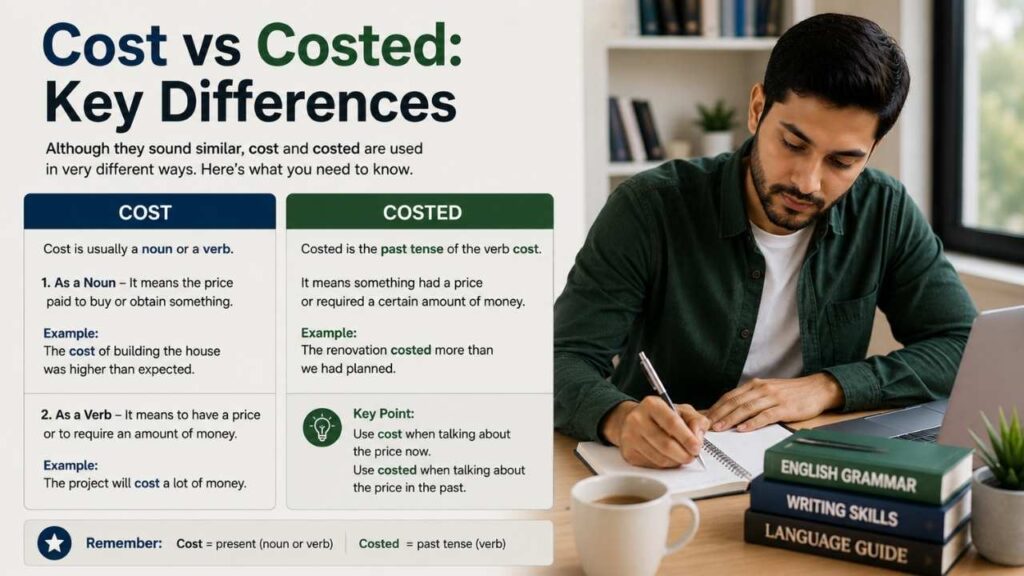
The difference between cost vs costed is important for correct English usage. Both come from the same verb, but they are used in different ways. Many learners confuse them because they expect a normal “-ed” form.
| Form | Usage | Example |
| cost | General past tense | The phone cost $200. |
| costed | Budgeting or estimation | The project was costed at $5,000. |
The main point is simple. We use cost in everyday English when talking about price in the past. We use costed only in special cases like business reports or financial planning.
Most learners make mistakes by saying “costed” in daily speech. But native speakers usually avoid it in normal conversation. This is why understanding cost grammar usage is very important. Once you know this difference, you can avoid one of the most common English mistakes.
Simple Examples of “Cost” in Sentences
To understand the past tense of cost, it is helpful to see real examples. The verb stays the same in all forms, which makes it easier once you learn the rule.
Present tense:
- This bag costs $40.
- The meal costs too much.
Past tense:
- The bag cost $40 last week.
- The meal cost more yesterday.
Incorrect example:
- The bag costed $40.
These examples show how cost in past tense sentences does not change. Many learners make the mistake of adding “-ed,” but that is not correct for this verb.
When you practice English, try to remember that cost past tense always stays the same. This will help you speak and write more naturally and avoid common grammar errors in daily use.
Common Mistakes Learners Make
Many learners make mistakes with the past tense of cost because they apply regular grammar rules. The most common error is adding “-ed” and saying “costed” in normal sentences. This is not correct in everyday English.
Another mistake is mixing up noun and verb use. As a noun, “cost” means price. As a verb, it shows the action of something having a price. Learners often confuse these two meanings.
Some learners also think all verbs must change in past tense. This leads to wrong sentences like “it costed me money,” which is incorrect.
To avoid these mistakes, remember:
- Do not add “-ed” to cost
- Use cost for past tense
- Use costed only in technical cases
Once you understand this, the confusion around cost or costed which is correct becomes very easy to solve.
Is “Cost” an Irregular Verb?
Yes, cost is an irregular verb in English grammar. This means it does not follow the normal rule of adding “-ed” to form the past tense. Instead, the verb stays the same in all forms.
The base form, past tense, and past participle are all cost:
- Base form: cost
- Past tense: cost
- Past participle: cost
This is why sentences like “It cost $10 yesterday” are correct without any change in spelling. Many learners search for cost grammar rules because they expect a different form, but there is no change.
Understanding this rule helps you use English more correctly and avoid common mistakes. It also helps you learn other similar verbs that do not change in the past tense. Once you know this pattern, using cost in past tense sentences becomes very simple and natural.
Related Verb Forms of Cost
The verb cost is very simple because it does not change in form. This is why many learners find it confusing at first, especially when they expect different endings.
Here are the main forms:
- Base form: cost
- Past tense: cost
- Past participle: cost
There is no change in spelling. This is different from regular verbs that add “-ed.” That is why people often search for past participle of cost or cost verb tense.
For example:
- This phone costs too much.
- It cost too much yesterday.
- It has always cost too much.
These examples show how cost usage in sentences stays the same in different time forms. Once you understand this, it becomes easy to use the verb correctly in both speaking and writing without confusion.
Quick Grammar Rules Summary
The past tense of cost is very simple once you understand the rule. The verb does not change form, which makes it an irregular verb in English grammar. This is different from most verbs that take “-ed” in the past tense.
Here are the main points:
- The past tense of cost is cost
- Do not add “-ed” in normal usage
- “Costed” is only used in technical or financial cases
- The verb stays the same in all forms
So, when you use cost in past tense sentences, remember that there is no spelling change. This rule helps you avoid common mistakes and improves your grammar accuracy. Once you learn this simple pattern, you can use the word correctly in daily speaking and writing without confusion.
FAQs
What is the past tense of cost?
The past tense of cost is cost, and it does not change form in English.
Is costed correct English?
Yes, but only in technical or financial contexts, not in everyday use.
Why is cost the same in past tense?
Because cost is an irregular verb that does not follow the “-ed” rule.
Can we say “it costed me money”?
No, the correct form is “it cost me money.”
When do we use costed?
We use it in budgeting or cost estimation in business writing.
Is cost a regular or irregular verb?
It is an irregular verb in English grammar.
What is the past participle of cost?
The past participle is also cost.
Conclusion
The past tense of cost is simple once you understand the rule: it stays cost in most cases. This is because cost is an irregular verb, so it does not follow the usual “-ed” pattern. Many learners get confused and use “costed,” but this is only correct in limited technical situations like budgeting or financial planning.
In everyday English, always use cost for present and past meanings. For example, “It cost $10 yesterday” is correct and natural. The form costed should be avoided in normal conversation and writing unless you are talking about cost estimation in a formal context.
By remembering this simple rule, you can avoid one of the most common grammar mistakes. Understanding cost grammar usage makes your English clearer, more natural, and more accurate in both speaking and writing.

Fahad is a seasoned English language trainer with a focus on IELTS and TEFL preparation.
He holds a Ph.D. in Applied Linguistics and has over 10 years of teaching experience.
Fahad is passionate about helping students achieve fluency and global opportunities.
His classes combine practical techniques with a supportive, student-first approach.