
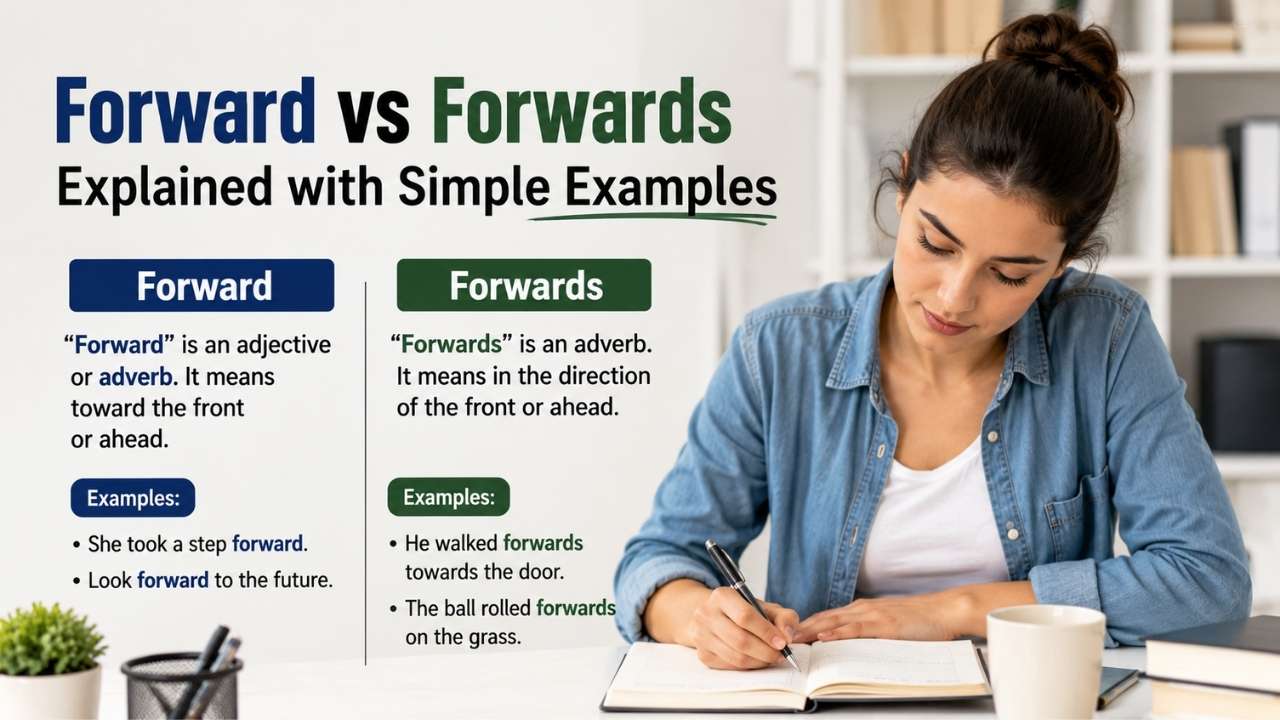
The confusion between forward vs forwards is a common problem in English grammar, especially for learners who want to write correctly in both formal and informal situations. These two words look almost identical, and both are related to movement or direction, which makes them even easier to mix up. Many people often wonder whether “forward” and “forwards” mean the same thing or if there is a real grammatical difference between them.
In simple terms, the difference is not about meaning but about usage, region, and style. The word “forward” is widely used in American English and formal writing, while “forwards” is more common in British English, especially in casual speech. Because of this variation, learners often feel unsure about which form is correct in different contexts.
In this article, we will clearly explain the meaning of forward and forwards, their differences, and how to use them correctly in real sentences.
Quick Answer
The difference between forward vs forwards is mainly about usage, not meaning. Forward is the standard form in American English and formal writing, while forwards is mostly used in British English as an adverb. Both mean movement ahead. In most cases, forward is the safer and more widely accepted choice in English grammar today.
What Does “Forward” Mean in English?
The word “forward” has several uses in English grammar. It can be a verb, adjective, or adverb, depending on the sentence. As a verb, it means to send something ahead, like forwarding an email. As an adjective, it describes someone who is confident or progressive, such as a forward-thinking person. As an adverb, it shows direction, like “step forward.”
Because of these different roles, forward is very common in daily English. It is used in speaking, writing, business, and academic work. In American English, it is the most preferred form in all contexts. It is clear, simple, and easy to understand.
Overall, forward is the standard global form. It works in formal and informal situations without causing confusion. This is why most writers and speakers use it when they want correct and natural English.
What Does “Forwards” Mean?
The word “forwards” is mainly used in British English. It works as an adverb and has the same meaning as “forward,” which is movement in a direction ahead. For example, people may say “walk forwards slowly” in everyday speech. It is common in spoken English but less common in formal writing.
Unlike “forward,” the word “forwards” is more informal and regional. It is not used much in American English, where “forward” is preferred. However, it is not incorrect. It is still part of English grammar and is understood everywhere.
In simple words, “forwards” is just a variation of “forward.” It does not change the meaning. It only reflects British usage and speaking style. If you see it, think of it as a casual or regional form of the same word.
Forward vs Forwards: Key Differences
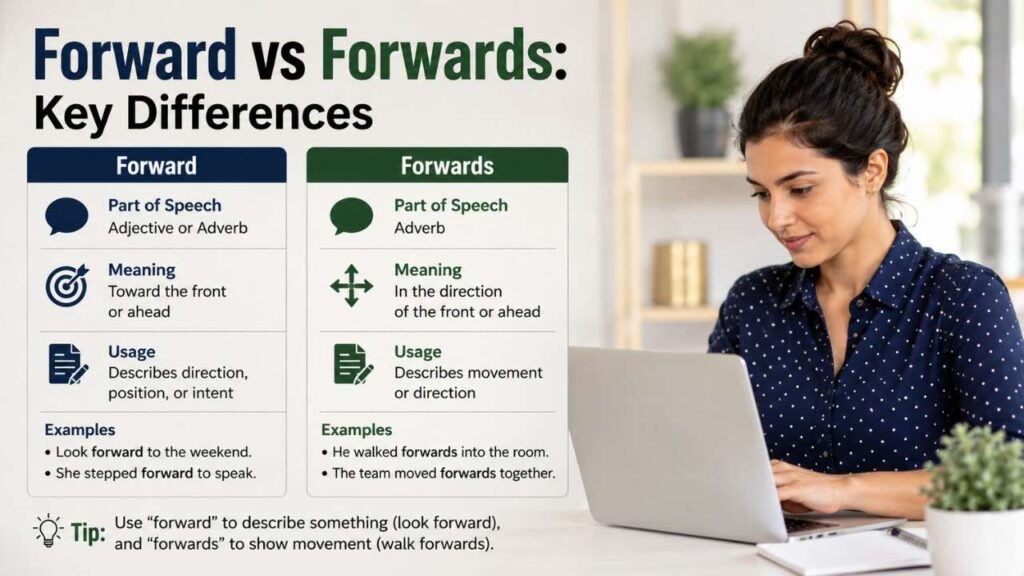
The main difference between forward vs forwards is how and where they are used. Both words show movement in a forward direction, but their usage style is different. “Forward” is the standard global form, while “forwards” is mainly used in British English.
| Feature | Forward | Forwards |
| Usage | Global standard | British English |
| Grammar | Verb, adjective, adverb | Mainly adverb |
| Formal writing | Preferred | Less preferred |
| Tone | Neutral | Informal |
| Region | US and global | UK |
In most cases, forward is the better choice for writing, especially in school, business, or online content. “Forwards” is fine in casual British speech but not needed in formal English. So, the safest option is always forward.
British vs American English Usage
The difference between British and American English explains why we see both forward and forwards. In American English, people always use “forward” in speaking and writing. It is simple and used in all situations, including formal documents, emails, and education.
In British English, both forms exist. People often say “forwards” in casual speech, but they still use “forward” in formal writing. This shows that “forwards” is more of a spoken style than a strict grammar rule.
This difference came from how English changed over time in different regions. British English kept older forms like “forwards,” while American English simplified them. Today, global English mostly prefers “forward” because it is clear and widely understood.
When Should You Use Forward or Forwards?
You should use “forward” in most situations. It works in formal writing, exams, business communication, and online content. It is the safest and most correct option for global English. For example, we say “move forward with the plan” in almost all professional cases.
Use “forwards” only in informal British English speech. It is common when people talk casually, such as “step forwards slowly.” However, it is not needed in formal writing or American English.
A simple rule is: if you are unsure, always choose forward. It is more universal and avoids mistakes. This helps you write clearly and correctly in any situation without worrying about regional differences.
Common Mistakes Learners Make
Many learners confuse forward vs forwards because they think both words are fully different. One common mistake is using “forwards” in formal writing, where “forward” is the correct choice. Another mistake is thinking that both words have different meanings, which is not true.
Some learners also misuse phrases like “looking forwards to,” which is often incorrect in formal English. The correct form is “looking forward to.” This mistake happens because of direct copying from spoken British English.
Another issue is mixing styles. Learners may switch between American and British usage without knowing the rule. The key is to stay consistent. In most cases, forward is the safer and correct option for clear English writing.
Examples in Sentences
Here are simple examples to understand forward vs forwards clearly. These sentences show how both words are used in real situations.
- We need to move forward with the project.
- He stepped forward and spoke clearly.
- She is a forward-thinking leader.
- In British English: “Walk forwards slowly.”
- The company is moving forward with new plans.
These examples show that both words describe direction or progress. However, forward is more common in global and formal English, while “forwards” appears mostly in casual British speech.
Is “Forwards” Grammatically Correct?
Yes, “forwards” is grammatically correct, but it depends on the situation. It is mainly used in British English as an adverb. It means the same thing as “forward,” which is movement in a direction ahead.
However, in American English and formal writing, “forward” is preferred. It is more standard and widely accepted. That is why you will see it more often in books, articles, and business writing.
So, “forwards” is not wrong, but it is more limited in use. If you want safe and global English, always choose forward. It works in all contexts without confusion.
Why English Has Two Forms
The reason we have forward and forwards is because English changed differently in regions. British English kept older word forms that end in “-s,” such as backwards, onwards, and forwards. These forms are still used in daily speech in the UK.
American English became more simplified over time. It removed many of these “-s” forms and kept only forward. This made the language easier and more consistent.
Today, both forms still exist, but global English prefers forward because it is simpler and more widely understood. This is why most international writing uses “forward” instead of “forwards.”
Quick Summary
In simple terms, forward vs forwards is not a meaning difference but a usage difference. “Forward” is the standard global form, used in American English and formal writing. “Forwards” is mainly British English, used in casual speech.
Both words describe movement or direction and are correct in grammar. However, forward is the safer and more universal choice. If you are unsure, always use forward in your writing.
FAQs
Is “forwards” grammatically correct?
Yes, forwards is grammatically correct, but it is mainly used in British English and informal speech.
Can I use “forward” in all situations?
Yes, forward is widely accepted and works in almost all formal and informal contexts.
What is the difference between forward and forwards?
The difference is mainly usage. Forward is standard English, while forwards is a regional British variation.
Which one is more formal?
Forward is more formal and preferred in academic, business, and professional writing.
Do Americans say “forwards”?
No, Americans usually prefer forward in both writing and speech.
Why do British people use “forwards”?
British English keeps older adverb forms like forwards, backwards, and onwards in casual usage.
Is “forwards” outdated?
No, it is not outdated, but it is less common in modern formal writing.
Which should I use in exams?
Use forward, because it is safer and more universally accepted in English exams.
Conclusion
The difference between forward vs forwards is simple once you understand the rule. Both words describe movement in a direction ahead, but they are used differently in English. Forward is the standard form used in American English and most formal writing. It works in all contexts, including academic, business, and everyday communication.
On the other hand, forwards is mainly used in British English, especially in informal speech. It is not wrong, but it is less common in formal writing and global English.
If you want to stay safe and correct in all situations, always choose forward. It is clear, widely accepted, and preferred in modern English usage.

Fahad is a seasoned English language trainer with a focus on IELTS and TEFL preparation.
He holds a Ph.D. in Applied Linguistics and has over 10 years of teaching experience.
Fahad is passionate about helping students achieve fluency and global opportunities.
His classes combine practical techniques with a supportive, student-first approach.