
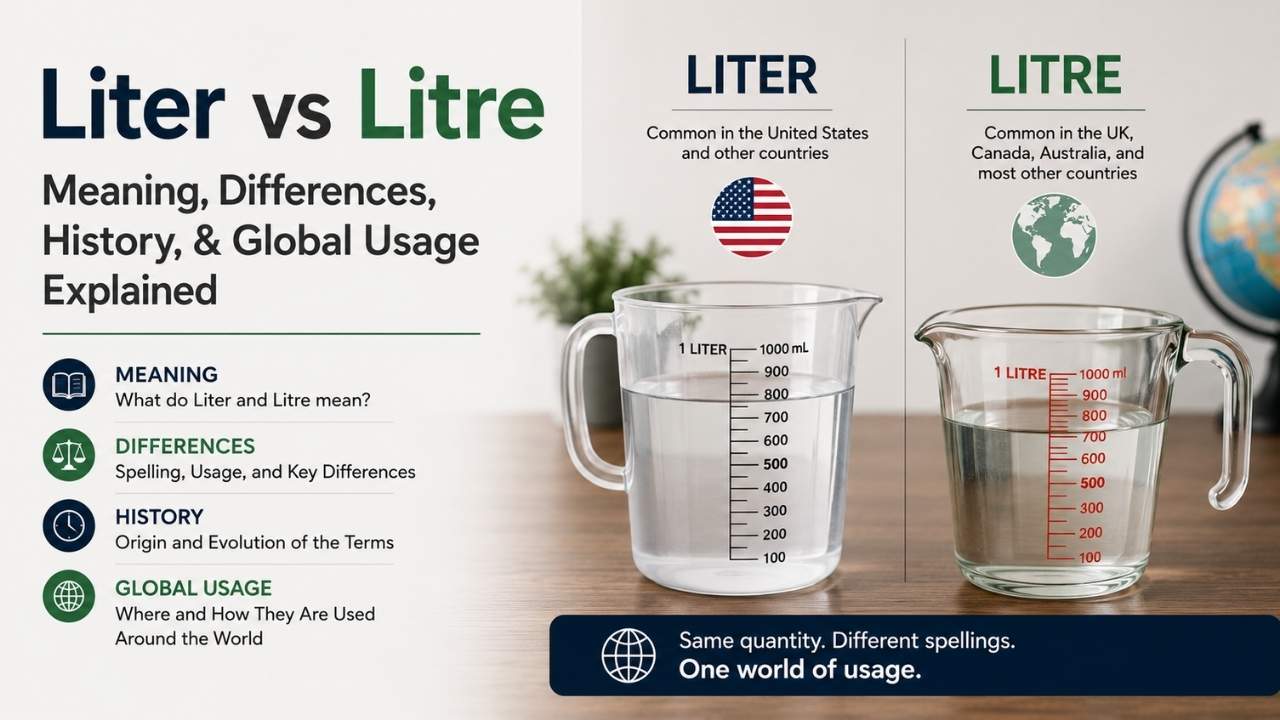
The confusion between liter vs litre is very common among English learners, writers, and students. Many people search for liter or litre difference or ask which spelling is correct in English. The simple answer is that both words are correct, and they mean the same metric unit of volume used to measure liquids like water, milk, and fuel.
The only difference between liter and litre is regional spelling. Liter is used in American English, while litre is preferred in British English and countries that follow it, such as the UK, India, and Pakistan. This difference is part of broader American vs British English spelling variations, not a change in meaning.
Understanding this helps avoid confusion in writing, exams, and science topics. In this article, we will clearly explain the liter vs litre difference, usage rules, and when to use each spelling correctly.
Quick Answer
Liter and litre are the same metric unit of volume used to measure liquids like water and milk. The only difference is spelling: liter is American English, while litre is British English. Both are correct, and there is no difference in value or usage. The choice depends on regional American vs British English spelling conventions.
What Is a Liter / Litre?
A liter (or litre) is a metric unit of volume used to measure liquids and other substances. It is commonly used in everyday life to measure things like water, milk, juice, and fuel. One liter is equal to 1000 milliliters, which makes it part of the metric system used around the world.
When people search for liter meaning or litre meaning, they are simply looking for the definition of this unit. It is used in science, education, and daily activities in many countries. For example, a water bottle may contain 1 liter or 1 litre of water depending on the spelling style used in that region.
The important thing to remember is that liter and litre are the same measurement unit. Only the spelling changes based on American vs British English spelling, not the actual quantity or value.
Liter vs Litre – Key Difference Explained
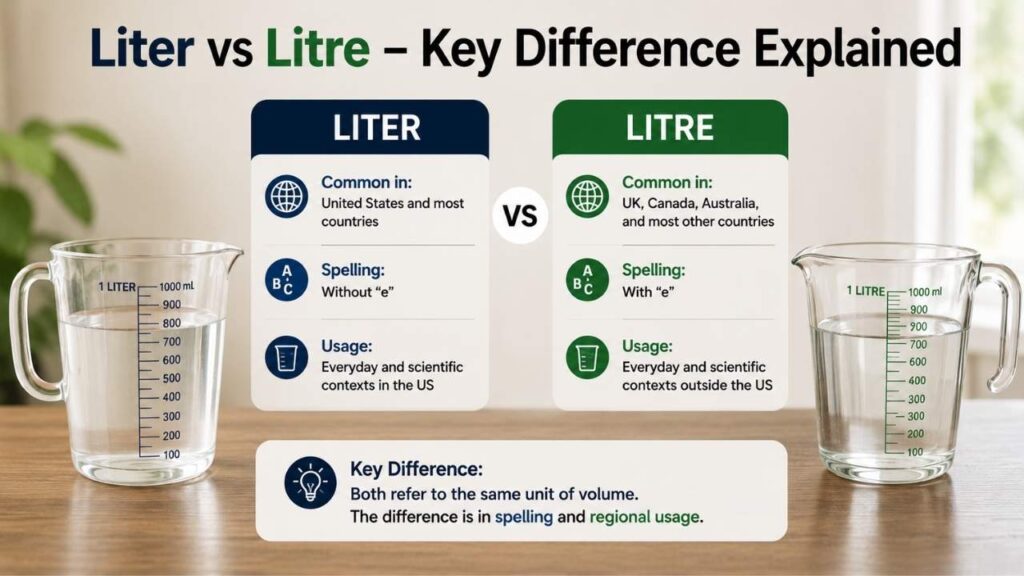
The main difference between liter vs litre is only spelling, not meaning. Both words represent the same metric unit of volume, so there is no change in size or value. This is a common point of confusion in topics like liter vs litre difference or difference between liter and litre.
In American English, the correct spelling is liter, while in British English, it is written as litre. Countries like the United States use “liter,” while places such as the UK, India, and Pakistan prefer “litre.”
Despite the spelling change, both words are used in the same way in science, daily life, and education. For example, 1 liter of water is equal to 1 litre of water. So, when comparing liter or litre, remember that they are identical in meaning and only differ because of regional English spelling rules.
Why Are There Two Spellings?
The two spellings liter and litre exist because of differences between American and British English spelling rules. The word originally comes from French, where it is spelled “litre.” British English kept this original spelling, which is why countries like the UK and others still use litre today.
In contrast, American English often simplifies spellings. Over time, the United States changed “litre” to liter to make spelling more direct and easier to use. This is part of a wider pattern in English, where many words have different forms in US and UK English.
This is why searches like why do liter and litre have different spellings or liter vs litre meaning are common. The important point is that both spellings refer to the same metric unit of volume, and the difference is only historical and linguistic, not scientific or mathematical.
Which Spelling Should You Use?
Choosing between liter or litre depends on where and how you are writing. Both spellings are correct, but they follow different American vs British English spelling rules. If you are writing for an American audience, you should use liter. If your readers are from the UK, India, Pakistan, or other Commonwealth countries, litre is more appropriate.
In academic writing, exams, or formal content, it is important to stay consistent. For example, IELTS or British curriculum writing usually prefers litre, while US-based education systems use liter.
Many people search for when to use liter or litre or correct spelling of liter or litre, and the simple rule is to match your audience. In science and global usage, both are accepted. The symbol “L” is also commonly used, so spelling does not change the actual measurement unit of volume.
Liter vs Litre in Different Countries
The spelling of liter vs litre changes depending on the country. In the United States, the correct spelling is liter, while in the United Kingdom, Canada, Australia, India, and Pakistan, the spelling litre is commonly used. This difference comes from American vs British English spelling rules, not from any change in measurement.
Even though spelling is different, the meaning stays the same everywhere. A liter or litre always refers to the same metric unit of volume used for liquids like water, milk, and fuel. For example, 1 liter of water in the US is equal to 1 litre of water in the UK.
This is why searches like which countries use liter or litre are common. No matter the country, the value does not change. Only the spelling adapts to local English usage, making it easier for readers to understand in their region.
Examples of Liter and Litre in Sentences
Understanding liter and litre becomes easier when you see them used in real sentences. Both spellings are used in the same way because they represent the same metric unit of volume. The only difference is American vs British English spelling.
For example, you can say, “I drank one liter of water today” in American English. In British English, the same sentence becomes, “I drank one litre of water today.” Both sentences have the same meaning.
Another example is fuel: “The car uses 5 liters of petrol” or “5 litres of petrol,” depending on the region. Milk, juice, and other liquids are also measured the same way.
These examples show that searches like liter vs litre usage examples or difference between liter and litre in sentences are simple to understand. The spelling changes, but the quantity and meaning remain exactly the same everywhere.
Is Liter or Litre Used in Science?
In science, both liter and litre are used to measure volume, but the most important part is the symbol “L”, which is the same worldwide. Scientists do not focus on spelling differences because the metric unit of volume stays constant in all countries.
Whether you see liter or litre, it always represents the same amount: 1000 milliliters. In chemistry, biology, and physics, this unit is used in experiments, solutions, and measurements. For example, a chemical solution might be written as 1 L, which is understood globally.
This is why searches like is liter or litre used in science are common. The answer is yes—both are accepted, but “L” is preferred for standard scientific writing. The spelling does not affect calculations or results, making it a universal measurement in education and research.
FAQs
Is liter and litre the same thing?
Yes, liter and litre are the same metric unit of volume. The only difference is spelling. Liter is used in American English, while litre is used in British English. The meaning and measurement are exactly the same.
Which is correct, liter or litre?
Both are correct. The choice depends on American vs British English spelling rules. Use liter for US English and litre for UK, India, Pakistan, and other Commonwealth countries.
What is the difference between liter and litre?
There is no difference in value. The only difference is spelling. Both refer to the same metric unit of volume used for liquids like water, milk, and fuel.
Is liter American or British English?
Liter is the American English spelling. British English and most Commonwealth countries use litre instead.
Why does UK use litre instead of liter?
The UK kept the original French spelling “litre”, while American English simplified it to “liter” as part of spelling reforms.
Are liter and litre used in science?
Yes, both are used in science, but the standard symbol is “L”, which is the same worldwide. It represents the same volume in all countries.
Can I use litre in American English writing?
It is better to use liter in American English writing. However, both are understood, but consistency is important in formal writing and exams.
What does 1 liter or litre mean?
1 liter (or litre) equals 1000 milliliters. It is a standard unit used to measure liquid volume in the metric system.
Conclusion
In simple terms, liter vs litre is not a difference in meaning but only in spelling. Both refer to the same metric unit of volume used to measure liquids like water, milk, and fuel. The spelling liter is used in American English, while litre is used in British English and many Commonwealth countries.
This difference is part of broader American vs British English spelling rules, not a change in science or measurement. In all cases, 1 liter is equal to 1 litre, and both are accepted in education, daily use, and science.
So, whether you see liter or litre, remember that they are the same. The correct choice simply depends on your region and writing style. Keeping this in mind will help you write clearly, avoid confusion, and use the right spelling in exams, academic work, and everyday communication.

Fahad is a seasoned English language trainer with a focus on IELTS and TEFL preparation.
He holds a Ph.D. in Applied Linguistics and has over 10 years of teaching experience.
Fahad is passionate about helping students achieve fluency and global opportunities.
His classes combine practical techniques with a supportive, student-first approach.