
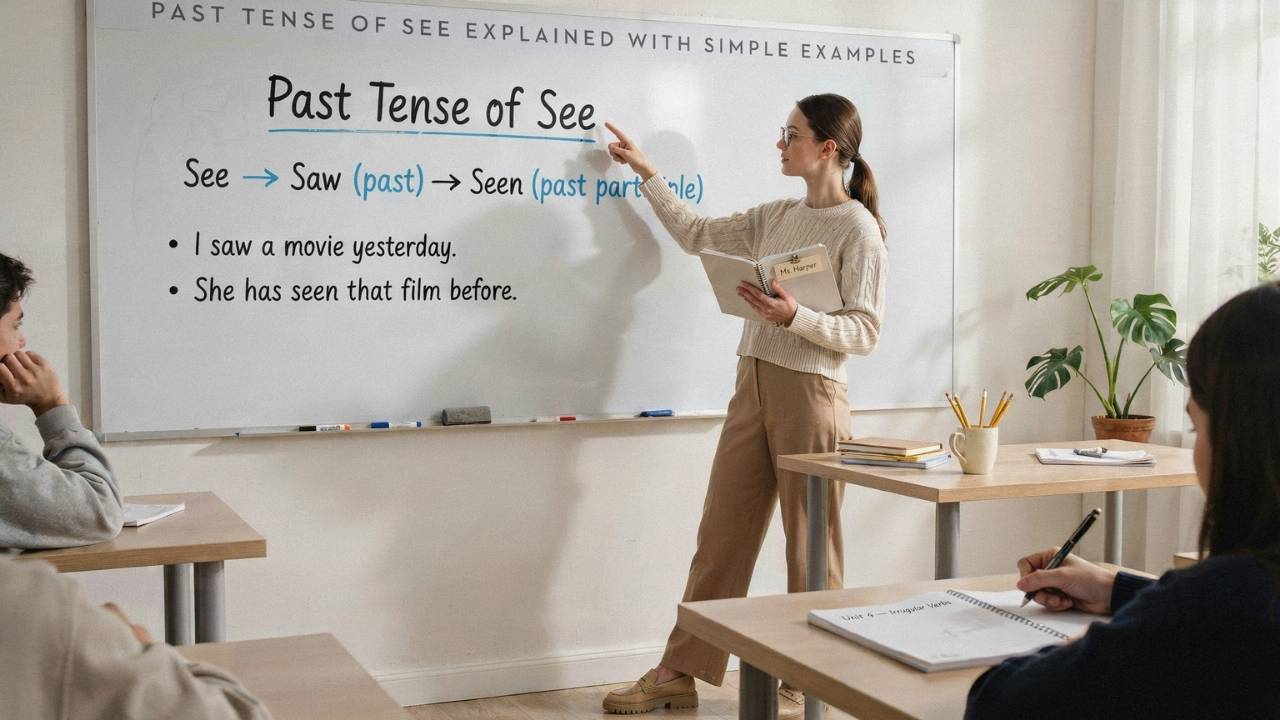
The past tense of “see” is saw, and the past participle of “see” is seen. This is one of the most common examples of an irregular verb in English grammar, which means it does not follow the normal “-ed” rule. Many learners search for see past tense, saw and seen grammar, and verb forms of see because it is often confusing at first.
In simple terms, we use “saw” when talking about a finished action in the past, like something that happened once. We use “seen” with helping verbs such as have, has, or had.
Understanding the difference between saw vs seen is very important for correct English. In this guide, we will explain everything with easy examples so you can avoid common mistakes like “I seen”, which is incorrect grammar.
Quick Answer
The past tense of “see” is “saw”, and the past participle is “seen”. “See” is an irregular verb, so it does not follow the regular “-ed” rule. We use saw for completed actions in the past, and seen with helping verbs like have, has, or had in perfect tenses.
Verb Forms of “See” at a Glance
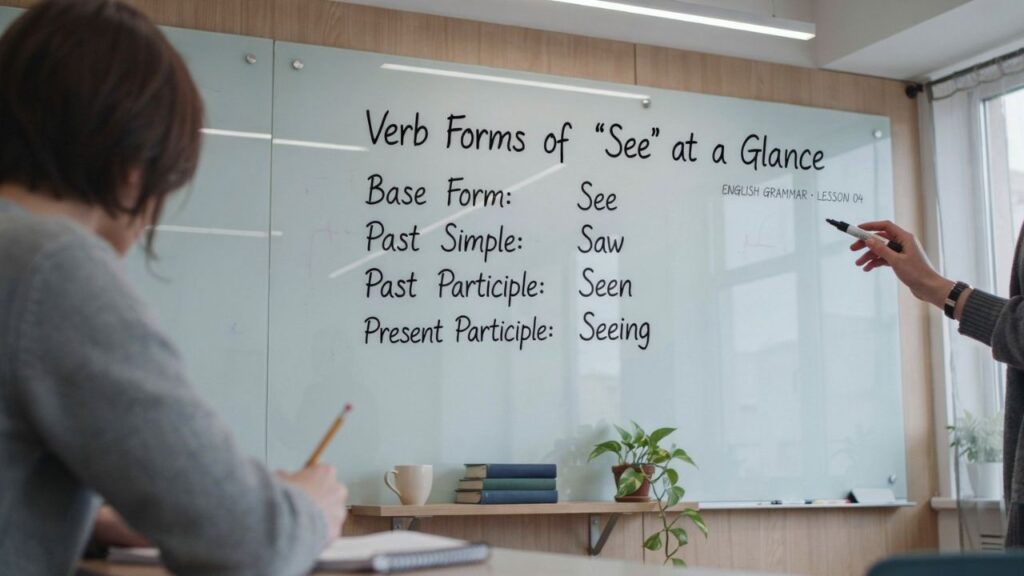
The verb “see” has different forms depending on time and sentence structure. It is an irregular verb, so it changes in an unusual way. The main forms are: see (base form), saw (past tense), seen (past participle), and seeing (present participle). Many learners search for see verb forms, verb conjugation see, and irregular verb see because it is commonly used in English.
Here is a simple structure:
- See → present (I see a bird)
- Saw → past (I saw a bird)
- Seen → perfect tense (I have seen a bird)
- Seeing → continuous form (I am seeing a bird)
Understanding these forms helps you avoid mistakes in grammar. The difference between saw and seen is very important for correct English. This table makes it easy to learn and remember the correct usage.
How to Use “Saw”
The word “saw” is the simple past tense of “see”. We use it when talking about an action that happened and finished in the past. It does not need any helping verb. Many learners search for how to use saw in a sentence or past tense of see examples because it is very common in daily English.
We use saw with time words like yesterday, last night, last week, or ago. For example, “I saw a movie yesterday” or “She saw her friend at school.”
The important rule is that saw is never used with have, has, or had. That is a common mistake learners make. Understanding the correct use of saw vs seen helps improve grammar accuracy. Always remember: saw = finished action in the past, simple and clear.
How to Use “Seen”
The word “seen” is the past participle of “see”. It is not used alone. It must be used with helping verbs like have, has, or had. This is why many learners search for past participle of see, use of seen in English, and when to use seen or saw.
We use seen in perfect tenses. For example: “I have seen that movie before” or “They had seen the results earlier.” These sentences show completed actions connected to the present or past.
A very important rule is that “seen” is never correct alone. Saying “I seen it” is wrong grammar. The correct form is “I saw it” or “I have seen it.” Understanding this difference helps avoid common English mistakes. Always remember: seen needs a helper verb to be correct.
Saw vs Seen
The difference between saw and seen is very important in English grammar. Many learners get confused because both come from the verb “see”, but they are used in different ways.
We use “saw” as the simple past tense. It does not need a helper verb. For example, “I saw a dog.” It shows a finished action in the past.
We use “seen” as the past participle, and it always needs a helper verb like have, has, or had. For example, “I have seen a dog.”
A key rule is: saw = standalone past action, while seen = helper verb required. This is why sentences like “I seen it” are incorrect. Many searches like saw vs seen difference and difference between saw and seen with examples come from this confusion. Understanding this rule improves your English grammar quickly.
Common Mistake: “I Seen”
One of the most common English mistakes is saying “I seen” instead of “I saw” or “I have seen.” This error happens because learners try to use “seen” as a past tense, but it is actually a past participle.
Correct examples are:
- “I saw it yesterday.” (simple past)
- “I have seen it before.” (present perfect)
Incorrect example:
- “I seen it yesterday.”
This mistake is very common in spoken English, especially in informal speech. That is why many people search for is I seen correct grammar, why I seen is wrong, and saw vs seen mistake.
The rule is simple: never use “seen” alone. It must always have a helper verb like have, has, or had. Remembering this will help you avoid one of the most common English grammar errors.
Easy Memory Trick to Remember Saw vs Seen
A simple way to remember saw vs seen is to use a memory trick. Think of it like this: “saw is simple, seen needs support.” This helps you quickly understand the difference between the two forms of the verb see.
Use “saw” when the action is finished in the past. It stands alone. For example, “I saw a bird.” No helper is needed.
Use “seen” when you have helper verbs like have, has, or had. For example, “I have seen that bird.” The helper verb is always required.
Many learners search for when to use saw or seen and difference between saw and seen with examples. This trick makes it easier to remember in daily use. Just remember: saw = solo action, seen = supported action. This simple idea helps avoid grammar mistakes.
Quick Practice Examples
Let’s practice the correct use of saw and seen with simple sentences. This will help you understand the past tense of see and the past participle of see better. Many learners improve quickly when they practice examples regularly.
Fill in the blanks:
- I ___ a movie yesterday. (Answer: saw)
- I have ___ that movie before. (Answer: seen)
- She ___ him at the park. (Answer: saw)
- They have ___ the results already. (Answer: seen)
These examples show the correct difference between saw vs seen. Remember, saw is used alone, while seen needs a helper verb like have or has.
Practicing sentences like these helps you avoid common mistakes such as “I seen”, which is incorrect. Many searches like past tense of see examples and how to use saw and seen are solved with simple practice like this.
FAQ
What is the past tense of “see”?
The past tense of “see” is “saw.” It is used for actions that happened and finished in the past, like “I saw a bird yesterday.”
What is the past participle of “see”?
The past participle is “seen.” It is used with helping verbs like have, has, or had, for example, “I have seen that movie.”
Is “seen” the past tense of see?
No, “seen” is not past tense. It is a past participle and must be used with a helper verb.
Is “I seen” correct grammar?
No, “I seen” is incorrect. The correct forms are “I saw” or “I have seen.”
What is the difference between saw and seen?
Saw is simple past and stands alone, while seen needs a helper verb like have or had.
Can we use “seen” without have or has?
No, “seen” cannot be used alone. It always needs a helper verb.
Why do people confuse saw and seen?
They sound simple, but English learners often mix them because both come from the verb see.
Conclusion
In simple English grammar, the past tense of “see” is “saw,” and the past participle is “seen.” Both come from the irregular verb “see,” which changes form in different tenses. Understanding saw vs seen is very important because they are used in different situations.
Remember, we use “saw” for completed actions in the past, like “I saw a movie yesterday.” We use “seen” with helper verbs like have, has, or had, such as “I have seen that movie before.” A common mistake is saying “I seen,” which is incorrect in English grammar.
By learning these simple rules and practicing examples, you can avoid confusion and improve your English skills. Keep this guide in mind whenever you use the verb see, saw, or seen in daily conversation or writing.

Fahad is a seasoned English language trainer with a focus on IELTS and TEFL preparation.
He holds a Ph.D. in Applied Linguistics and has over 10 years of teaching experience.
Fahad is passionate about helping students achieve fluency and global opportunities.
His classes combine practical techniques with a supportive, student-first approach.