
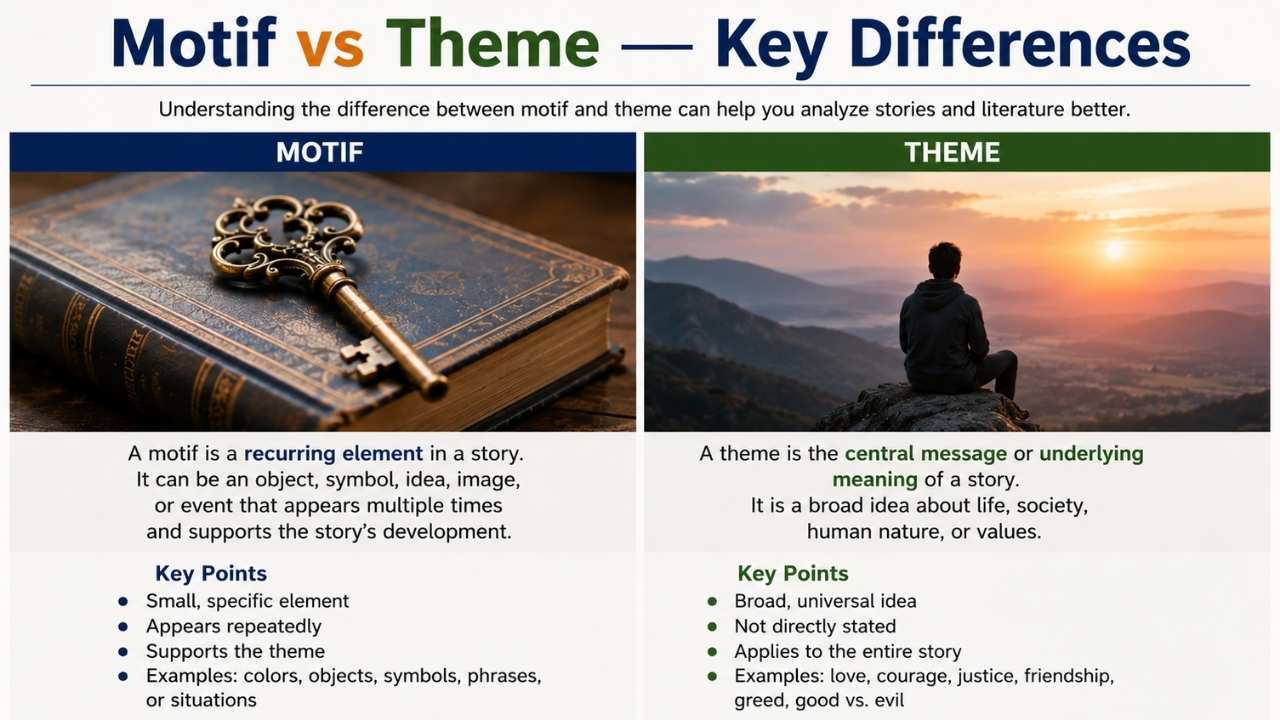
In literature, students often confuse motif vs theme, but these two ideas are not the same. Understanding the difference between motif and theme helps you read stories more clearly and write better analysis in exams or essays. A theme is the central message of a story, while a motif is a repeated element that supports that message.
Many learners search for simple explanations like motif vs theme explained simply or what is the difference between motif and theme in simple terms, because textbooks often make it confusing. In reality, both concepts work together in storytelling. Writers use recurring motifs to highlight important ideas, while the theme definition in literature explains what the story truly means.
In this article, you will learn motif and theme definition, clear examples, and how both connect in literature, movies, and writing.
Quick Answer
A motif vs theme comparison shows two different literary elements. A theme is the central message of a story, while a motif is a repeated element like an image or idea. Motifs support and highlight themes through repetition. In short, theme is the meaning, and motif is the pattern that helps express that meaning clearly in literature.
What is a Theme in Literature?
A theme in literature is the main idea or message that the writer wants to share with the reader. It is abstract and not directly shown in the story. Instead, readers understand it by looking at events, characters, and outcomes.
The theme definition in literature often includes ideas like love, power, identity, betrayal, or freedom. For example, a story may show that “power can corrupt people,” which becomes the central theme. This answers common searches like what is a theme in literature and theme examples in literature.
Themes are not single objects or actions; they represent the deeper meaning of the story. Writers often include multiple themes in one story, such as friendship and sacrifice. In simple terms, a theme is the message behind the story, not just what happens in it. It guides the reader’s understanding of the entire narrative.
What is a Motif in Literature?
A motif in literature is a repeated element that appears throughout a story to support the main idea. It can be an image, object, phrase, sound, or situation. The motif meaning in literature focuses on repetition, not the central message.
For example, repeated images of darkness may suggest fear or danger. This helps explain searches like what is a motif in literature and motif examples in literature. Unlike a theme, a motif is concrete and visible in the story. Writers use recurring motifs to strengthen emotional impact and guide readers toward deeper meaning. A story may include many motifs, such as mirrors, journeys, or weather patterns.
These repeated elements slowly build understanding in the reader’s mind. In short, a motif is a repeated clue in the story, not the final message. It helps support and highlight the theme without directly stating it.
Motif vs Theme — Key Differences
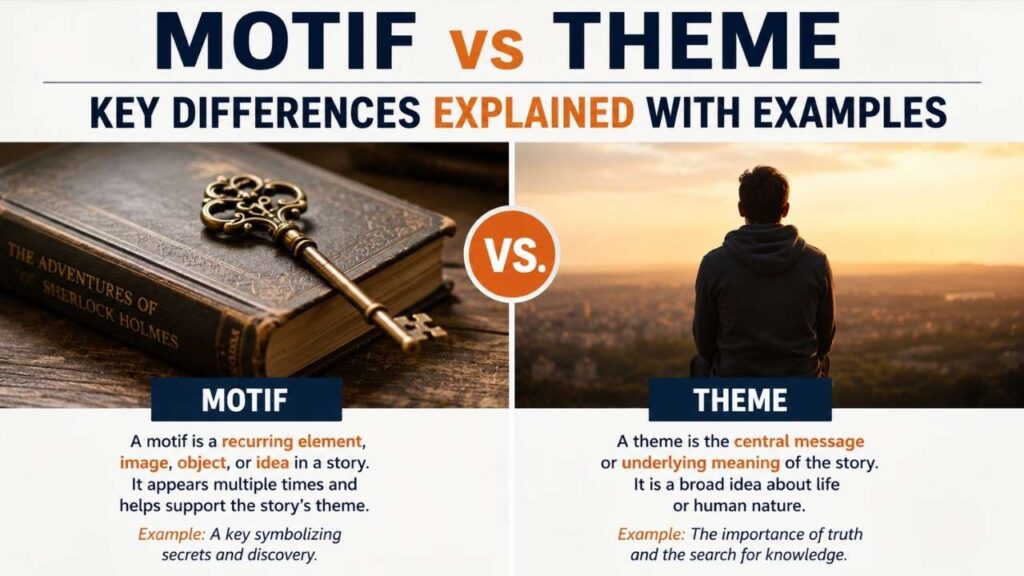
The difference between motif and theme becomes clear when you compare their roles in a story. A theme is the central message, while a motif is a repeated element that supports that message. A theme is abstract, but a motif is concrete and visible. For example, “love” can be a theme, while repeated images of hearts or letters can be motifs.
Many learners search for motif vs theme in literature, motif vs theme examples, and difference between motif and theme in literature because they look similar but function differently. A theme explains what the story means, while a motif shows how that meaning appears repeatedly. You can also see this in a simple comparison: theme is the idea, motif is the pattern.
Understanding this difference helps in literary analysis motif vs theme difference and improves essay writing skills.
How Motifs Help Develop a Theme
Motifs play an important role in shaping the theme in literature. They do not stand alone; instead, they repeat throughout the story to slowly build meaning. This helps answer questions like how do motifs support themes in literature and how motifs develop a theme in storytelling. Each time a motif appears, it strengthens the reader’s understanding of the central message.
For example, repeated storm scenes may show emotional conflict, which supports a theme of inner struggle. This process is called thematic development in literature. Writers use motifs to guide readers without directly stating the message. Over time, these repeated elements create emotional depth and clarity. In simple terms, a motif works like evidence, while the theme is the conclusion.
This connection is key in understanding motif and theme difference and connection in literature.
Common Mistakes Students Make
Many students confuse motif vs theme because both appear in story analysis. One common mistake is thinking that a motif is the same as a theme. Another mistake is confusing a motif with a symbol. A symbol appears once, but a motif repeats many times. Students also mix up motif vs symbol vs theme, which leads to unclear answers in exams.
Some learners think that every repeated object is a theme, but that is incorrect. A theme is always a broad message, while motifs are supporting patterns. This confusion often appears in searches like is motif the same as theme in literature. To avoid mistakes, students should remember that motifs show repetition, while themes show meaning.
Understanding this difference improves literary analysis motif vs theme difference and helps in writing clearer essays and exam answers.
Quick Memory Trick
A simple way to remember motif vs theme is to think of this rule: a motif is a “repeated clue,” and a theme is the “big message.” This helps students quickly understand motif vs theme explained simply without confusion. If you see something repeating in a story, like colors, objects, or phrases, it is likely a motif. If you ask, “What is this story trying to say?” you are thinking about the theme.
This trick also helps with questions like how to identify motif vs theme in a story. Another easy way to remember is: motif shows patterns, theme shows meaning. Many students use this method during exams because it saves time and reduces confusion. With this approach, you can clearly separate literary motif meaning from the theme definition in literature, making analysis much easier.
Motif vs Theme vs Symbol
To fully understand motif vs theme, it also helps to include symbols. A symbol represents something once, while a motif repeats many times. A theme is the overall message of the story. This difference is important for questions like motif vs symbol vs theme difference. For example, a single white dove may be a symbol of peace, but repeated images of doves can become a motif.
The theme might be peace or hope. In simple terms, a symbol is a single sign, a motif is a repeated pattern, and a theme is the final meaning. Understanding this structure improves literary analysis guide motif theme symbol skills. Many students confuse these terms, but remembering their roles makes analysis easier.
This clarity is especially useful in essays, exams, and literature analysis motif vs theme difference questions.
Real-Life and Media Examples
Understanding motif vs theme examples becomes easier when we look at stories and films. In literature, darkness is often used as a recurring motif to show fear or confusion. In movies, repeated rain scenes can represent sadness or change. These motifs help build themes like loss, struggle, or growth.
For example, in many stories, the theme may be “good vs evil,” while motifs like shadows or broken objects support it. This also applies to theme examples in literature and movies. In simple terms, motifs appear many times, while themes remain the central message throughout. Writers use this technique in books, films, and even music. This answers common searches like motif examples in movies and theme examples
FAQs
Is motif the same as theme?
No, a motif is a repeated element, while a theme is the central message of a story.
What is a motif in literature?
A motif is a recurring image, idea, or symbol that supports the story’s meaning.
What is a theme in literature?
A theme is the main message or lesson behind a story.
Can a story have multiple themes?
Yes, most stories include more than one theme.
Can a story have multiple motifs?
Yes, writers often use several motifs throughout a story.
How do motifs support themes?
Motifs reinforce themes by repeating important ideas or images.
What is the main difference between motif and theme?
A motif is repetition; a theme is the overall meaning.
How do you identify a motif?
Look for repeated images, phrases, or ideas in the story.
How do you identify a theme?
Ask what the story is trying to say about life or human nature.
Why are motifs important?
They help deepen meaning and strengthen the story’s theme.
Conclusion
In conclusion, the difference between motif vs theme is simple once you understand their roles. A theme is the central message or meaning of a story, while a motif is a repeated element that helps express that meaning. Motifs appear many times as patterns, images, or ideas, and they support the development of themes throughout the narrative.
When you clearly understand both, literary analysis becomes easier and more accurate. Remember, motifs show repetition, and themes show meaning.

Fahad is a seasoned English language trainer with a focus on IELTS and TEFL preparation.
He holds a Ph.D. in Applied Linguistics and has over 10 years of teaching experience.
Fahad is passionate about helping students achieve fluency and global opportunities.
His classes combine practical techniques with a supportive, student-first approach.