
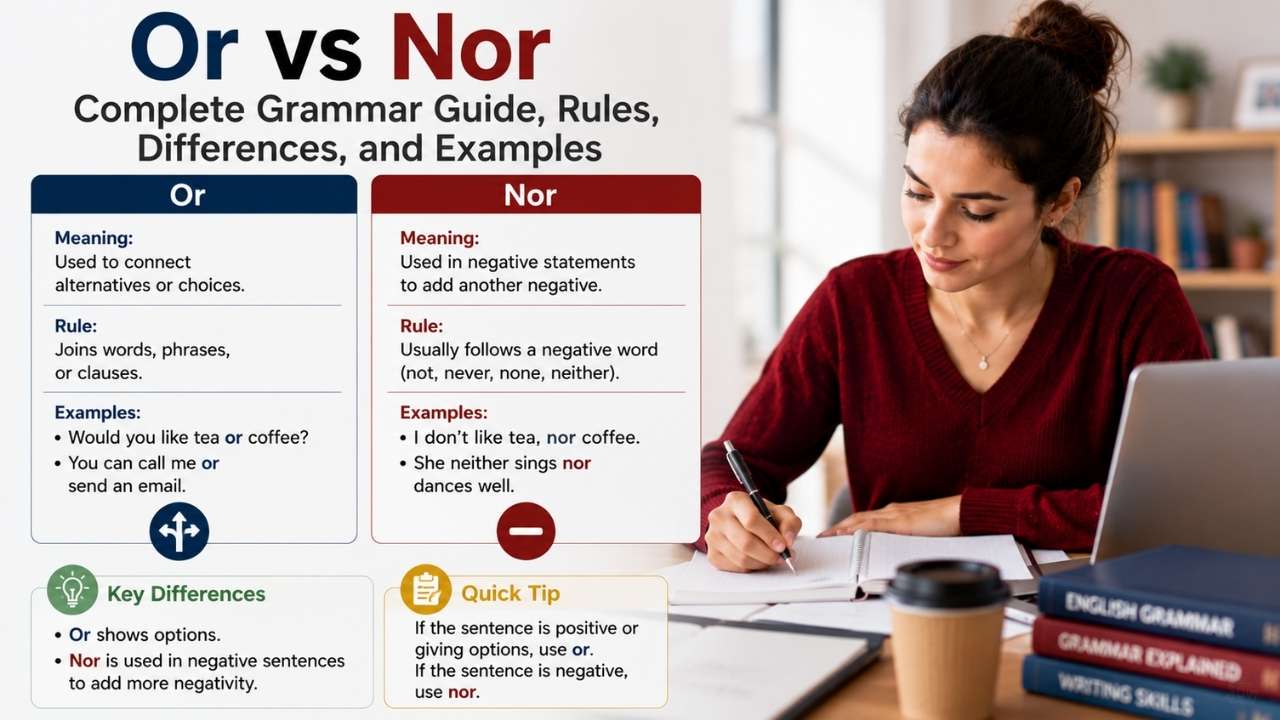
The words “or” and “nor” are small, but they often create big confusion in English grammar. Many learners search for or vs nor grammar rules because both words connect ideas, yet they work in very different ways. In simple terms, “or” is used in positive or neutral choices, while “nor” appears in negative sentences. This difference affects how we build correct sentences and avoid common mistakes in English writing.
In this guide, we will clearly explain the difference between or and nor, when to use each one, and how they work in real sentences. You will also learn rules like either or vs neither nor, along with easy examples.
By the end, you will understand nor usage in English grammar and how to use both words correctly in everyday writing and speaking without confusion.
Quick Answer
Or vs Nor: “Or” is used in positive or neutral sentences to show choices, like “tea or coffee.” “Nor” is used in negative sentences, often after “neither” or another negative clause, like “neither tea nor coffee.” The main difference in grammar rules is that “or” shows options, while “nor” continues negation in sentence structure.
What Does “Or” Mean in English Grammar?
The word “or” is a coordinating conjunction used to show choice or possibility. In simple English grammar, “or” connects two or more options and helps the reader understand alternatives. For example, you can say, “You can have tea or coffee.” This shows a clear choice between two things. The keyword or vs nor grammar rules often starts here because “or” works in positive or neutral sentences.
We usually use “or” in sentence structure rules when we want to present options, conditions, or decisions. It works in both formal and informal English. For example: “Do you want to go now or later?” This shows flexibility in meaning. Unlike negative structures, “or” does not depend on words like “neither.”
Understanding conjunction usage rules helps you avoid confusion between similar connectors. In short, “or” is simple, direct, and widely used in everyday English.
What Does “Nor” Mean in English Grammar?
The word “nor” is used in negative sentences and is part of English grammar rules for conjunctions. It connects two negative ideas and usually follows the word “neither.” For example, “He likes neither tea nor coffee.”
This is a key part of neither nor usage, which many learners search for when studying grammar. The keyword nor usage in English grammar is important because it only works in specific negative structures.
We use “nor” in sentence structure rules when continuing a negative statement. For example: “She did not call, nor did she send a message.” Here, “nor” helps extend the negative meaning. Unlike “or,” it cannot stand alone in most cases. It follows strict negative sentence construction rules. This makes it different from general conjunctions.
Learning how to use nor correctly in a sentence helps you avoid common grammar mistakes and improves writing accuracy in both formal and academic English.
Or vs Nor Key Differences Explained
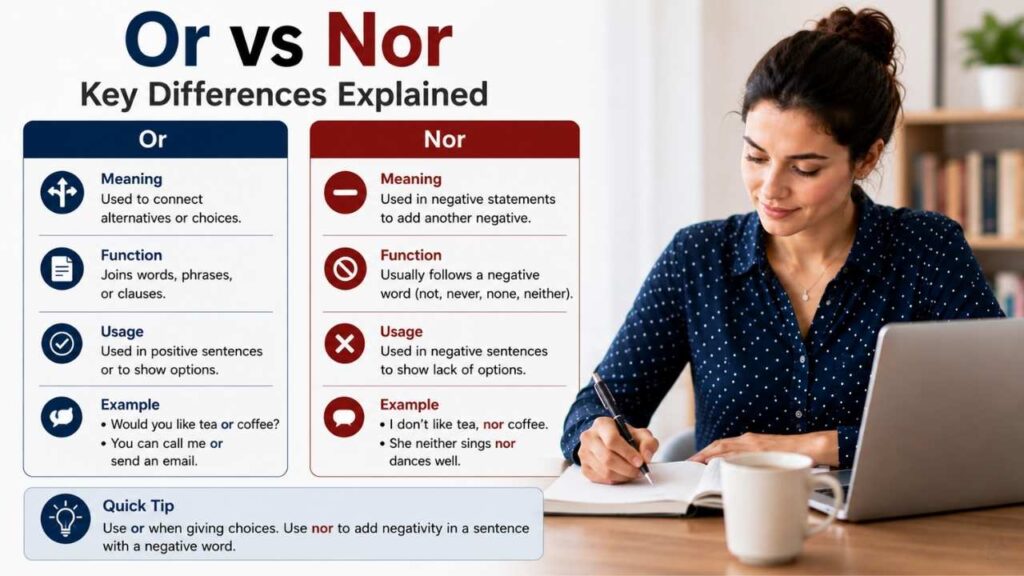
The main difference between or and nor in English grammar lies in sentence polarity. The word “or” is used in positive or neutral choices, while “nor” is used in negative sentence structures. This is one of the most important grammar rules for conjunctions that learners must understand. For example, “You can study or relax” shows choice, while “He did not study, nor did he relax” shows continued negation.
Another key difference is structure. “Or” works freely in sentence construction rules, but “nor” depends on negative words like neither or not. This makes nor usage in English grammar more limited but more specific. In formal writing, “nor” often requires inversion, which changes word order.
Understanding this contrast helps you avoid common grammar mistakes with nor. In short, “or” gives options, while “nor” continues negative meaning in structured sentences.
The “Neither…Nor” Rule
The structure “neither…nor” is one of the most important parts of English conjunction rules explained simply. We use it to connect two negative ideas in a sentence. For example, “She likes neither apples nor oranges.” This is the standard form of neither nor usage, and it is essential for correct English grammar.
In sentence structure rules, “neither” comes first, followed by the first option, and “nor” introduces the second option. Both parts must match in grammar form to keep parallel structure in grammar. For example: “He is neither angry nor upset.” This keeps the sentence balanced and clear.
A key rule is subject-verb agreement. When using neither nor, the verb agrees with the closest subject. This is often tested in English grammar rules because learners confuse it easily. Mastering this structure helps you avoid grammar mistakes using neither nor and improves both writing and speaking accuracy.
Can “Nor” Be Used Without “Neither”?
Yes, “nor” can be used without “neither”, but only in specific cases. This is part of advanced English grammar rules for conjunctions and often appears in formal writing. When “nor” is used alone, it usually follows a negative statement and requires inversion. For example: “He did not come, nor did he call.” This structure is common in formal English usage rules.
In sentence structure rules, this usage helps extend a negative idea without repeating “neither.” However, learners often make mistakes by using “nor” incorrectly in positive sentences. That is why understanding nor usage in English grammar is important.
This structure is more common in written English than spoken English. It improves clarity and flow in formal writing. However, beginners should first master neither nor usage before using standalone “nor.” This prevents confusion and helps avoid common grammar mistakes with nor in English.
When Should You Use “Or” Instead of “Nor”?
You should use “or” when your sentence is positive or offers choices. This is one of the simplest conjunction usage rules in English grammar. For example, “Do you want water or juice?” Here, both options are neutral and not negative. This is a clear case of correct or vs nor usage difference.
In contrast, “nor” is only used in negative sentence construction rules, so it cannot replace “or” in positive sentences. A useful rule is: if the sentence does not contain “not” or “neither,” you should use “or.” This helps you avoid common grammar confusion between or and nor.
Another important point is decision structure. “Or” is used when giving choices, conditions, or alternatives. For example: “You can stay or leave.” Understanding this simple rule helps you improve English sentence structure rules and prevents incorrect usage in everyday writing.
Common Mistakes With Or and Nor
Many learners make common grammar mistakes with nor and or because they mix positive and negative structures. One frequent mistake is using “nor” in a positive sentence, which is incorrect. For example, saying “I like tea nor coffee” is wrong because nor usage in English grammar requires a negative structure.
Another mistake is forgetting the neither nor pairing rules. Learners sometimes use “nor” without “neither” in simple sentences, which can sound incomplete or incorrect. For example, “He likes apples nor oranges” is incorrect without proper structure.
Some also confuse or vs nor grammar rules by using them interchangeably. However, “or” shows choice, while “nor” continues negation. Understanding sentence structure rules and negative sentence construction rules helps avoid these issues. Practicing correct examples improves accuracy and reduces grammar confusion between or and nor in English writing.
Real-Life Sentence Examples
Here are simple examples to understand or vs nor usage difference in real English sentences. For “or,” we use positive or neutral choices: “You can call me or message me.” Another example is: “Do you want to go now or later?” These follow normal sentence structure rules in English grammar.
For “nor usage in English grammar,” we use negative structures: “She did not smile, nor did she speak.” Another example is: “He is neither rich nor famous.” These follow neither nor usage rules and show how negative ideas connect.
Comparing both helps clarify the difference between or and nor in English grammar. “Or” gives options, while “nor” continues negation. Practicing these examples improves understanding of conjunction usage rules and helps avoid common grammar mistakes in sentence construction. Regular use of examples makes grammar easier to remember and apply naturally.
Quick Grammar Rules Summary
Here are simple grammar rules for conjunctions (or vs nor):
- Use “or” in positive or neutral sentences.
- Use “nor” in negative sentences only.
- Use “neither…nor” for paired negative structures.
- Do not use “nor” in positive sentences.
- Use inversion when “nor” stands alone in formal writing.
These rules explain how to use nor correctly in a sentence and how it differs from “or.” The main idea is simple: “or” gives choices, while “nor” continues negation.” Understanding this helps improve English sentence structure rules and reduces grammar errors in writing and speaking.
FAQs
What is the difference between or and nor?
“Or” shows choices in positive sentences, while “nor” continues negative meaning in sentences.
When should I use “nor”?
Use “nor” in negative sentences, usually after “neither” or another negative clause.
Can I use “nor” without “neither”?
Yes, but only in formal writing with inversion, like “Nor did he agree.”
What does “either or” mean?
It shows a choice between two options in positive sentences.
What does “neither nor” mean?
It connects two negative ideas in one sentence.
Is “or” used in negative sentences?
No, “or” is mainly used in positive or neutral contexts.
Why do people confuse or and nor?
Because both connect ideas, but their grammar rules and sentence polarity differ.
Conclusion
Understanding or vs nor grammar rules is important for writing clear and correct English sentences. The word “or” is used to show choices in positive or neutral sentences, while “nor” is used in negative structures to continue a negation. Learning the difference between or and nor in English grammar helps avoid common mistakes and improves sentence accuracy.
When you use neither…nor correctly, your writing becomes more natural and grammatically strong. Always remember: “or” gives options, and “nor” continues negative meaning.” Practicing these rules with examples will make your English clearer, more confident, and error-free in both speaking and writing.

Fahad is a seasoned English language trainer with a focus on IELTS and TEFL preparation.
He holds a Ph.D. in Applied Linguistics and has over 10 years of teaching experience.
Fahad is passionate about helping students achieve fluency and global opportunities.
His classes combine practical techniques with a supportive, student-first approach.