
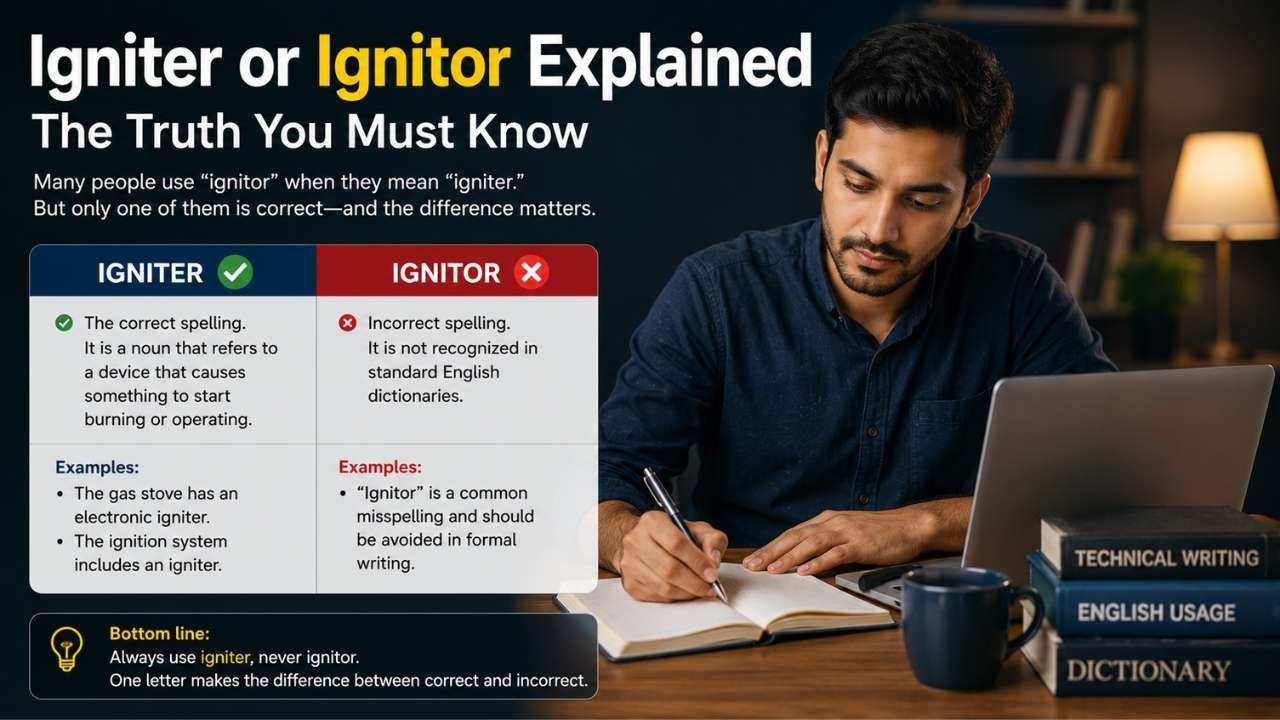
The debate around igniter vs ignitor often confuses writers, students, engineers, and even professionals who work with technical equipment. Since both words look similar and relate to the process of ignition, many people wonder whether they have different meanings or if one spelling is more correct than the other. Questions such as “Is ignitor a real word?”, “Which spelling is correct?”, and “Can igniter and ignitor be used interchangeably?” are common.
In simple terms, both words refer to something that starts or supports combustion by creating the heat, spark, or energy needed for an ignition system to work. However, their usage differs across dictionaries, industries, and professional writing. While igniter appears more frequently in modern English, technical documentation, and manufacturer manuals, ignitor still exists as an accepted variant in certain contexts.
This guide explains the difference between igniter and ignitor, their meanings, history, industry usage, and which spelling you should use in everyday, professional, and technical writing.
Quick Answer
Quick Answer: Both igniter and ignitor are correct words that refer to a device that starts ignition or supports combustion. However, igniter is the more common spelling in modern English, technical writing, manufacturer manuals, and industry documentation. While ignitor remains an accepted variant, most professionals, writers, and manufacturers prefer igniter for clarity and consistency.
What Does Igniter Mean?
An igniter is a device or component that starts the process of ignition. Its main job is to create the heat, spark, or energy needed to begin combustion. You can find an igniter in many everyday systems, including a furnace, gas stove, water heater, boiler, and other gas appliances. Without an igniter, these systems may not start properly.
The igniter meaning is simple: it is something that helps fuel catch fire safely and efficiently. Different systems use different types of igniters. Some create a spark, while others use heat to start the flame. For example, a hot surface igniter in a furnace becomes extremely hot before lighting the gas.
Today, the word igniter appears most often in technical writing, engineering documents, appliance manuals, and product descriptions. Because of its widespread use, many professionals consider it the standard spelling.
What Does Ignitor Mean?
The word ignitor has the same basic meaning as igniter. It refers to a device or component that starts an ignition system by creating heat, a spark, or another source of energy. In other words, both words describe something that helps begin combustion.
Although the meanings are the same, ignitor is less common in modern English. Some industries, manufacturers, and technical documents still use this spelling, but it appears less frequently than igniter. This is why many people ask, “Is ignitor a real word?” The answer is yes. Dictionaries and industry sources recognize it as a valid spelling.
In some older documents and specialized fields, you may see ignitor used instead of igniter. However, if you are writing for a general audience, using igniter will usually feel more familiar and professional to readers.
Igniter vs Ignitor – The Key Difference
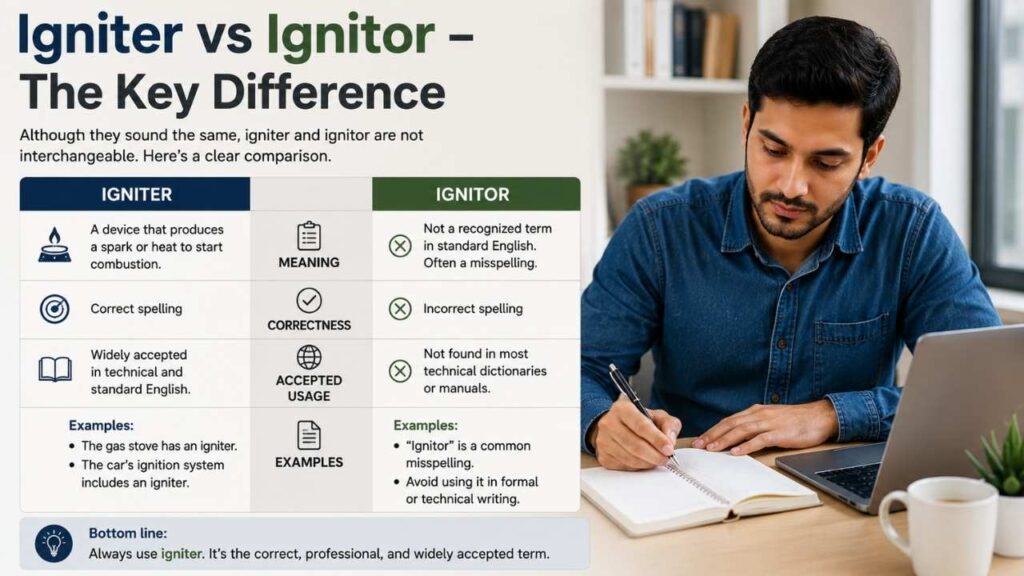
When comparing igniter vs ignitor, the most important thing to understand is that both words have the same meaning. They both describe a device that starts ignition or supports combustion. The difference lies mainly in spelling and usage rather than function.
The spelling igniter is much more common in dictionaries, technical writing, product manuals, and online searches. Many manufacturers also prefer this version when describing an ignition device or replacement part. Because of this, people often see igniter as the standard spelling.
On the other hand, ignitor remains an accepted alternative. Some industries and older publications still use it, especially in technical settings. Neither spelling is wrong, but one is clearly more popular.
If your goal is clear communication, igniter is usually the better choice because most readers recognize it immediately.
Is Ignitor a Real Word?
Many people assume that ignitor is a spelling mistake, but that is not true. If you have ever asked, “Is ignitor a real word?”, the answer is yes. Dictionaries, technical references, and industry publications recognize ignitor as a valid word.
The confusion happens because igniter appears much more often in modern English. As a result, many readers become familiar with that spelling first. However, this does not make ignitor incorrect. Both words refer to the same type of ignition device and perform the same role in an ignition system.
You may still find ignitor in engineering documents, product specifications, and equipment manuals. Some manufacturers have used this spelling for years and continue to do so today.
While ignitor is correct, most writers prefer igniter because it is more common, easier to recognize, and widely accepted across industries.
Which Spelling Is More Common?
If you compare the popularity of the two spellings, igniter clearly appears more often. It dominates online searches, dictionaries, technical articles, appliance manuals, and manufacturer websites. This widespread use makes it the preferred choice for most readers and professionals.
One reason for its popularity is consistency. Many companies use igniter in product descriptions, replacement part catalogs, and maintenance guides. Writers also favor it because it matches common English word patterns and feels more natural to many readers.
Although ignitor remains a correct spelling, it appears less frequently in modern publications. You may still find it in older documents or specialized industries, but it does not have the same level of recognition.
For anyone wondering which spelling is more common, the answer is simple: igniter is the dominant form and the one most people expect to see today.
Why “Igniter” Is Preferred by Most Experts
Most language experts, technical writers, and manufacturers prefer the spelling igniter because it is the version people see most often. It appears in dictionaries, industry publications, appliance manuals, and engineering documents. This consistent usage has helped igniter become the standard term in many fields.
Another reason experts choose igniter is clarity. Readers instantly recognize the word and understand its connection to ignition and combustion. When companies write product descriptions or maintenance guides, they often select terms that are familiar to the largest audience. In most cases, that term is igniter.
Using one common spelling also reduces confusion. Technical teams, manufacturers, and content writers benefit when everyone uses the same terminology. Although ignitor remains a valid word, igniter has become the preferred choice because it is widely accepted, easy to recognize, and commonly used across industries.
The History and Etymology of Igniter and Ignitor
To understand igniter vs ignitor, it helps to look at their history. Both words come from the verb ignite, which means to start a fire or begin combustion. Over time, English speakers created different word forms from this root word, leading to both igniter and ignitor.
The spelling igniter follows a common English pattern found in words such as “writer” and “builder.” Because of this familiar structure, it became more popular in everyday language and professional writing. The spelling ignitor developed as an alternative form and appeared in some technical fields and publications.
As language evolved, both spellings remained in use. However, igniter gradually became the dominant choice in dictionaries, technical documentation, and product manuals. Today, both terms are correct, but igniter has stronger support from modern usage and industry standards.
Igniter vs Ignitor in Different Industries
The discussion about igniter vs ignitor becomes more interesting when you look at different industries. In the HVAC industry, professionals usually use the term furnace igniter when talking about heating systems and replacement parts. Appliance manufacturers also prefer igniter when describing components used in gas stoves, ovens, and water heaters.
In the automotive industry, the word often appears when discussing parts connected to ignition systems. Industrial manufacturers also use igniter when referring to equipment that starts fuel-burning processes. Because many industries rely on clear technical communication, they tend to choose the most recognized spelling.
Although ignitor still appears in some engineering documents and product specifications, it is far less common. Across HVAC, manufacturing, and appliance industries, igniter remains the preferred term because it provides consistency and reduces confusion among technicians and customers.
How Manufacturers Refer to Igniters
Manufacturers play an important role in determining which terms become standard. When you look at product manuals, replacement part catalogs, and maintenance guides, you will notice that most companies use the word igniter rather than ignitor.
For example, products such as a gas range igniter, oven igniter, or hot surface igniter usually appear under the igniter spelling. Companies prefer this approach because it matches common search behavior and makes product information easier for customers to understand. A customer looking for a replacement part is more likely to search for igniter than ignitor.
Consistency also helps manufacturers avoid confusion in technical documentation. Using the same terminology across manuals, websites, and support materials creates a better experience for users. While some brands still use ignitor, the majority rely on igniter as their standard term for ignition-related components.
Igniter in Technical Writing
In technical writing, clear language is extremely important. Engineers, technicians, and manufacturers need terms that readers can understand quickly and accurately. This is one reason why igniter appears more often in technical reports, product specifications, and engineering documents.
When describing an ignition device, technical writers usually choose the spelling that readers expect to see. Since igniter is more common, it helps create consistency across manuals, repair guides, and training materials. A technician reading about a furnace igniter or gas appliance igniter immediately understands the subject without confusion.
Technical writing also values standard terminology. Using one widely accepted spelling makes communication easier between manufacturers, suppliers, and maintenance teams. Although ignitor remains correct, many organizations prefer igniter because it aligns with industry practices and improves readability in professional documents.
Igniter vs Ignitor in Academic and Professional Writing
Academic and professional writing often follows established language standards. In these settings, writers usually choose words that are widely recognized and accepted. Because of this, igniter appears more frequently than ignitor in research papers, technical studies, business documents, and educational materials.
Professional writers aim to avoid confusion for their audience. Since igniter is the more familiar spelling, it often becomes the safer choice. Readers can quickly understand the meaning without wondering whether the word is a typo or an uncommon variation.
In academic writing, consistency is also important. Using one spelling throughout a document creates a cleaner and more professional presentation. Although ignitor remains a valid term, many editors and organizations prefer igniter because it aligns with modern usage trends. For most professional and educational purposes, igniter is the recommended option.
Common Examples of Igniter and Ignitor in Sentences
Looking at examples can make the difference between igniter and ignitor easier to understand. In everyday and professional writing, both words refer to the same type of device that starts ignition.
Examples using igniter:
- The technician replaced the furnace igniter before winter.
- The gas stove would not light because the igniter failed.
- The engineer tested the igniter before starting the system.
Examples using ignitor:
- The manual listed the ignitor as a replacement part.
- The ignitor activated the combustion process.
- The technician inspected the ignitor during maintenance.
These examples show that both spellings work in similar situations. However, most modern manuals, websites, and technical documents use igniter. If you want your writing to match current industry standards, igniter is usually the better choice.
Common Mistakes People Make
Many people make simple mistakes when discussing igniter vs ignitor. One common mistake is believing that ignitor is incorrect. In reality, both spellings are valid and refer to the same type of ignition device.
Another mistake is using both spellings in the same document. Switching between igniter and ignitor can confuse readers and make writing appear inconsistent. It is usually better to choose one version and use it throughout the content.
Some writers also assume that the two words describe different devices. This is not true. Both terms relate to equipment that starts combustion or supports an ignition system. The difference is mainly in spelling and usage.
To avoid confusion, use the spelling that best fits your audience. In most situations, igniter is the preferred choice because it is more common and widely recognized.
When Should You Use Igniter?
If you are unsure which spelling to choose, igniter is usually the safest option. It appears more often in dictionaries, technical documentation, product descriptions, and manufacturer manuals. Most readers recognize it immediately, which makes communication easier.
Use igniter when writing blog posts, educational content, business documents, engineering reports, and product guides. It is also the preferred spelling for many industries, including HVAC, appliance repair, and manufacturing. If your goal is clear and professional writing, igniter will usually meet your needs.
You may still use ignitor when following specific company terminology or referencing documents that already use that spelling. The key is consistency. Once you choose one version, use it throughout your content.
For most situations, especially professional and technical writing, igniter remains the recommended choice because it is familiar, accepted, and widely used.
FAQs
Is ignitor or igniter correct?
Both ignitor and igniter are correct spellings. They refer to the same device that starts ignition or helps begin combustion. However, igniter is more commonly used in modern English, technical writing, and manufacturer manuals, making it the preferred choice in most situations.
What is an igniter?
An igniter is a device that produces heat, a spark, or energy to start an ignition system. It is used in systems like furnaces, gas stoves, water heaters, and boilers. Its main job is to safely start the combustion process so the equipment can function properly.
What is an ignitor?
An ignitor has the same meaning as igniter. It is a component that helps start combustion by creating a spark or heat source. Although less common, it is still a valid spelling and appears in some technical documents and older industry references.
Why are there two spellings: igniter and ignitor?
The two spellings come from the root word ignite. Over time, English developed different word forms, leading to both igniter and ignitor. Language evolution and industry usage patterns caused both versions to continue, even though igniter became more popular.
Which spelling is more common, igniter or ignitor?
Igniter is much more common in modern usage. It appears in dictionaries, product manuals, engineering documents, and online searches more frequently than ignitor. Because of this, most writers and manufacturers prefer igniter for clarity and consistency.
Do manufacturers use igniter or ignitor?
Most manufacturers use the spelling igniter in product descriptions, replacement parts, and technical manuals. You will often see terms like furnace igniter or gas stove igniter. However, a few older documents or brands may still use ignitor.
Can igniter and ignitor be used interchangeably?
Yes, both words can be used interchangeably because they have the same meaning. However, it is better to stay consistent in your writing. In most professional and technical content, igniter is preferred because it is more widely recognized.
What does an igniter do in a furnace or gas appliance?
In a furnace or gas appliance, the igniter creates the heat or spark needed to start combustion. Once activated, it helps ignite the gas safely so the system can produce heat. Without a working igniter, the appliance will not start properly.
Is ignitor used in technical writing?
Yes, ignitor sometimes appears in technical writing, but it is less common than igniter. Many engineers and manufacturers prefer igniter because it is more consistent and widely accepted in modern technical documentation.
Which spelling should I use in professional writing?
For professional writing, igniter is the best choice. It is more common, widely accepted, and used in most industry documents, manuals, and academic content. Using igniter helps ensure clarity and consistency for readers.
Conclusion
The confusion between igniter vs ignitor is common, but the difference is simple. Both words refer to the same device that starts ignition by creating heat, a spark, or energy needed for combustion. In meaning, there is no real difference, and both spellings are technically correct.
However, usage patterns clearly show that igniter is the preferred spelling in modern English. It appears more often in dictionaries, technical writing, manufacturer manuals, and industry documents. Because of this wide acceptance, most professionals, engineers, and content writers choose igniter to maintain clarity and consistency.
The spelling ignitor is still valid, but it is less common and often found in older texts or specific technical references. If you want your writing to feel natural, professional, and easy to understand, igniter is usually the best choice. Staying consistent with this spelling will help your content match industry standards and improve reader trust.

Fahad is a seasoned English language trainer with a focus on IELTS and TEFL preparation.
He holds a Ph.D. in Applied Linguistics and has over 10 years of teaching experience.
Fahad is passionate about helping students achieve fluency and global opportunities.
His classes combine practical techniques with a supportive, student-first approach.