
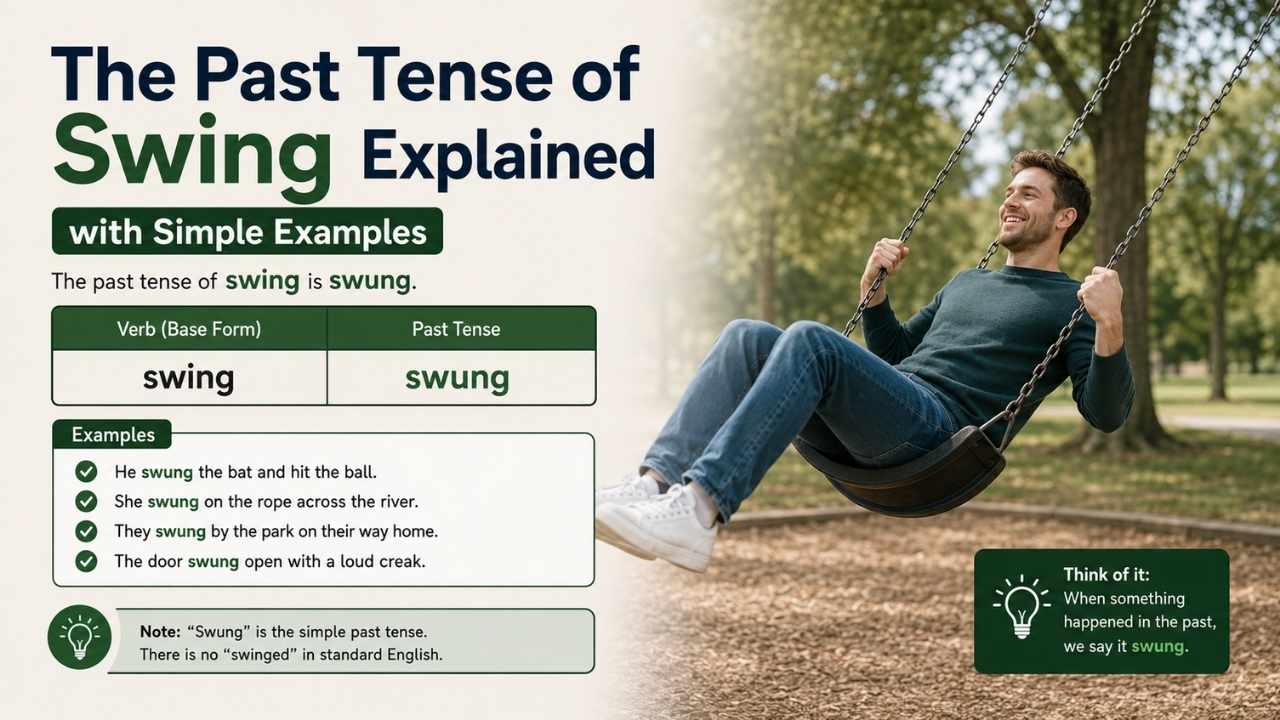
The past tense of “swing” is a common grammar question in English, especially for learners and students. The correct form is “swung,” which is used when talking about something that already happened. “Swing” is an irregular verb, so it does not follow the normal rule of adding “-ed” in the past tense, which is why many people search for “swing past tense,” “swing verb forms,” or even confuse it with “swang vs swung.”
In everyday English, we use swung in many situations, such as when someone swings a bat, a child swings on a rope, or a door swings open. This makes understanding the correct form very important for clear communication.
In this article, we will explain the verb forms, meaning, and usage of swung, along with simple examples to help you fully understand the past tense of swing in real English sentences.
Quick Answer
The past tense of “swing” is “swung.” It is an irregular verb, so it does not take “-ed” like regular verbs. We use swung to describe past actions, such as “He swung the bat” or “The door swung open.” The forms are: swing (present), swung (past), swung (past participle).
Verb Forms of Swing
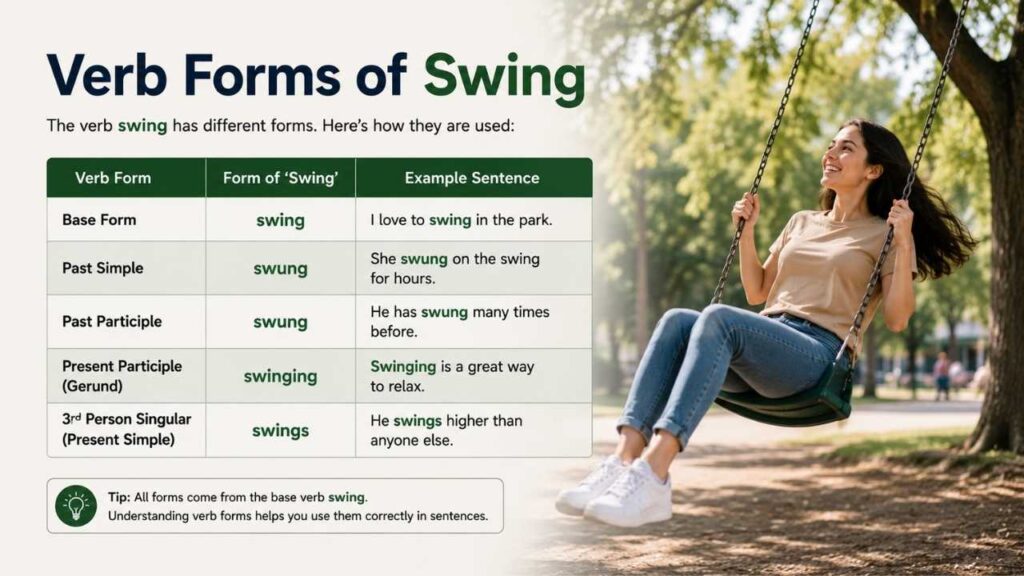
The verb “swing” has three main forms that are important in English grammar. These forms help us use the verb in present, past, and perfect tenses correctly. The base form is swing (V1), which we use in the present tense, such as “I swing every day.”
The past tense form is swung (V2), which is used for completed actions, like “He swung the bat yesterday.” The past participle is also swung (V3), and it is used with helping verbs, such as “has” or “have,” for example, “She has swung on that rope before.”
This verb is an irregular verb, so it does not follow the normal “-ed” rule. Many learners also search for “swing conjugation,” “swing verb forms,” or “past participle of swing” when trying to understand it. Learning these forms helps you use swung correctly in both speaking and writing.
Why “Swing” Becomes “Swung
The verb “swing” changes to “swung” in the past tense because it is an irregular verb. This means it does not follow the usual rule of adding “-ed” like regular verbs. Instead, the vowel sound in the word changes completely. This type of change is common in English verbs such as sing → sang → sung or ring → rang → rung.
There is no fixed rule that learners can simply apply to all irregular verbs, so swung must be memorized. Over time, English developed this form naturally, and it became the standard usage in modern English. That is why we say “He swung the bat” instead of “swanged” or “swinged.”
Understanding this helps avoid common mistakes and improves grammar accuracy. When learners search for “swing past tense,” “irregular verb swing,” or “swing conjugation,” they are usually trying to understand this exact rule change.
“Swung” in Sentences
The word “swung” is used in many simple and everyday English sentences. It shows that an action already happened in the past. For example, “He swung the bat and hit the ball” describes a completed action in sports. Another example is “The child swung on the rope at the park,” which shows physical movement. We can also use it for objects, like “The door swung open slowly.”
In some cases, swung is used in a figurative way. For example, “The mood swung from happy to sad” shows a change in feeling. These examples help learners understand how flexible the verb is in real life.
People often search for “examples of swing in past tense,” “how to use swung in a sentence,” or “swing past tense examples.” Practicing these sentences makes it easier to remember that swung is the correct past form of swing.
Is “Swang” Correct English?
The word “swang” is not correct in standard English. The correct past tense of “swing” is “swung.” Many learners make this mistake because they try to follow regular verb rules or mix it with similar-sounding words. However, “swang” is considered incorrect in formal English writing and speaking.
In some informal speech or dialects, people may still say “swang,” but it is not accepted in grammar rules or exams. The standard and correct form is always swung, whether in writing, conversation, or academic use. For example, “He swung the bat” is correct, while “He swang the bat” is wrong.
This confusion often appears in searches like “swang vs swung,” “is swang correct,” or “why do people say swang.” Learning the correct form helps avoid grammar mistakes and improves clarity in communication. Always remember: swing → swung, not swang.
Quick Comparison Table
It is easy to get confused between “swang” and “swung,” but only one form is correct in English grammar. The correct past tense of “swing” is “swung.” The word “swang” is not accepted in standard English and is considered incorrect in formal writing, exams, and professional communication.
For example, we say “He swung the bat,” not “He swang the bat.” Similarly, “The door swung open” is correct usage. Many learners mistakenly use “swang” because they try to follow regular verb patterns, but swing is an irregular verb, so it changes completely.
| Word | Correct? | Usage |
| swang | Incorrect | Not standard English |
| swung | Correct | Past tense and past participle |
People often search for “swang vs swung” or “is swang correct,” and the answer is always the same: swung is the only correct form.
Related Irregular Verbs
The verb “swing” belongs to a group of irregular verbs in English. These verbs do not follow the normal “-ed” rule in the past tense. Instead, they change their form completely. Learning similar verbs helps you remember patterns more easily.
For example, sing → sang → sung, ring → rang → rung, and bring → brought → brought follow different irregular patterns. Just like these, swing → swung → swung also changes in a unique way.
These verbs are often grouped together in English learning because they have similar sound changes. Many learners search for “irregular verbs list,” “swing conjugation,” or “verb forms of swing” when studying grammar.
Practicing these verbs regularly helps improve fluency in speaking and writing. Once you understand how swung works, it becomes easier to remember other irregular verbs as well.
FAQs
What is the past tense of swing?
The past tense of “swing” is “swung.” It is an irregular verb, so it does not use “-ed” like regular verbs.
Is it swang or swung?
The correct form is “swung.” “Swang” is incorrect in standard English and should not be used in writing or exams.
What is the past participle of swing?
The past participle of swing is also “swung.” For example: “She has swung on the rope before.”
Is swing a regular or irregular verb?
Swing is an irregular verb because its past form changes completely to swung instead of “swinged.”
How do you use swung in a sentence?
You can say: “He swung the bat” or “The door swung open slowly.”
Why do people say swang?
People say “swang” due to informal speech or confusion with regular verb patterns, but it is not correct.
Can swing ever become swinged?
No, “swinged” is incorrect. The correct form is always swung.
What are the verb forms of swing?
The forms are: swing (present), swung (past), swung (past participle).
Conclusion
The past tense of “swing” is “swung,” and it is an irregular verb in English. This means it does not follow the common rule of adding “-ed” to form the past tense. Instead, the word changes completely, which is why learners often get confused with incorrect forms like “swang” or “swinged.”
Understanding swung is important for using English correctly in both speaking and writing. You can use it in many real-life situations, such as sports (“He swung the bat”), movement (“The door swung open”), and even emotions or changes (“The mood swung quickly”).
The key point to remember is simple: swing → swung → swung. Once you learn this pattern, it becomes easy to use the verb correctly in different tenses. Practicing examples and reading simple sentences will help you remember it naturally and avoid common mistakes in everyday English.

Fahad is a seasoned English language trainer with a focus on IELTS and TEFL preparation.
He holds a Ph.D. in Applied Linguistics and has over 10 years of teaching experience.
Fahad is passionate about helping students achieve fluency and global opportunities.
His classes combine practical techniques with a supportive, student-first approach.