
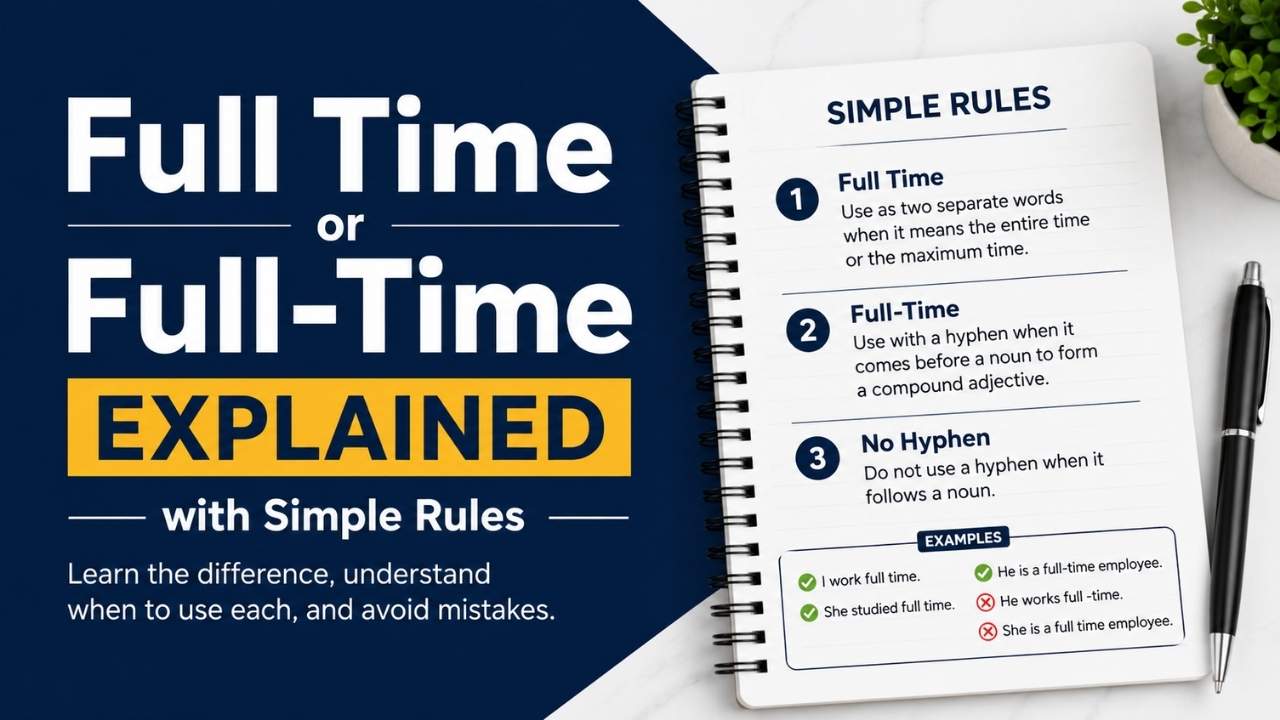
Have you ever stopped while writing and wondered whether it should be full-time or full time? You’re not alone. Many writers, students, and professionals get confused about the correct hyphenation of this common term. The good news is that the rule is actually simple once you understand how it works.
In English grammar, the choice between full-time and full time depends on how the phrase is used in a sentence. Sometimes it acts as a compound adjective, while other times it functions as a noun phrase. Knowing this difference will help you avoid common writing mistakes and improve your professional communication.
In this guide, you’ll learn when to use full-time, when not to hyphenate full time, how the same rule applies to part-time, and plenty of real-world examples to make the concept easy to remember.
Quick Answer
Use full-time with a hyphen when it comes before a noun and acts as a compound adjective, such as full-time employee or full-time job. Use full time without a hyphen when it stands alone in a sentence, such as “She works full time.” The same grammar rule applies to part-time and part time.
What Is the Difference Between Full-Time and Full Time?
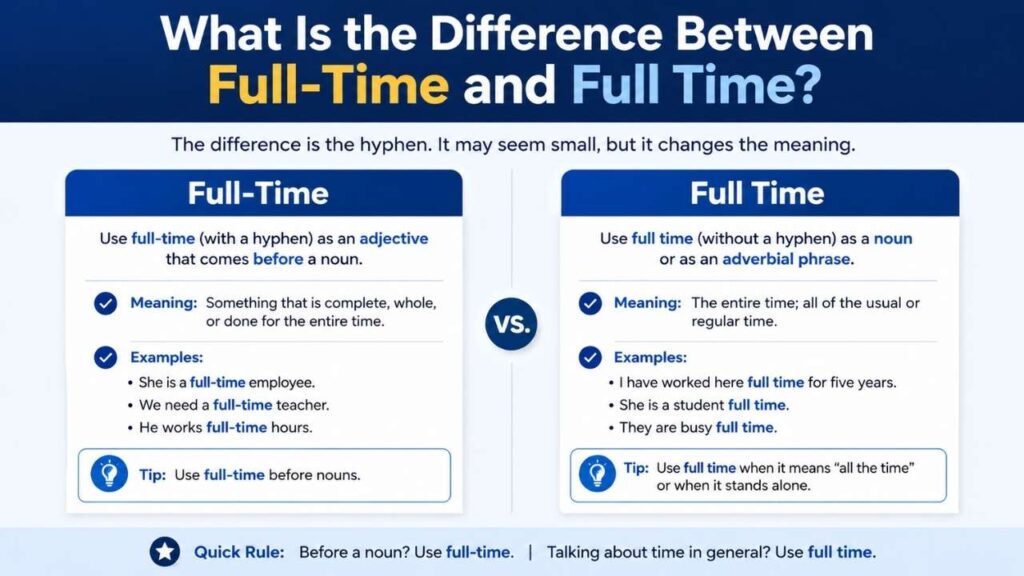
The difference between full-time and full time comes down to how the phrase works in a sentence. While both forms have the same meaning, they follow different grammar rules.
Use full-time with a hyphen when it comes before a noun and acts as a compound adjective. In this case, it describes a person, job, position, or activity. For example, “She accepted a full-time job” and “He is a full-time employee.”
Use full time without a hyphen when the phrase stands alone as a noun phrase or describes how someone works or studies. For example, “She works full time” and “He studies full time.”
If you’re wondering when to use full-time or should full-time be hyphenated, remember this simple rule: before a noun, use the hyphen; otherwise, leave it out.
When Should You Hyphenate Full-Time?
You should use full-time with a hyphen when it works as a compound adjective before a noun. In simple terms, the phrase joins together to describe something that comes right after it. This is one of the most common hyphenation rules in English grammar.
For example, you would write full-time employee, full-time job, full-time position, or full-time student. In each case, the hyphen helps readers understand that the two words work together as one description.
Many style guides and professional editors follow this rule because it improves clarity and avoids confusion. If you’re asking, should full-time be hyphenated, the answer is yes when it appears before a noun.
A simple trick is to check the next word. If full-time is directly describing a person, job, or thing, use the hyphen.
When Should You Not Hyphenate Full Time?
You should write full time without a hyphen when the phrase is not directly describing a noun. In these situations, it usually acts as a noun phrase or tells how someone works, studies, or spends their time.
For example, it is correct to write, “She works full time” or “They attend school full time.” In these sentences, full time is not functioning as a compound adjective, so a hyphen is unnecessary.
One of the most common grammar mistakes is using a hyphen everywhere. While full-time employee is correct, I work full-time is often considered incorrect in standard grammar and many style guides.
If you are unsure when not to hyphenate full time, remember this rule: when the phrase follows the verb and does not describe a noun, write full time without the hyphen.
Is Part-Time or Part Time Different?
The grammar rule for part-time and part time is exactly the same as the rule for full-time and full time. The only difference is the number of hours being discussed.
Use part-time with a hyphen when it appears before a noun. For example, “She found a part-time job” and “He is a part-time worker.” Here, the phrase acts as a compound adjective.
Use part time without a hyphen when it stands alone in a sentence. Examples include, “She works part time” and “He studies part time.”
Many writers search for part-time or part time grammar because they are unsure about the correct form. Fortunately, the rule is simple. If the phrase describes a noun, use the hyphen. If it does not, leave the hyphen out.
Why Compound Adjectives Use Hyphens
Understanding compound adjectives makes it easier to know when to use full-time and similar expressions. A compound adjective happens when two or more words work together to describe a noun.
The hyphen connects the words and shows readers that they should be read as a single idea. For example, in full-time employee, the words “full” and “time” combine to describe the employee.
This rule is not limited to full-time. You will also see examples such as well-known author, high-quality product, long-term plan, and full-service restaurant.
Without the hyphen, readers may need extra time to understand the meaning. That is why many grammar experts and style guides recommend using hyphens for compound modifiers before nouns.
Learning this rule helps improve your writing style and reduces common punctuation mistakes.
Full-Time vs Full Time Examples in Sentences
Looking at real examples is one of the easiest ways to understand full-time vs full time. Once you see the pattern, the rule becomes much easier to remember.
Correct Examples
- She accepted a full-time job.
- He is a full-time employee.
- They hired a full-time manager.
- She works full time.
- He studies full time.
- They travel full time.
Incorrect Examples
- She accepted a full time job.
- He is a full time employee.
- She works full-time.
The first two examples need a hyphen because the phrase describes a noun. The last example should not use a hyphen because the phrase follows the verb.
If you ever wonder about the correct usage of full-time, checking sentence structure is usually enough to find the answer.
AP Style, Chicago Style, and Editorial Rules
Most major style guides agree on the basic rule for full-time and full time. However, writers should still understand how professional publications handle these terms.
In AP Style, full-time is usually hyphenated when it comes before a noun, such as full-time employee or full-time position. When it appears after a verb, it is often written as full time.
The Chicago Manual of Style follows a similar approach for compound adjectives. The goal is to improve clarity and make sentences easier to read.
Editors also focus on consistency. If you choose one style guide, follow it throughout the article. This creates a cleaner reading experience and improves professionalism.
Understanding style guide rules can help writers, students, and businesses avoid grammar errors and maintain a polished writing style.
Common Mistakes Writers Make
Many writers understand the basic rule but still make mistakes with full-time and full time. These errors often happen because the phrase can function in different ways.
One common mistake is adding a hyphen everywhere. For example, writing “I work full-time” may not follow standard grammar rules because the phrase is not describing a noun.
Another mistake is forgetting the hyphen before a noun. Phrases such as full-time employee, full-time student, and full-time position should usually include a hyphen.
Some writers also mix different editorial styles in the same article. This can make the content look inconsistent.
To avoid these issues, focus on sentence structure. Ask yourself whether the phrase is acting as a compound adjective or a noun phrase. In most cases, the correct form becomes obvious once you identify its role.
Is Full-Time One Word, Two Words, or Hyphenated?
Many people ask whether full-time is one word, two words, or a hyphenated term. The answer depends on how the phrase is used.
It is not normally written as one word. Instead, the correct forms are full-time with a hyphen or full time as two separate words.
Use full-time when the phrase acts as a compound adjective before a noun. Examples include full-time job, full-time employee, and full-time student.
Use full time when the phrase stands alone or follows a verb. For example, “She works full time” and “He studies full time.”
If you are searching for the difference between full-time and full time, remember that both are correct. The key is understanding sentence structure and applying the proper grammar rule in each situation.
Full-Time in Business, Employment, and Education
The term full-time is commonly used in business, employment, and education. In each setting, the grammar rule remains the same, but the meaning may vary slightly.
In the workplace, a full-time employee usually works a regular schedule set by the employer. A full-time position often includes consistent hours and may offer employee benefits.
In education, a full-time student is someone who studies according to the institution’s required course load. Schools and universities often use this term in official documents.
Whether you are discussing a full-time job, full-time work, or a full-time student, the hyphen is needed when the phrase appears before a noun.
Understanding these real-world examples helps writers apply the correct usage confidently in professional, academic, and everyday communication.
FAQs
Is full-time always hyphenated?
No. Full-time is hyphenated when it comes before a noun, such as full-time employee. When it stands alone in a sentence, write full time without a hyphen.
What is the difference between full-time and full time?
Full-time acts as a compound adjective before a noun, while full time functions as a noun phrase or adverbial phrase after a verb.
When should you use full-time with a hyphen?
Use full-time when it directly describes a noun, such as full-time job, full-time student, or full-time position.
Is full time a noun phrase?
Yes. In sentences like “She works full time,” the phrase acts as a noun phrase and does not require a hyphen.
Is full-time an adjective?
Yes. Full-time is a compound adjective when it appears before a noun and describes that noun.
Is part-time hyphenated?
Yes, part-time follows the same grammar rule as full-time. Use the hyphen before a noun and remove it when the phrase stands alone.
Is full-time one word or two words?
It is normally written as either full-time (hyphenated) or full time (two words). It is not usually written as one word.
How do style guides treat full-time?
Most style guides, including AP Style and Chicago Style, recommend using full-time before a noun and full time in other situations.
How do you use full-time in a sentence?
Example: “She accepted a full-time job at a marketing company.” Here, the hyphen is needed because the phrase describes the noun.
How do you use full time in a sentence?
Example: “He works full time and attends classes in the evening.” Since the phrase follows the verb, no hyphen is needed.
Conclusion
Knowing the difference between full-time and full time is easier than many people think. The rule comes down to how the phrase functions in a sentence.
Use full-time with a hyphen when it acts as a compound adjective before a noun. Examples include full-time employee, full-time job, and full-time student. Use full time without a hyphen when the phrase stands alone, such as “She works full time” or “He studies full time.”
The same rule applies to part-time and part time, making it easier to remember similar expressions.

Fahad is a seasoned English language trainer with a focus on IELTS and TEFL preparation.
He holds a Ph.D. in Applied Linguistics and has over 10 years of teaching experience.
Fahad is passionate about helping students achieve fluency and global opportunities.
His classes combine practical techniques with a supportive, student-first approach.