
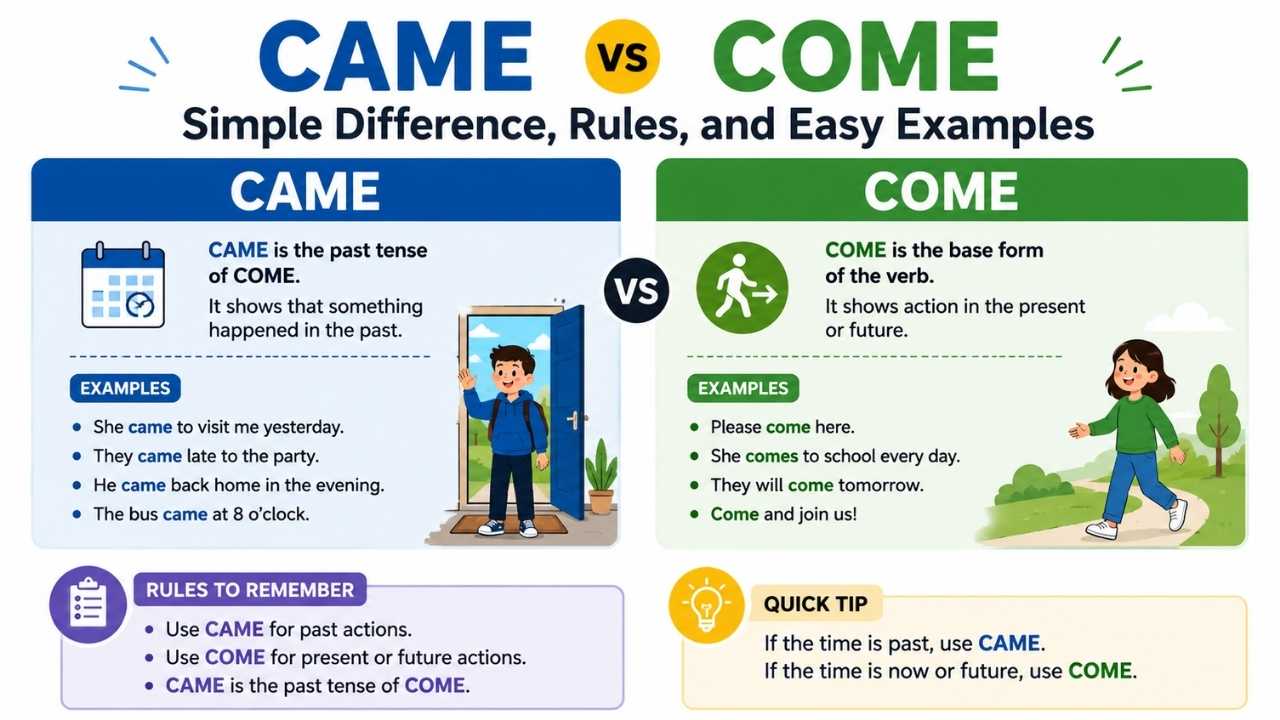
Many English learners get confused between “come vs came”, and that’s completely normal because they look similar but are used in different situations. The main difference is actually very simple: “come” is used for the present or general actions, while “came” is the past tense of “come” and is used for actions that already happened.
For example, you say “I come here every day” when talking about a habit, but you say “I came here yesterday” when talking about a finished action in the past. In this guide, we will clearly explain the difference between come and came, their correct usage, and common mistakes learners make.
You will also see easy examples that help you understand how native speakers use these words in daily English conversation.
Quick Answer
The difference between come and came is based on time. Come is used for present actions, habits, or general situations, while came is the past tense of come and is used for completed actions. For example, “I come here daily” shows habit, but “I came yesterday” shows past action. Always check time words before choosing.
Meaning of “Come”
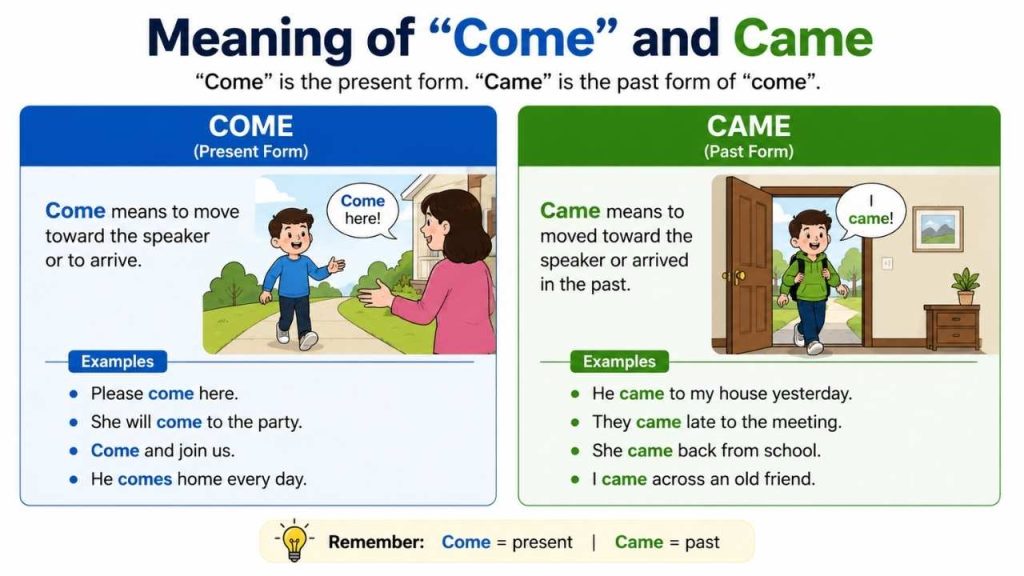
The word “come” is the present form of the verb and is used when something is happening now, happens regularly, or may happen in the future. It is often used in daily English conversations and simple grammar sentences. For example, “I come to school every day” shows a habit.
We also use come when talking about movement toward a place, like “Please come here.” Another common use is in future plans, such as “They will come tomorrow.” Understanding the verb forms of come helps you avoid mistakes in English. Many learners confuse it with past tense, but remember that come is not used for completed past actions.
It is always linked with present or general time. Learning correct come vs came usage makes your English sound more natural and clear in daily communication.
Meaning of “Came”
The word “came” is the past tense of come, and it is used when an action is already finished in the past. It tells us that something happened before now. For example, “She came home late yesterday” shows a completed action.
We also use came in stories or when talking about past events, like “He came to visit me last week.” It is important to remember that came is never used for present habits or current actions. Many learners make mistakes like “I come yesterday,” but the correct form is “I came yesterday.”
This helps improve your sentence correction English skills. Using came correctly makes your English more accurate and natural. Always check if the time word shows the past, like yesterday, last week, or ago, before choosing came vs come in your sentence.
Came vs Come Comparison Table
Understanding came vs come usage becomes very easy when you compare them side by side. “Come” is used for present actions, habits, and general situations, while “came” is used for completed past actions. For example, you can say “I come here often,” but you say “I came here yesterday.”
Another difference is that come is used in daily routines, while came is used in past stories or events. Think of it like this: come = now or regular life, and came = finished past life events. This simple comparison helps you avoid confusion in English grammar.
Many learners mix these forms, but once you understand the rule, your English grammar explanation becomes much clearer. Always check the time in your sentence before choosing the correct form. This table makes learning come vs came fast, simple, and easy to remember.
The Simple Decision Rule
A very easy way to choose between come and came is to use a simple decision rule. First, ask yourself: “Is this action already finished?” If the answer is yes, then use came. If the action is happening now or happens regularly, use come.
For example, “I came home early” is correct because it is a finished action. But “I come home early every day” is correct for a habit. This rule works for almost all came vs come usage cases. Many learners get confused because they focus on meaning, but the key is time reference in grammar.
Words like yesterday, last week, or ago always need came, while words like every day, usually, or now need come. This simple method helps with quick grammar correction English in speaking and writing.
Common Mistakes Learners Make
Many English learners make simple mistakes when using come and came, mostly because they ignore time words. One common error is saying “I come yesterday,” which is incorrect. The correct sentence is “I came yesterday.”
Another mistake is “He come to school last week,” but it should be “He came to school last week.” Learners also mix present and past forms in one sentence, which creates confusion. These errors happen because of weak understanding of verb tense rules. To avoid this, always check if the action is finished or not. If it is past, use came.
If it is present or repeated, use come. Practicing sentence correction English helps reduce these mistakes. Learning correct patterns improves your confidence in both writing and speaking English. With practice, you can easily master come vs came usage without confusion.
Come vs Came in Real Spoken English
In real spoken English, people use come and came very naturally based on time. Native speakers don’t think about rules; they just follow the situation. For example, they say “I come here often” when talking about habits or routines. But they say “I came home late” when talking about something that already happened.
In daily conversation, time words like yesterday, today, or always help choose the correct form. Understanding this helps you improve your spoken English grammar usage. Many learners struggle because they translate directly from their language, but English depends on time context.
When you practice listening and speaking, you will notice how often come vs came is used correctly. Using these forms naturally will make your English sound more fluent and clear in real-life conversations, classrooms, and everyday communication.
Time Reference Guide
Time words are very important in understanding come vs came usage. They help you choose the correct verb easily. If the sentence includes words like yesterday, last week, ago, or in 2020, you should use came because these words show past time. For example, “She came here yesterday.”
On the other hand, if the sentence includes words like every day, usually, always, or now, you should use come. For example, “I come here every day.” This is a simple way to improve your English grammar explanation skills.
Many learners forget to check time words and make mistakes. But once you understand this rule, your sentence accuracy improves quickly. Always look at the time clue first before choosing between come and came. This habit makes your English writing and speaking much more correct and natural.
Quick Memory Trick
A very simple memory trick can help you remember come vs came usage easily. Think of “CAME = Completed Action Moved Ended.” This means the action is already finished in the past. For example, “I came home early” shows a completed action.
Now remember “COME = Current or Common Events.” This means actions happening now or regularly. For example, “I come here every day” shows a habit. This trick helps you quickly decide the correct verb without thinking too much about grammar rules. Many learners improve faster when they use easy memory methods like this.
It also helps reduce confusion in sentence correction English tasks. With practice, this simple trick becomes automatic, and you will naturally choose the right form in both speaking and writing. It makes learning come and came simple, fast, and stress-free.
FAQ
Is “I come yesterday” correct?
No, it is incorrect. The correct sentence is “I came yesterday” because it shows a past action.
What is the past tense of come?
The past tense of come is came, used for finished actions.
When do we use “come”?
We use come for present actions, habits, or general situations.
When do we use “came”?
We use came for actions that already happened in the past.
Can I say “I come here every day”?
Yes, it is correct because it shows a regular habit.
Why do learners confuse come and came?
Because both words look similar, but they depend on time reference in grammar.
Is “I have came” correct?
No, the correct form is “I have come,” not “came.”
How can I remember the difference easily?
Think: come = now, came = past.
Conclusion
The difference between come and came is very simple once you understand the rule of time. Come is used for present actions, habits, and general situations, while came is used for actions that are already finished in the past. For example, “I come here often” shows a habit, but “I came here yesterday” shows a completed action.
Always check the time words in the sentence to choose the correct form. If the action is ongoing or repeated, use come. If it is completed, use came. By practicing these simple rules and examples, you can avoid common grammar mistakes and improve your English speaking and writing skills easily.

Fahad is a seasoned English language trainer with a focus on IELTS and TEFL preparation.
He holds a Ph.D. in Applied Linguistics and has over 10 years of teaching experience.
Fahad is passionate about helping students achieve fluency and global opportunities.
His classes combine practical techniques with a supportive, student-first approach.