
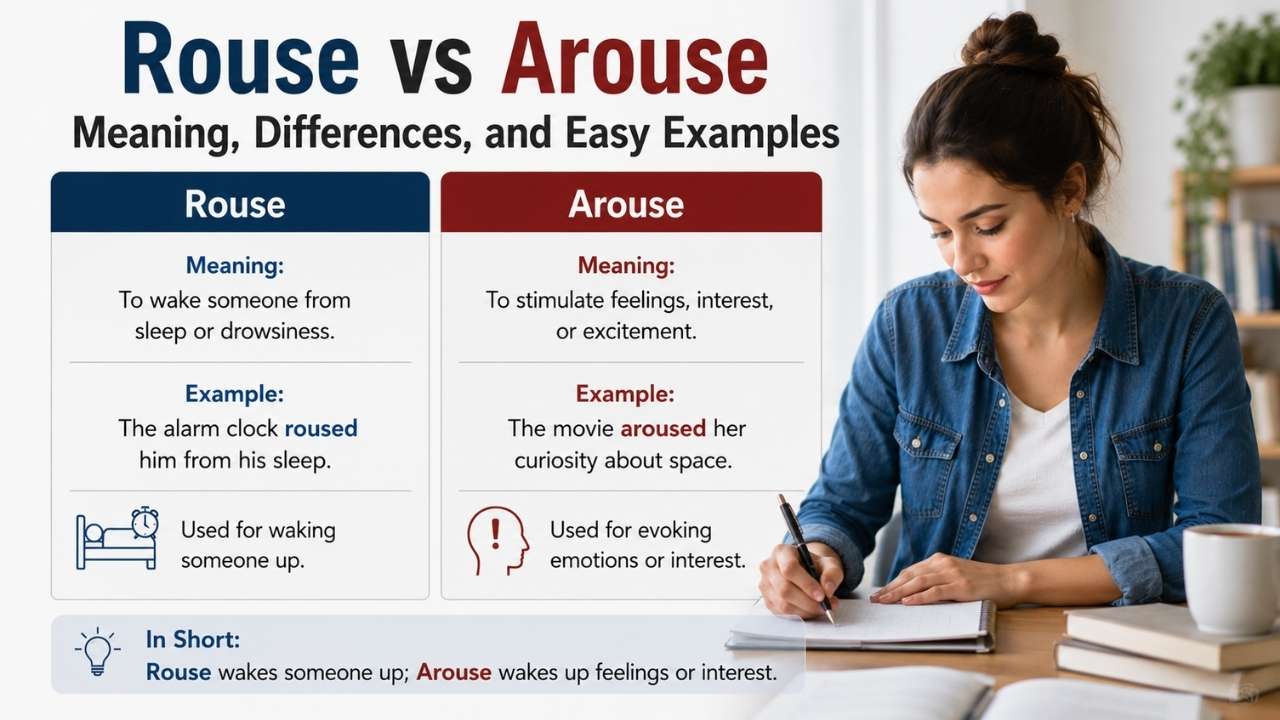
Many English learners get confused when they compare “rouse vs arouse” because both words look similar and sound almost the same. This often creates difficulty in understanding their correct usage in English grammar. However, their meanings are actually quite different when you look closely at real-life usage.
The word “rouse” usually means to wake someone up or make someone alert, especially from sleep or inactivity. On the other hand, “arouse” means to stimulate feelings, emotions, curiosity, or reactions. Because both words relate to “activation,” learners often mix them up in writing and speaking.
In this article, you will clearly learn the difference between rouse and arouse, their meanings, examples, and simple rules. We will also explore common mistakes, memory tricks, and real sentence usage to help you understand these confusing English verbs easily.
Quick Answer
The main difference between rouse and arouse is simple. Rouse means to wake someone up or make them active physically, while arouse means to create emotions, interest, or feelings in someone. For example, you can rouse someone from sleep, but you can arouse curiosity or suspicion in a person.
In short, rouse = physical activation, and arouse = emotional or mental stimulation. This is the fastest way to understand rouse vs arouse meaning in English grammar.
You cannot use them interchangeably because their verb usage differences depend on context. One deals with the body or alertness, and the other deals with the mind or feelings. This simple rule helps learners avoid confusion in writing and speaking.
Rouse vs Arouse
The easiest way to understand rouse vs arouse meaning is through a direct comparison. These two verbs look similar, but they function differently in English sentences. The confusion happens because both words describe a kind of “activation,” but the type of activation is not the same.
| Feature | Rouse | Arouse |
| Meaning | Wake up / make alert | Create emotion or reaction |
| Type | Physical action | Emotional or mental action |
| Example | Rouse someone from sleep | Arouse curiosity |
| Usage | Everyday situations | Formal/emotional contexts |
| Common idea | Wakefulness | Feelings or interest |
This table shows the difference between arouse and rouse clearly. You can use it as a quick reference when writing or learning English vocabulary differences. It also helps reduce confusion in English verb usage differences.
What Does “Rouse” Mean?
The word “rouse” means to wake someone up, activate them, or bring them out of inactivity. It often relates to physical movement or alertness. In simple terms, if someone is sleeping or inactive, you rouse them to make them active again.
For example, you can say, “The loud noise roused him from sleep.” This shows clear rouse meaning in English grammar. It is commonly used in situations where someone needs to become alert or responsive.
Common collocations of rouse include “rouse from sleep,” “rouse from bed,” and “rouse attention.” These phrases help learners understand real usage.
Unlike emotional verbs, rouse definition stays focused on physical or external actions. It does not usually describe feelings or emotional reactions, which makes it different from arouse meaning in English.
What Does “Arouse” Mean?
The word “arouse” means to create a feeling, emotion, reaction, or interest in someone. It is used when something affects the mind or emotions rather than the physical body. For example, a speech can arouse emotions, or a mystery can arouse curiosity.
In simple English, arouse meaning focuses on internal reactions. It is often used in more formal or written contexts. For instance, “The movie aroused interest among viewers” shows emotional engagement.
Common arouse collocations include “arouse curiosity,” “arouse suspicion,” and “arouse interest.” These expressions show how the word connects with emotional or mental states.
A key point in arouse vs rouse meaning is that arouse is not about waking someone physically. Instead, it deals with psychological or emotional responses, which makes it more abstract and expressive in English usage.
Key Difference Between Rouse and Arouse
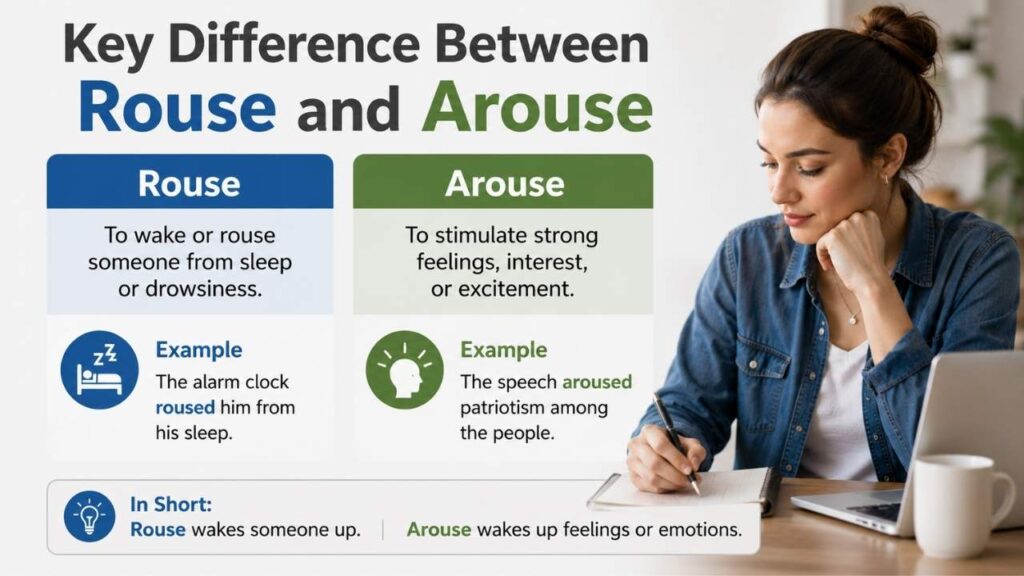
The main difference between rouse and arouse is based on the type of action each word describes. Rouse refers to physical awakening or alertness, while arouse refers to emotional or mental stimulation.
When you understand this rule, it becomes easy to solve confusion in grammar explanation arouse rouse topics. Think of rouse as something physical, like waking someone up in the morning. In contrast, think of arouse as something emotional, like creating curiosity or excitement.
Another important point is that rouse is more literal, while arouse is more abstract. This is why learners often struggle with word choice in English when using these verbs.
You cannot replace one with the other because their semantic difference rouse arouse is strong. Using them correctly improves clarity in both writing and speaking.
Easy Memory Trick
A simple way to remember rouse vs arouse difference is to use this easy trick:
Rouse = Rise (wake up physically)
Arouse = Affect (feel emotions or reactions)
This memory trick helps learners quickly recall the correct rouse and arouse difference during writing or exams. If you think of waking up, always use rouse. If you think of feelings, interest, or emotions, use arouse.
Many English learners confuse these words because of similar spelling and pronunciation. However, this trick simplifies confusing English verbs into an easy pattern.
For example:
- Loud sound can rouse someone from sleep.
- A story can arouse curiosity.
This simple association helps you avoid mistakes in English vocabulary differences and improves accuracy in real communication.
Can Rouse and Arouse Be Used Interchangeably?
No, rouse and arouse cannot be used interchangeably because they carry different meanings and grammatical roles. Even though both verbs describe a type of activation, they operate in completely different contexts.
The confusion often happens in English verb usage differences, but replacing one with the other can change the meaning or make the sentence incorrect. For example, saying “The alarm aroused him from sleep” sounds unnatural, because arouse is not used for physical waking.
Similarly, using rouse for emotions like curiosity or suspicion is usually incorrect in formal English. This is an important rule in understanding rouse vs arouse meaning.
So, always match the word with its correct context:
- Use rouse for physical alertness.
- Use arouse for emotional or mental reactions.
This clear rule improves accuracy in writing and prevents common grammar mistakes in English learning.
Common Mistakes Learners Make
Many learners confuse rouse vs arouse because both words look similar and relate to activation. One common mistake is using arouse for waking up, which is incorrect. Another mistake is using rouse for emotions, which does not fit proper English usage.
For example, saying “The noise aroused him from sleep” is wrong because arouse meaning in English grammar does not include physical waking. Similarly, “The story roused my curiosity” is less natural compared to “aroused my curiosity.”
Another issue is mixing them in English vocabulary differences tasks, especially in exams or writing assignments. This happens because learners focus on spelling instead of meaning.
To avoid these mistakes, always check context first. Ask yourself: Is it physical or emotional? This simple rule helps prevent confusion in rouse vs arouse meaning and improves correct sentence formation in English.
Rouse vs Arouse in Sentences
Understanding rouse vs arouse meaning becomes easier when you see real examples.
5 Examples of Rouse:
- The loud alarm roused him from deep sleep.
- The coach roused the team before the match.
- The noise roused the baby from bed.
- She tried to rouse him early in the morning.
- The speech roused the crowd to attention.
5 Examples of Arouse:
- The story aroused curiosity in the readers.
- The movie aroused emotions among the audience.
- His behavior aroused suspicion in the police.
- The idea aroused interest in investors.
- The speech aroused strong feelings in the crowd.
These examples clearly show the difference between rouse and arouse in real usage. They help learners understand how each verb behaves in English sentences and improve grammar accuracy in writing and speaking.
FAQs
What is the difference between rouse and arouse?
The main difference between rouse and arouse is based on meaning and usage. Rouse means to wake someone up or make them physically active, while arouse means to create emotions, feelings, or reactions. For example, you can rouse someone from sleep, but you can arouse curiosity or suspicion. In simple terms, rouse = physical awakening, and arouse = emotional stimulation. This clear distinction helps avoid confusion in English verb usage differences and improves correct sentence formation in both writing and speaking.
Can rouse and arouse be used interchangeably?
No, rouse and arouse cannot be used interchangeably because they have different meanings. If you replace one with the other, the sentence often becomes incorrect or unnatural. For example, “The alarm aroused him from sleep” is wrong because arouse meaning in English grammar does not include physical waking. Similarly, using rouse for emotions like curiosity or suspicion is not natural in formal English. Always use rouse for physical actions and arouse for emotional or mental reactions.
Does arouse only mean sexual feelings?
No, arouse does not only mean sexual feelings. Although it can sometimes be used in that context, its main meaning is to stimulate emotions, interest, or reactions. For example, a movie can arouse curiosity, a speech can arouse emotions, and a situation can arouse suspicion. In modern English usage, arouse meaning in English is much broader and depends on context. It is important not to limit the word to one meaning only.
Does rouse mean wake up?
Yes, rouse commonly means to wake someone up or make them alert. It is often used when someone is sleeping or inactive. For example, “The loud noise roused him from sleep” clearly shows this meaning. In rouse meaning in English grammar, the focus is on physical awakening or becoming active. It can also mean to bring someone to attention or action, especially in group or motivational contexts.
What is a simple memory trick to remember rouse vs arouse?
A very easy memory trick is: Rouse = Rise (wake up physically) and Arouse = Affect (feelings or emotions). This helps learners quickly understand rouse vs arouse difference without confusion. If the situation involves sleep, movement, or alertness, use rouse. If it involves curiosity, emotions, or reactions, use arouse. This simple method is widely used to avoid mistakes in English vocabulary differences.
Is rouse used in formal or informal English?
Rouse can be used in both formal and informal English, but it is more commonly found in written or descriptive contexts. It is often used in literature, news writing, and storytelling when describing physical awakening or alertness. In everyday speech, people may use simpler words like “wake up” instead. However, rouse meaning in English grammar remains standard and correct in both formal and informal usage.
What are common mistakes with rouse and arouse?
One common mistake is using arouse for waking someone up, which is incorrect. Another mistake is using rouse for emotional reactions like curiosity or suspicion. For example, saying “The story roused my curiosity” is less natural than “aroused my curiosity.” These errors happen because learners confuse English verb usage differences. Always check whether the meaning is physical or emotional before choosing the correct word.
Can arouse be used in academic writing?
Yes, arouse is commonly used in academic and formal writing, especially when describing emotions, reactions, or psychological responses. For example, researchers may say a topic arouses interest or arouses concern. In arouse meaning in English, the word fits well in analytical, scientific, and formal contexts. However, it should be used carefully because tone sensitivity matters in professional writing.
What are synonyms of rouse and arouse?
Some common synonyms of rouse include wake, stir, alert, and awaken. For arouse, synonyms include stimulate, excite, trigger, and provoke. However, these synonyms are not always interchangeable in every context. Understanding rouse vs arouse meaning helps you choose the correct synonym depending on whether the situation is physical or emotional.
Why do learners confuse rouse and arouse?
Learners often confuse rouse and arouse because both words are similar in spelling, pronunciation, and general idea of “activation.” In English vocabulary differences, this similarity creates misunderstanding, especially for ESL students. However, once you remember that rouse is physical and arouse is emotional, the confusion becomes much easier to solve.
Conclusion
The confusion between rouse vs arouse is very common, especially for English learners, because both words seem similar and both relate to the idea of “activation.” However, once you clearly understand their meanings, the difference becomes very simple.
Rouse is used when we talk about physical waking or making someone alert, such as waking someone from sleep or bringing attention to something. On the other hand, arouse is used when we talk about emotions, curiosity, interest, or psychological reactions. This is the key point in understanding rouse vs arouse meaning in English grammar.
Remember this simple rule:
- Rouse = physical action (wake up, alert)
- Arouse = emotional reaction (feelings, curiosity, suspicion)
Using this distinction correctly will help you avoid common mistakes in English verb usage differences and improve your writing clarity. With practice and examples, you can easily master both words and use them confidently in real communication.

Fahad is a seasoned English language trainer with a focus on IELTS and TEFL preparation.
He holds a Ph.D. in Applied Linguistics and has over 10 years of teaching experience.
Fahad is passionate about helping students achieve fluency and global opportunities.
His classes combine practical techniques with a supportive, student-first approach.