
Have you ever stopped mid-sentence and wondered — is it daddies or daddys? Or maybe you typed daddy’s and then second-guessed yourself, wondering if you used the apostrophe correctly?
You are not alone. This is one of those small but genuinely confusing grammar questions that trips up native speakers and English learners alike. The good news is that the answer is simple once you understand the rule behind it — and that rule applies to hundreds of other English words too.
This guide covers everything you need to know about the plural of daddy. You will learn the correct spelling, understand why it changes the way it does, know the difference between daddies and daddy’s, and find out how to use the word confidently in any context. By the end, you will never second-guess this word again.
Quick answer:
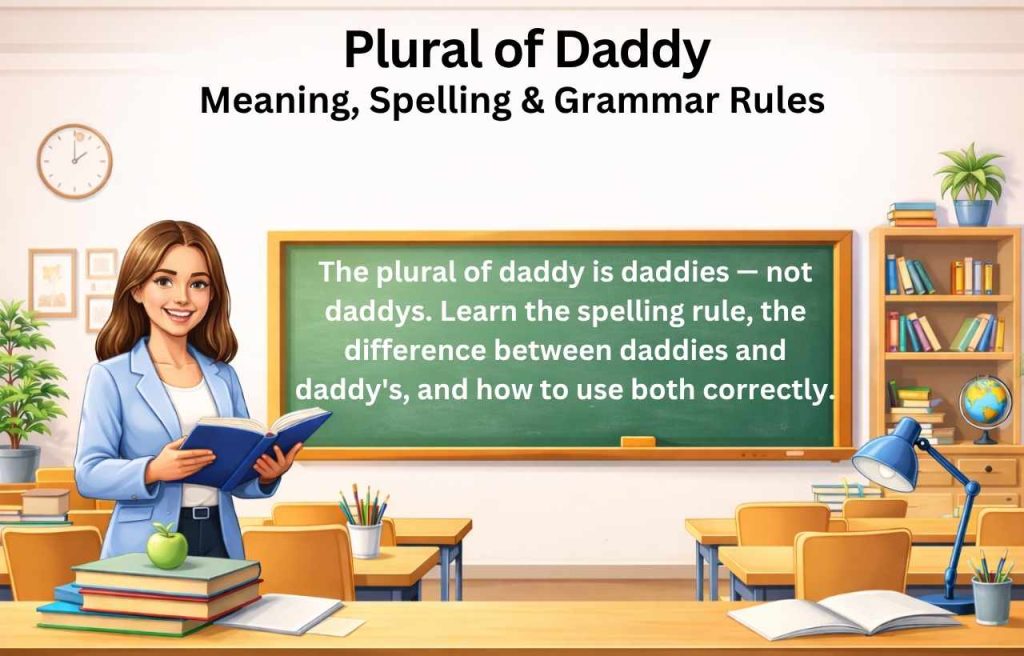
The plural of daddy is daddies. You change the y to i and add es. “Daddys” is always wrong, and “daddy’s” is the possessive form — not the plural.
What is the plural of daddy?
The plural of daddy is daddies.
When you want to talk about more than one father, you do not simply add an s to the end. You follow a standard English grammar rule that applies to all nouns ending in a consonant followed by y. That rule tells you to drop the y, add ies in its place, and you have your plural form.
So the transformation looks like this:
daddy → daddies
This is not an exception or an irregular form. It is a perfectly regular, rule-following plural that behaves exactly the way English grammar says it should. Once you understand the pattern, you will apply it automatically — not just to daddy, but to dozens of similar words.
Here are some example sentences that use the plural form correctly:
- The school invited all the daddies to the sports day event.
- Two daddies sat at the front of the classroom during the reading session.
- The children ran straight to their daddies after the performance ended.
- Several daddies formed a group at the park every Saturday morning.
In every one of those sentences, the word refers to more than one father. That is when you use daddies — not daddy, not daddys, and not daddy’s.
Why does the spelling change? The grammar rule explained
The reason daddy becomes daddies instead of daddys comes down to one straightforward English spelling rule.
When a noun ends in a consonant plus the letter y, you do not just add an s to make it plural. Instead, you change the y to an i and then add es. This rule exists because of how words sound when spoken aloud. Adding a plain s after the y would make the word harder to pronounce naturally. The y-to-ies change keeps the pronunciation smooth and consistent.
The word daddy ends in the consonant d followed by the letter y. That puts it squarely under this rule.
Here is the same pattern in action across other common words:
- baby → babies
- city → cities
- lady → ladies
- puppy → puppies
- story → stories
- party → parties
- country → countries
- cherry → cherries
Every single one of these follows the same rule as daddy. They all end in a consonant plus y, and they all become plural by changing the y to ies. This tells you that daddies is not a special case — it is a member of a very large and consistent family of English words.
The key rule to remember: consonant + y at the end of a noun → change y to ies in the plural.
Daddies vs daddys — which spelling is correct?
Daddies is correct. Daddys is always wrong.
This is the most common spelling mistake people make with this word. They know they need a plural, so they instinctively add an s at the end — the same way they would with most other English nouns. But that standard s rule does not apply to words ending in consonant plus y.
“Daddys” breaks the rule. No reputable dictionary, style guide, or grammar authority accepts it as a correct spelling. Merriam-Webster lists daddies as the plural. The Longman Dictionary of Contemporary English lists daddies as the plural. Wiktionary lists daddies as the plural. Every major reference source agrees.
If you use “daddys” in a piece of writing, spell-check will flag it. A grammar-conscious reader will notice it. In professional or academic writing, it will undermine your credibility. The fix is simple — use daddies every time you need the plural form.
A useful way to check yourself: if you can replace the word with “more than one father” and the sentence still makes sense, you need the plural — and the plural is always daddies.
Daddies vs daddy’s — understanding the apostrophe
This is where a lot of writers get confused, so let’s clear it up completely.
Daddies and daddy’s look almost the same, but they mean completely different things and serve completely different grammatical purposes.
Daddies is the plural. It means more than one daddy. There is no apostrophe, and no ownership is involved. You use it when you simply want to refer to multiple fathers.
- All the daddies gathered outside the school gates.
- The daddies on the team organised a charity match.
Daddy’s is the possessive form. The apostrophe and s together show that something belongs to one daddy. You use it when one father owns or is associated with something.
- This is my daddy’s jacket.
- She sat in daddy’s favourite chair.
- The children laughed at daddy’s jokes all evening.
The apostrophe always signals ownership — never a plural. This is one of the most fundamental rules in English punctuation. An apostrophe s never makes a word plural. It always shows that something belongs to something or someone.
Here is a quick way to tell them apart every time:
If you are talking about more than one father and nothing belongs to anyone, write daddies — no apostrophe.
If you are talking about something that belongs to one father, write daddy’s — apostrophe before the s.
There is also a third form worth knowing: daddies’ — with the apostrophe placed after the s. This is the possessive form of the plural. You use it when something belongs to multiple fathers collectively.
- The daddies’ group decided to plan a surprise party.
- All the daddies’ names appeared on the school register.
So to summarise all three forms clearly:
Daddy — one father, no ownership implied. Daddies — more than one father, no ownership. Daddy’s — something belongs to one father. Daddies’ — something belongs to multiple fathers.
What does daddy mean? Definition and history
Understanding the plural is easier when you understand the word itself.
Daddy is an informal, affectionate word for father. People use it most often in family settings — children use it when speaking to or about their fathers, and adults use it in warm or nostalgic contexts. The word carries a sense of closeness and emotional familiarity that the more formal word “father” does not always convey.
According to Merriam-Webster, daddy is a noun meaning father. Its first known use in English dates back to 1523, making it a word with more than five hundred years of history in the language. It belongs to the same family as dad, dada, papa, and pop — all informal variations that children naturally develop in early speech because these sounds are among the easiest for young children to produce.
The word daddy appears in several extended meanings beyond the literal sense of father:
As a reference to the best or most powerful example of something. In informal British and American English, people say “the daddy of all” to describe something that surpasses everything else in its category. For example: “That thunderstorm was the daddy of all storms.” This use treats the word as a mark of supreme authority or size.
As a term for a male lover or protector. In informal and slang usage — with origins in African American Vernacular English — the word has long carried a meaning related to a romantic partner or a man who provides support and protection. Related terms like sugar daddy and baby daddy come from this extended meaning.
As a slang term for a leader or dominant figure. In certain social contexts, including prison slang documented in the Wiktionary entry, a “daddy” refers to a person who holds power or authority within a group.
For most everyday writing, though, daddy simply means father — and daddies simply means fathers, in a warmer and more personal tone.
How to use daddies correctly in sentences
Now that you know the rule, here is how to use daddies confidently in different types of writing and conversation.
In family and everyday contexts, daddies works naturally in any sentence where you refer to multiple fathers. Children use it most naturally, but adults use it too — especially in parenting discussions, family storytelling, and informal writing.
- Three daddies volunteered to help with the school trip.
- The babies all smiled when their daddies walked through the door.
- The group chat was full of daddies sharing advice about sleep routines.
In writing about fatherhood and parenting, the word adds warmth and accessibility that “fathers” sometimes lacks. If you write parenting content, blog posts, or social media captions aimed at families, daddies fits naturally in an informal and friendly tone.
- Modern daddies take a much more active role in childcare than previous generations.
- Research shows that children benefit significantly when their daddies engage in regular play.
In professional and formal writing, you would generally replace daddies with fathers. Legal documents, academic papers, and official reports prefer the neutral term. However, in child psychology literature or educational material written from a child’s perspective, daddies appears appropriately and adds emotional relevance.
One grammatical point to watch: because daddies is a plural noun, it always takes a plural verb. Do not pair it with singular verbs.
Correct: The daddies were cheering from the sideline. Wrong: The daddies was cheering from the sideline.
Correct: Several daddies have signed up for the workshop. Wrong: Several daddies has signed up for the workshop.
Common mistakes to avoid
People make the same handful of mistakes with this word again and again. Knowing them in advance means you will not repeat them.
Writing “daddys” instead of “daddies.” This is the most common error. There is no version of standard English — British, American, Australian, or otherwise — where “daddys” is accepted as correct. Always write daddies.
Using “daddy’s” when you mean the plural. The apostrophe signals ownership, never number. If you mean more than one father and nothing belongs to anyone, drop the apostrophe and write daddies.
Using the plural with a singular verb. Daddies is plural, so it always needs a plural verb — were, have, are, do — not was, has, is, does.
Capitalising mid-sentence without reason. You capitalise Daddy when you use it as a name or title in place of a person’s actual name — for example, “Can I help you, Daddy?” or “I asked Daddy to call me.” But when you use it as a common noun with an article or possessive pronoun, you keep it lowercase — “her daddy,” “a daddy,” “the daddies.”
Daddies in other varieties of English
The spelling and grammar rules for daddies do not change between British English and American English. Both varieties follow the same consonant-plus-y rule, and both spell the plural daddies. There is no transatlantic disagreement here.
Where the two varieties differ slightly is in how often and how freely they use the word in adult speech. American English tends to accept daddies in a wider range of semi-formal and adult contexts. British English, which generally treats diminutive or childish terms more carefully in adult speech, tends to reserve the word more strictly for child-centred contexts or deliberate emotional expression.
Australian, Canadian, and other English varieties largely follow the American pattern, though regional attitudes toward informal family vocabulary vary by community and generation.
Regardless of where you write or speak, the spelling rule stays the same everywhere: the plural of daddy is daddies.
FAQs
Is it daddies or daddys?
It is always daddies. “Daddys” is a spelling error. English grammar requires nouns ending in a consonant plus y to form their plural by changing y to ies — so daddy becomes daddies.
Is daddy’s the plural of daddy?
No. Daddy’s is the possessive form, meaning something belongs to one daddy. The plural form is daddies, with no apostrophe.
How do you spell the plural of daddy?
You spell it d-a-d-d-i-e-s. The y in daddy changes to an i, and you add es.
When should I capitalise Daddy?
Capitalise it when you use it as a name or title in direct address — “Good morning, Daddy” or “I told Daddy about the trip.” Keep it lowercase when you use it as a general noun — “her daddy,” “two daddies,” “a daddy’s love.”
What is daddies’ with the apostrophe after the s?
That is the plural possessive form. It shows that something belongs to more than one daddy. For example: “The daddies’ cheers filled the stadium” — meaning the cheers came from multiple fathers.
Can I use daddies in formal writing?
In most formal writing, you would use “fathers” instead. However, in child psychology, early childhood education, and family-centred content, daddies appears appropriately and naturally.
Conclusion
The plural of daddy is daddies — full stop. You change the y to i and add es, following one of the most consistent and reliable rules in English grammar. “Daddys” does not exist in correct English, and “daddy’s” is a possessive form, not a plural.
This rule does not change based on whether you write in British English or American English. It does not change based on context, formality, or region. Every time you need to write about more than one daddy, the correct form is daddies — every single time.
The broader pattern behind this rule applies to baby, city, lady, puppy, party, story, and hundreds of other words. Once you understand it, you apply it automatically — and you will never misspell daddies again.

Fahad is a seasoned English language trainer with a focus on IELTS and TEFL preparation.
He holds a Ph.D. in Applied Linguistics and has over 10 years of teaching experience.
Fahad is passionate about helping students achieve fluency and global opportunities.
His classes combine practical techniques with a supportive, student-first approach.