

The words lead and led often confuse English learners because they look similar but work in different ways. Many people search for “lead vs led”, “difference between led and lead”, and “lead vs led meaning” because they are unsure which form to use in writing. This confusion usually happens because “lead” changes form depending on tense, which is a common feature of irregular verbs in English grammar.
In simple terms, lead is the present tense, while led is the past tense. When someone is currently guiding or directing a group, we use lead. When the action already happened, we use led. For example, “She leads the team” becomes “She led the team yesterday.” This article will explain the full grammar rules, usage, and examples of lead and led, so you can avoid common mistakes and write more confidently in English.
Quick Answer
Lead vs led is a common grammar confusion in English. Lead is the present tense verb meaning to guide or direct, while led is its past tense form. For example, she leads the team today, but she led it yesterday. The rule is simple: use lead for now, led for completed actions in the past.
What Does “Lead” Mean?
The word lead is a verb that means to guide, direct, or be in charge of something. It is used in the present tense, which means the action is happening now or happens regularly. Many learners search for “lead meaning”, “lead verb forms”, and “how to use lead” because it is commonly used in both speaking and writing.
For example, we say:
- She leads the class discussion.
- He leads the team at work.
- They lead projects every week.
In all these sentences, the action is happening in the present or is a regular habit. The base form is “lead,” and it also changes to “leads” in third-person singular. Understanding this helps avoid mistakes in grammar rules lead vs led, especially when switching between tenses in writing.
What Does “Led” Mean?
The word led is the past tense of lead, and it describes an action that already happened. Many people search “led meaning”, “lead past tense”, and “is it led or lead” because they are unsure when to switch forms.
We use led when the guiding or directing action is finished. For example:
- She led the team to victory.
- He led the meeting yesterday.
- They led the project successfully last year.
In each case, the action is complete, so we do not use “lead.” Instead, we use led as the correct past form of this irregular verb. This is important in both academic writing and daily communication because using the wrong tense can create common grammar mistakes with led and lead. Always remember: if the action already happened, use led, not lead.
Lead vs Led — Key Differences
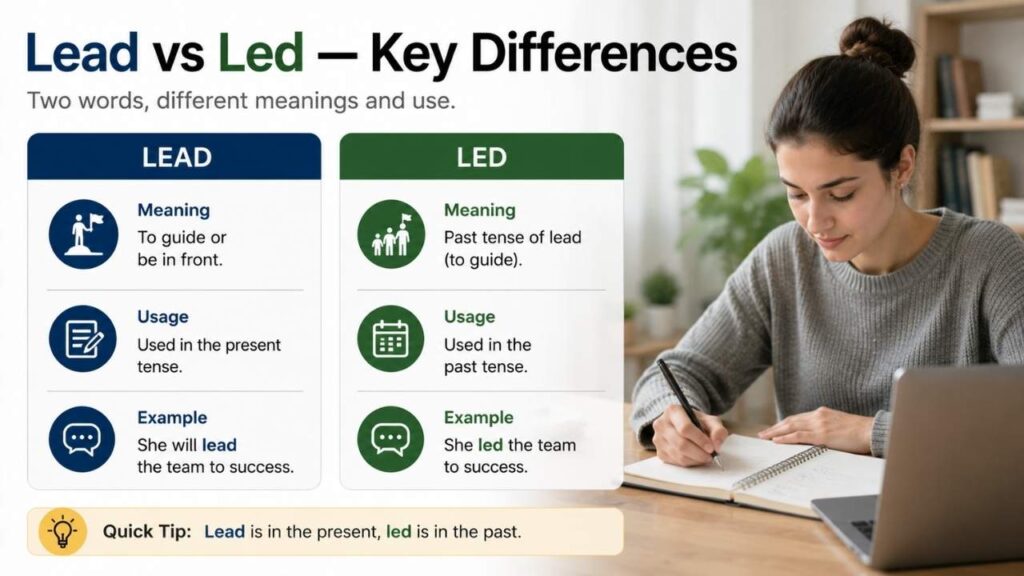
Understanding the difference between lead and led becomes much easier when we compare them side by side. Many learners search “lead vs led examples” or “lead vs led grammar” because visual comparison helps memory.
| Feature | Lead | Led |
| Tense | Present | Past |
| Meaning | To guide or direct | Guided or directed |
| Usage | Ongoing or regular action | Completed action |
| Example | She leads the team | She led the team yesterday |
The main rule is simple: lead = now, led = before. This is one of the most important English grammar rules for irregular verbs. When writing essays or professional content, using the correct form improves clarity and prevents confusion. This table also helps answer many People Also Ask questions like “what is the difference between lead and led” and “how do you use led in a sentence.”
How to Use Lead and Led in Sentences
To use lead and led correctly in writing, you must first understand the time of the action. Many learners search “how to use lead and led” or “when to use lead or led in writing” because tense confusion is very common.
Use lead when the action is happening now:
- She leads a marketing team.
- They lead daily meetings.
- He leads by example.
Use led when the action already happened:
- She led a marketing team last year.
- They led the discussion yesterday.
- He led the project successfully.
This simple rule helps you avoid tense inconsistency in writing, which is a common ESL mistake. Always check the time reference in your sentence before choosing the correct form. This habit improves both academic and professional writing quality.
Common Mistakes with Lead vs Led
Many writers make common mistakes with led and lead because they forget the time context of the sentence. One frequent error is using “lead” instead of “led” when talking about the past. For example, writing “She lead the team yesterday” is incorrect.
Another mistake is mixing tenses in the same paragraph, which creates grammar confusion in English writing. ESL learners often struggle with this because irregular verbs do not follow a simple pattern.
To avoid these errors:
- Always check if the action is past or present.
- Remember: led = finished action.
- Practice with simple sentences daily.
Learning lead vs led grammar rules becomes easier with repetition. Once you understand the pattern, you will avoid most writing mistakes and improve clarity in essays, emails, and professional documents.
Easy Trick to Remember Lead vs Led
A simple way to remember the difference between lead and led is to use a memory trick. Many learners search for “easy way to remember lead vs led” because grammar rules can feel confusing at first.
Think of it like this: LED is already “done.” Just like an LED light is a finished product, the word led shows a completed action in the past. On the other hand, lead is ongoing and active.
Another trick is to link it with time:
- Lead = Now
- Led = Last time
These simple memory tools help you quickly choose the correct form without thinking too much. This method is especially useful for ESL learners and beginners in English grammar, because it reduces confusion and builds writing confidence over time.
Is “Led” Always the Past Tense of Lead?
Yes, led is always the past tense of lead, and this is one of the most important English irregular verb rules. Many learners search “is led always the past tense of lead” or “can lead be used in past tense” because they are unsure about exceptions.
In standard English grammar, there is no exception where “led” changes meaning. It always represents a completed action in the past. For example:
- She led the team (past action).
- He led the discussion (finished event).
The verb lead is irregular, meaning it does not follow the usual “-ed” rule for past tense. Instead of “leaded,” it changes to led. Understanding this rule is essential for correct verb tense usage in English writing, especially in academic and professional contexts.
Why English Has Irregular Verb Forms
English has irregular verbs like lead → led because the language evolved over time from older forms of English. Many learners search “why is lead spelled led in past tense” because it does not follow normal grammar patterns.
In regular verbs, we simply add “-ed” to form the past tense. However, irregular verbs changed differently due to historical language development and usage patterns. Over time, common verbs like lead became simplified into shorter forms like led.
This irregular structure is why English learners often find grammar confusing. However, once you learn common irregular verbs, patterns become easier to recognize. Understanding this background helps improve grammar awareness and writing accuracy, especially when dealing with verbs in different tenses.
Quick Summary Table
To quickly revise the difference between lead and led, here is a simple summary:
- Lead = present tense (happening now)
- Led = past tense (already happened)
- Both belong to the same verb but change based on time
- “Led” is the correct past form of “lead”
This simple rule helps answer most questions like “lead vs led difference”, “what is the past tense of lead”, and “how to use led correctly”. Always check the time of action before choosing the correct form.
FAQs
What is the difference between lead and led?
Lead is present tense, while led is the past tense of the same verb.
Is it correct to say lead or led?
Both are correct, but lead is used for present actions and led for past actions.
What is the past tense of lead?
The past tense of lead is led.
Can lead be used in past tense?
No, in past tense you must use led, not lead.
Why is led not spelled leaded?
Because lead is an irregular verb in English grammar.
How do you use led in a sentence?
Example: She led the team to victory last year.
Is led a word in English?
Yes, led is a valid English word and past tense of lead.
What does lead mean in grammar?
Lead means to guide, direct, or be in charge in present tense.
What are examples of lead vs led?
She leads meetings today. She led meetings yesterday.
Why do people confuse lead and led?
Because both words look similar but represent different tenses.
Conclusion
The difference between lead and led is simple once you understand the tense rule. Lead always refers to the present or ongoing action, while led shows a completed action in the past. This small change in spelling carries an important grammar difference in English writing.
By remembering this rule, you can avoid common mistakes in essays, emails, and daily communication. Always check the time of action before choosing the correct form. With practice, using lead vs led correctly becomes natural and helps you write more clearly and confidently.

Fahad is a seasoned English language trainer with a focus on IELTS and TEFL preparation.
He holds a Ph.D. in Applied Linguistics and has over 10 years of teaching experience.
Fahad is passionate about helping students achieve fluency and global opportunities.
His classes combine practical techniques with a supportive, student-first approach.