
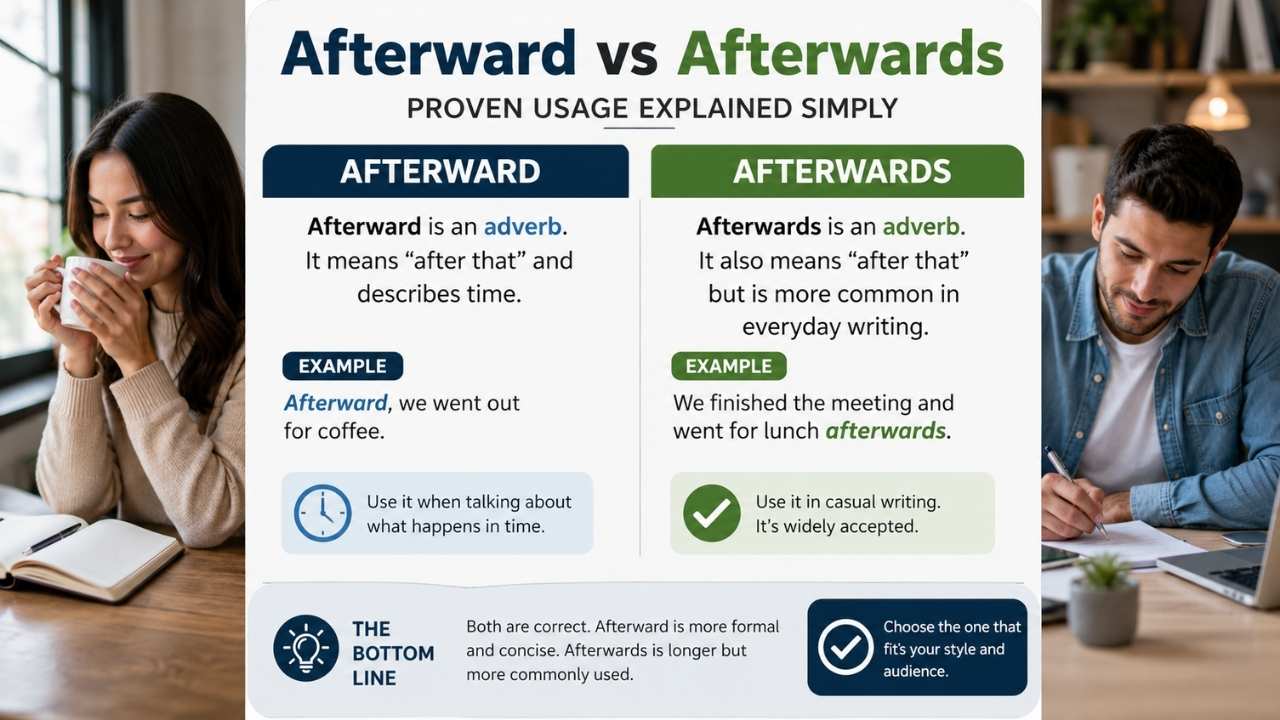
Many writers get confused about afterward vs afterwards, but the truth is simple. Both words have the same meaning: they describe something that happens later in time or after an event. So, in terms of grammar and meaning, there is no real difference between afterward and afterwards.
The main difference comes from English usage rules. Afterward is more commonly used in American English, while afterwards is preferred in British English. This is a case of regional spelling variation, not correctness.
In most situations, you can use either word without changing the meaning of your sentence. For example, both “We went home afterward” and “We went home afterwards” are correct. The choice depends on your writing style, audience, and consistency in English usage.
Quick Answer
The difference between afterward vs afterwards is very small. Both words mean “later” or “after something happens” and follow the same grammar rules. The only difference is usage: afterward is more common in American English, while afterwards is preferred in British English. Both are correct, so the choice depends on your writing style and audience.
Afterward vs Afterwards Comparison Table
The difference between afterward vs afterwards is mostly about usage style, not meaning. Both words function as adverbs of time and describe something that happens later.
| Feature | Afterward | Afterwards |
| Meaning | Later in time | Later in time |
| Grammar role | Adverb | Adverb |
| US usage | More common | Less common |
| UK usage | Less common | More common |
| Correctness | Correct | Correct |
| Formality | Neutral | Neutral |
As you can see, both words are fully correct in English grammar rules. The choice depends on British vs American English usage, not on correctness. Writers should focus on consistency in style, especially in academic or professional writing.
Why Are There Two Versions of the Same Word?
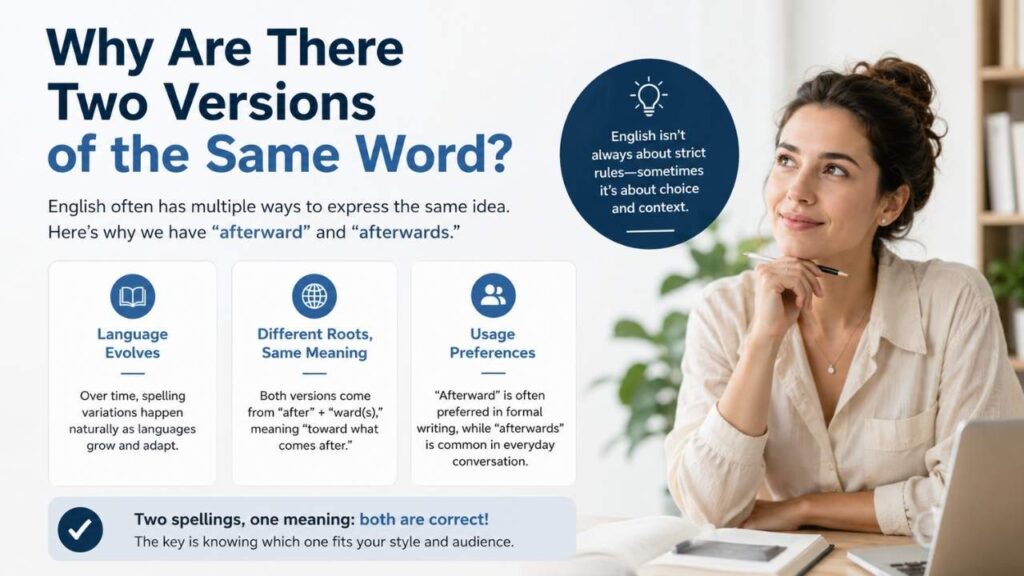
The reason we have afterward vs afterwards comes from the history of English language development. In older English, many adverbs ended in “-ward” or “-wards”, and both forms were accepted.
Over time, American English started to prefer shorter forms like afterward, while British English kept the older style like afterwards. This is part of a larger pattern of regional English differences, such as toward/towards and forward/forwards.
Both forms are still correct today because English does not remove older versions when new ones appear. Instead, it allows both to exist.
So, the difference is not about grammar rules. It is about language evolution and regional preference, not correctness or meaning.
Is One More Correct Than the Other?
Many learners ask if afterward vs afterwards has a “correct” version. The simple answer is no. Both words are grammatically correct and accepted in modern English.
Neither form is more formal or more professional. They are both used in writing, speaking, academic work, and everyday communication.
The only important rule is consistency. If you start using afterward in an article, you should continue using it throughout. Mixing both forms in the same text can look unorganized.
Style guides like British and American English standards focus more on audience than correctness. So, the choice depends on who you are writing for, not grammar rules.
In short, both words are equal in meaning. The difference is only about regional writing style, not correctness.
Usage in Sentences
Understanding afterward vs afterwards usage becomes easy when you see real examples. Both words work the same way as adverbs of time, meaning something happens later.
Afterward (American English examples):
- We went for coffee afterward.
- She called me afterward to explain everything.
Afterwards (British English examples):
- We went shopping afterwards.
- He felt better afterwards.
You can also use both in similar positions in a sentence. The meaning never changes.
In modern English grammar usage, both forms are acceptable in writing and speaking. The choice depends on your audience and style guide.
These examples show that afterward and afterwards meaning is always the same. Only the spelling changes based on regional English preferences, not grammar rules or sentence structure.
Common Mistakes Writers Make
When using afterward vs afterwards, many writers make simple mistakes that affect clarity. The most common mistake is thinking that one form is wrong. In reality, both are correct in English grammar rules.
Another mistake is mixing both forms in the same article. For example, using afterward in one paragraph and afterwards in another can break writing consistency. This is especially important in academic writing and SEO content.
Some writers also try to change the meaning, but both words always mean “later in time.” There is no hidden difference.
To avoid mistakes, choose one form based on your audience—American English or British English—and stick with it throughout your content. This improves readability and keeps your writing clean and professional.
Afterward vs Afterwards in Academic Writing
In academic writing, the choice between afterward vs afterwards depends on style guidelines, not grammar rules. Both forms are acceptable because they share the same meaning: “later in time.”
Most universities focus on consistency in writing style. If you are following American English, you should use afterward. If you are following British English, use afterwards. Mixing both forms in one paper is not recommended.
Style guides like APA or MLA do not treat one form as better than the other. Instead, they expect writers to follow a single regional style.
So, in essays, research papers, or formal writing, the key rule is simple: choose one version and stay consistent. This helps maintain clear and professional academic grammar usage.
British vs American English Rules for Adverbs
The difference between afterward vs afterwards is part of a larger pattern in British vs American English usage. Many English adverbs have two accepted forms depending on region.
For example, words ending in “-ward” and “-wards” often follow the same rule. American English prefers shorter forms like afterward, while British English prefers forms with “-s” like afterwards.
Other examples include:
- Toward / Towards
- Forward / Forwards
- Backward / Backwards
These are all regional spelling variations, not grammar errors. Both versions are correct in modern English.
When writing, the most important rule is to stay consistent with one style. This ensures clear English grammar usage and avoids confusion for readers.
When Should You Use “Afterward” Instead of “Afterwards”?
Choosing between afterward vs afterwards depends on your audience and writing style. If you are writing for an American audience, afterward is usually preferred. If your readers are British or follow UK English, afterwards is more common.
In SEO writing, consistency is very important. Search engines do not treat one form as better, but they do prefer clear and consistent language within a page.
You should also consider the type of content. In formal or academic writing, follow the required style guide. In casual writing, either form is fine as long as you stay consistent.
So, the rule is simple: match your audience, keep your style consistent, and both forms will work correctly in any sentence.
FAQ
What is the difference between afterward vs afterwards?
oth mean “later,” but afterward is mainly American English and afterwards is British English.
Is afterward correct English?
Yes, afterward is fully correct and widely used in American English writing.
Is afterwards correct English?
Yes, afterwards is also correct and commonly used in British English.
Are afterward and afterwards interchangeable?
Yes, both words are interchangeable because they have the same meaning.
Which is more common: afterward or afterwards?
It depends on region. Americans prefer afterward, while British English prefers afterwards.
Can I use afterwards in American English?
Yes, but it is less common. It is still grammatically correct.
Is one more formal than the other?
No, neither is more formal. Both are neutral in tone.
How do I choose between afterward and afterwards?
Choose based on your audience and stay consistent in your writing style.
Do they change the meaning of a sentence?
No, both always mean “later in time” with no change in meaning.
Why are there two spellings?
They exist due to British vs American English spelling differences in adverb forms.
Conclusion
The difference between afterward vs afterwards is simple and mainly based on regional English usage. Both words mean “later in time” and follow the same grammar rules, so neither is more correct than the other.
The key distinction is style: afterward is commonly used in American English, while afterwards is preferred in British English. In all cases, both forms are accepted in modern writing, including academic and professional content.
The most important rule is consistency. Once you choose one form, use it throughout your writing to keep it clear and professional. In short, both are correct, both are interchangeable, and your choice depends only on your audience and writing style.

Fahad is a seasoned English language trainer with a focus on IELTS and TEFL preparation.
He holds a Ph.D. in Applied Linguistics and has over 10 years of teaching experience.
Fahad is passionate about helping students achieve fluency and global opportunities.
His classes combine practical techniques with a supportive, student-first approach.