

Few adjectives start with Y, since it sits among the least-used letters to begin an English word. That scarcity is exactly what makes the ones that exist so useful — from everyday words like youthful and yummy to sharper, more literary choices like yare and yeasty.
This guide covers real, dictionary-verified Y adjectives only — organized by tone (positive, negative, descriptive) and by how they describe people — with clear meanings, correct example sentences, and guidance on when each word actually fits.
Quick Answer
Adjectives that start with Y are uncommon but genuinely useful. Youthful means full of youthful energy, yielding means flexible or compliant, yare means quick and ready, and yellow-bellied means cowardly. Because so few adjectives start with Y, most either describe age, distance, sound, or personality, and a handful — like yobbish and yare — carry a distinctly literary or British feel rather than everyday American usage.
TL;DR
- Youthful and young-at-heart describe energy and a youthful spirit.
- Yellow-bellied means cowardly; yobbish means rude or loutish (British).
- Yare means quick, agile, and ready — mostly literary or nautical today.
- Yielding describes flexibility; it can be a compliment or a criticism depending on context.
- Yummy and yucky are informal, everyday words about taste or unpleasantness.
- Several word lists online include invented or non-dictionary “Y adjectives” — this guide sticks to real, verifiable ones.
What Are Adjectives That Start With Y?
Adjectives that start with Y describe people, things, sounds, distances, or qualities using words beginning with that letter. Like any adjective, they can appear before a noun, as in a yielding branch, or after a linking verb, as in the schooner was yare.
English simply has far fewer words that begin with Y than with almost any other letter, so this list stays short compared to letters like M or L. Many surviving Y adjectives are also archaic, informal, or regional rather than standard modern American usage, which is worth knowing before you use one in formal writing.
Why Y Is a Rare Starting Letter
Y rarely opens native English words because it more often functions as a consonant-vowel hybrid inside or at the end of words — think happy or yes — rather than as a common word-starting sound. Many Y-initial adjectives that do exist are archaic (yare, yon), informal (yucky, yummy), or regional (yobbish, chiefly British).
Positive Adjectives That Start With Y
Positive Y adjectives tend to describe energy, flexibility, or genuine enthusiasm, and several genuinely earn a place in everyday writing rather than just filling out a list. Youthful and young-at-heart are the most common of the group in everyday American English, while yare and yeomanly lean more literary, often showing up in fiction or formal writing rather than casual conversation.
A few of these words carry double meanings depending on tone. Yielding, for instance, can sound admirable (“a yielding, cooperative teammate”) or slightly critical (“too yielding to set boundaries”) — context decides which reading applies. Merriam-Webster traces yare back to Old English, where it simply meant “ready” — a sense the word has kept for more than a thousand years.
| Adjective | Meaning | Example |
| Youthful | Full of youthful energy and freshness | Her youthful enthusiasm made the whole team work harder. |
| Young-at-heart | Maintaining a youthful spirit regardless of age | My grandfather stayed young-at-heart well into his eighties. |
| Yare | Quick, agile, and ready for action (archaic/nautical) | The small boat proved yare in the narrow channel. |
| Yielding | Flexible, cooperative, or willing to compromise | His yielding attitude made negotiations far easier. |
| Yeomanly | Sturdy, dependable, and hardworking | The crew performed yeomanly service during the storm. |
| Yummy | Tasty or highly pleasing (informal) | The bakery’s cinnamon rolls were absolutely yummy. |
Recommended for you: Adjectives That Start With X
Negative Adjectives Starting With Y
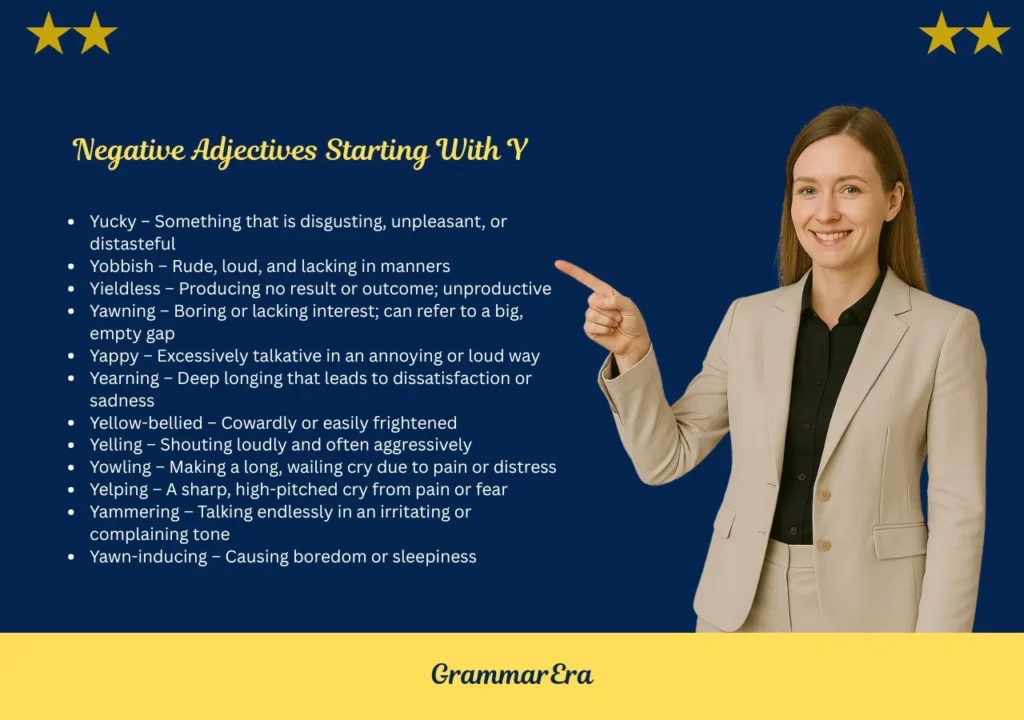
Negative Y adjectives mostly describe cowardice, rudeness, boredom, or unpleasant sound. Yellow-bellied is the most recognized of these — Merriam-Webster defines it simply as “not having courage: cowardly,” and labels it informal and old-fashioned, a tone that has stuck to the word since it first appeared in American slang.
Yobbish belongs mainly to British English, describing loutish or badly-behaved conduct — Collins English Dictionary confirms it as chiefly British slang for someone who behaves in a noisy, rude, and sometimes aggressive way in public. Words like yappy and yowling describe irritating or mournful sounds rather than personality traits directly, so they suit descriptions of animals or noise more than people.
| Adjective | Meaning | Example |
| Yellow-bellied | Cowardly, lacking courage (informal) | He was too yellow-bellied to admit his mistake. |
| Yobbish | Rude, loutish, badly behaved (chiefly British) | The referee ejected two fans for yobbish behavior. |
| Yappy | Noisy and prone to constant, high-pitched barking or talking | The yappy terrier barked at every passerby. |
| Yawning | Gaping wide open; suggesting boredom or emptiness | A yawning gap opened between the two proposals. |
| Yucky | Disgusting or distasteful (informal) | The leftover soup smelled genuinely yucky. |
| Yowling | Making a long, mournful, wailing cry | The cat kept yowling outside the back door all night. |
Descriptive and Neutral Adjectives That Start With Y
Not every Y adjective carries emotional weight. Several simply describe color, time, distance, or origin — the kind of practical, neutral words you’d use in ordinary description rather than personality writing. These words show up constantly in everyday American English, even though nobody thinks of them as unusual just because they start with Y.
Yeasty is worth a special note: dictionaries list it with two different senses — literally resembling yeast or fermentation, and figuratively lively or turbulent — so its tone depends entirely on context. Yearly and year-round, meanwhile, function almost like calendar vocabulary — useful in scheduling, business writing, and everyday planning far more often than in creative description.
| Adjective | Meaning | Example |
| Yellow | The color between green and orange; also informal for cowardly | She painted the nursery a soft yellow. |
| Yellowish | Somewhat yellow in color | The old photograph had turned yellowish with age. |
| Yearly | Happening once a year | The company holds a yearly review every January. |
| Year-round | Available or ongoing throughout the entire year | The pool stays open on a year-round schedule. |
| Yonder | Distant, over there (archaic/poetic) | The old carol asks, “Yonder peasant, who is he?” |
| Yeasty | Resembling yeast, or figuratively lively and turbulent | The bread had a yeasty smell fresh from the oven. |
Y Adjectives to Describe a Person’s Character
When you need a Y adjective specifically for personality, a smaller, more reliable set applies. These words work well in character descriptions, reviews, or creative writing, precisely because each one has a clear, verifiable meaning rather than a vague or invented one. Choosing correctly here matters more than in most categories, since a character adjective often carries a clear judgment about someone’s behavior.
Someone youthful brings energy; someone yielding compromises easily; someone yare reacts quickly under pressure. On the critical side, yellow-bellied signals cowardice and yobbish signals poor manners — both strong words best reserved for situations where that judgment is intentional.
| Adjective | Meaning | Example |
| Youthful | Energetic, fresh, optimistic in outlook | Despite his age, his youthful curiosity never faded. |
| Yielding | Cooperative and easy to work with | She’s a yielding mediator, always looking for common ground. |
| Yare | Quick-witted and ready to respond | His yare replies made him a formidable debater. |
| Yeomanly | Dependable and hardworking without complaint | She did yeomanly work organizing the entire event alone. |
| Yellow-bellied | Cowardly, unwilling to face difficulty | He felt yellow-bellied for avoiding the tough conversation. |
| Yobbish | Rude and poorly mannered | His yobbish comments embarrassed the entire table. |
How to Use Y Adjectives Correctly in a Sentence
Most Y adjectives follow completely normal adjective placement — before the noun or after a linking verb. The real risk isn’t grammar; it’s reaching for an unfamiliar or invented-sounding word when a plainer one would communicate more clearly.
Correct Examples
- “The team showed yeomanly effort during the final stretch of the project.”
- “Her yielding nature made her easy to negotiate with.”
- “That was a genuinely yucky smell coming from the fridge.”
Common Mistakes
The biggest mistake is treating any word that merely starts with Y as a legitimate adjective. Many “Y adjective” lists online include invented compounds — like turning a hobby or noun into an adjective on the spot — that don’t appear in any dictionary. If a word doesn’t show up in Merriam-Webster, Cambridge, or Collins, treat it as informal wordplay rather than standard English.
A second common mistake is using regional words like yobbish in American writing without knowing it reads as distinctly British — it will sound noticeably out of place in casual U.S. conversation.
Formal vs. Informal Y Adjectives
Formal or literary Y adjectives include yare, yeomanly, and yonder — words that fit fiction, poetry, or elevated writing but sound unusual in a text message or casual email. Reaching for one of these in a business report can work well when you want a slightly elevated, old-fashioned tone on purpose.
Informal Y adjectives include yummy, yucky, and yappy — everyday, conversational words you’d use with friends or in casual writing, but generally not in a business report or academic paper. Swapping in delicious, unpleasant, or noisy instead usually reads as more professional without losing the original meaning.
British vs. American Usage of Y Adjectives
Grammar doesn’t change between the two varieties, but frequency does. Yobbish is common in British English and largely absent from everyday American speech, while words like yummy, yucky, and youthful work naturally in both varieties without any adjustment, since none of the three carries any specifically regional flavor.
American writers generally favor plainer alternatives — cowardly over yellow-bellied, rude over yobbish — reserving the rarer Y adjective for moments when its specific flavor or informality genuinely serves the sentence. Recognizing which words carry a British accent, even in writing, helps you avoid sounding unintentionally out of place to an American audience.
FAQs
What are some real adjectives that start with Y?
Genuine, dictionary-verified examples include youthful, yielding, yare, yellow-bellied, yobbish, yummy, and yonder.
Is Y a common starting letter for adjectives?
No. Y is one of the least common starting letters in English, so the pool of genuine Y adjectives stays small compared to almost any other letter.
What does yellow-bellied mean?
Yellow-bellied means cowardly or lacking courage. Merriam-Webster labels it informal and old-fashioned, typically used as a colorful insult rather than neutral description.
What does yare mean?
Yare means quick, agile, and ready for action. It’s an older word, most often seen today in nautical or literary writing rather than everyday conversation.
Is yobbish an American word?
Not really. Yobbish belongs chiefly to British English, describing rude or loutish behavior, and will sound noticeably foreign in standard American writing.
Can I use yummy and yucky in formal writing?
Generally no. Both are informal, conversational words — fine for casual writing or speech, but better replaced with words like delicious or unpleasant in formal contexts.
Test Your Understanding
1. What does “yellow-bellied” mean?
A. Full of energy
B. Cowardly
C. Talkative
D. Distant
2. Which adjective means “quick, agile, and ready for action”?
A. Yucky
B. Yare
C. Yielding
D. Yearly
3. Which word is chiefly British rather than American?
A. Youthful
B. Yummy
C. Yobbish
D. Yellow
4. “Yeasty” can mean which of the following?
A. Only a smell related to bread
B. Cowardly
C. Resembling yeast, or figuratively lively/turbulent
D. Distant or far away
5. Why are there so few adjectives that start with Y?
A. Y is a recently invented letter
B. Y rarely opens native English words
C. Dictionaries exclude Y words
D. Y adjectives were banned in the 1800s
Answer Key:
1. B — Yellow-bellied means cowardly.
2. B — Yare means quick, agile, and ready.
3. C — Yobbish is chiefly British English.
4. C — Yeasty carries both a literal and figurative sense.
5. B — Y rarely functions as a native word-starting sound in English.
Conclusion
Genuine adjectives that start with Y form a small but real group — from everyday words like youthful and yummy to sharper, more literary choices like yare and yeomanly. Each one carries a specific, verifiable meaning rather than existing purely to fill out a list.
When you reach for one of these words, match the tone to your writing: keep yummy and yucky casual, save yare and yeomanly for more literary moments, and use yellow-bellied or yobbish only when that sharper judgment is genuinely what you mean. Precision, not novelty, is what makes any of these words actually work in a sentence.
Related Grammar and Language Guides
Adjectives Start With X: Meanings and Examples
Adjectives Start With K: Meaning, Use, and Examples
Adjectives Start with M: Meanings, Examples, and Uses
Adjectives Start with L: Boost Your Vocabulary

Fahad is a seasoned English language trainer with a focus on IELTS and TEFL preparation.
He holds a Ph.D. in Applied Linguistics and has over 10 years of teaching experience.
Fahad is passionate about helping students achieve fluency and global opportunities.
His classes combine practical techniques with a supportive, student-first approach.