
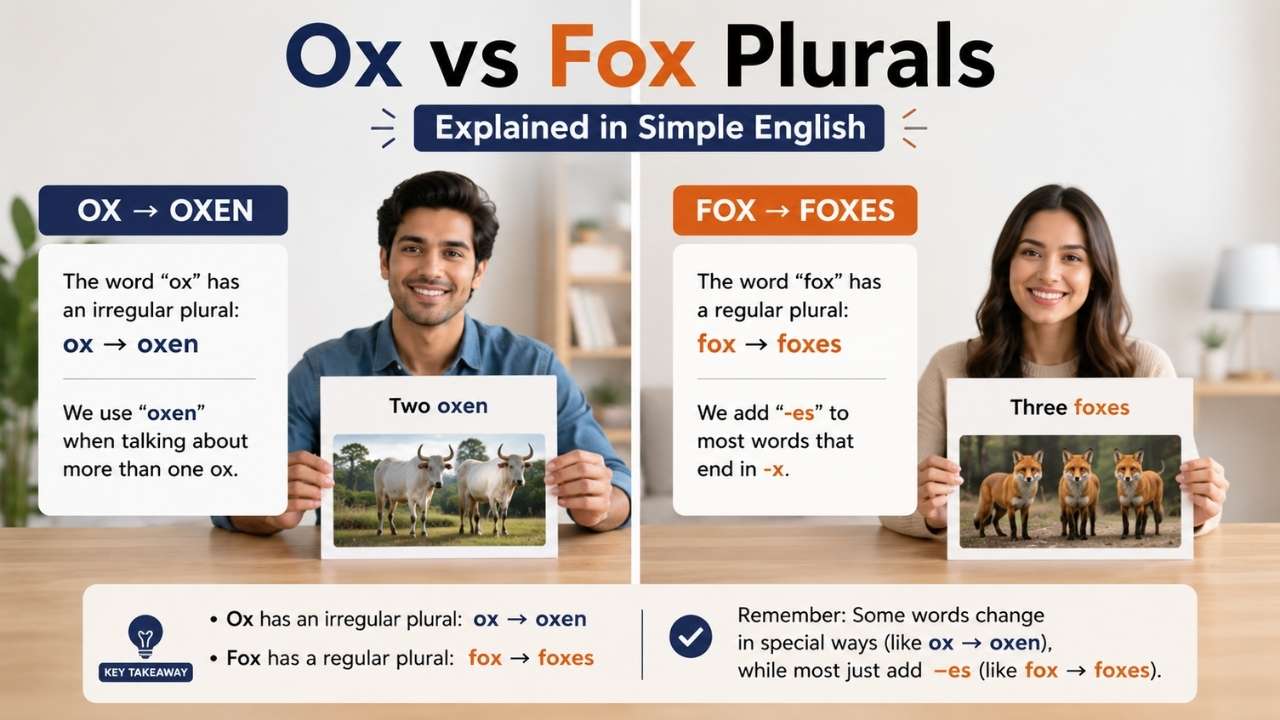
Many English learners get confused when they see words like ox and fox change in the plural form. You might expect both to follow the same rule, but English does not always behave in a simple way. That is why questions like “why is the plural of ox oxen but the plural of fox foxes?” often appear in grammar discussions and searches.
In this article, we will clearly explain the plural of ox and fox, and why they follow different patterns. We will also explore the idea of irregular plural nouns, and how English grammar rules have changed over time.
By the end, you will understand the difference between Ox vs Fox Plurals, and why one word follows an old form while the other follows a modern rule.
Quick Answer
The plural of ox is oxen, and the plural of fox is foxes. This difference happens because oxen is an old irregular plural noun from Old English, while foxes follows a modern rule where we add “-es” to words ending in x. So, oxen vs foxes reflects historical change in English grammar.
Why “Ox” Becomes “Oxen”
The word ox becomes oxen because it comes from Old English, where plural forms were very different from today. In the past, many nouns used special endings like “-en” instead of just adding “s” or “es.” That is why we still say oxen today.
This is a classic example of an irregular plural noun, and it is often used in explanations about irregular plural nouns in English and Old English plural forms.
Over time, English became simpler, but some old words stayed the same. That is why we do not say “oxes.” Instead, we keep the historical form oxen, even though it does not follow modern grammar rules.
Why “Fox” Becomes “Foxes”
The plural of fox is foxes because it follows a normal English grammar rule. In modern English, when a word ends in x, we usually add “-es” to make it plural. That is why we say foxes, not “foxen.”
This rule is part of English plural rules, which also apply to words like box → boxes and bus → buses. It makes pronunciation easier and more natural.
Unlike ox, the word fox did not keep an old historical form. Instead, it moved into the modern system of regular plural nouns. That is why the plural of fox is simple and follows the standard rule used in everyday English writing and speaking.
Key Difference Between Ox and Fox
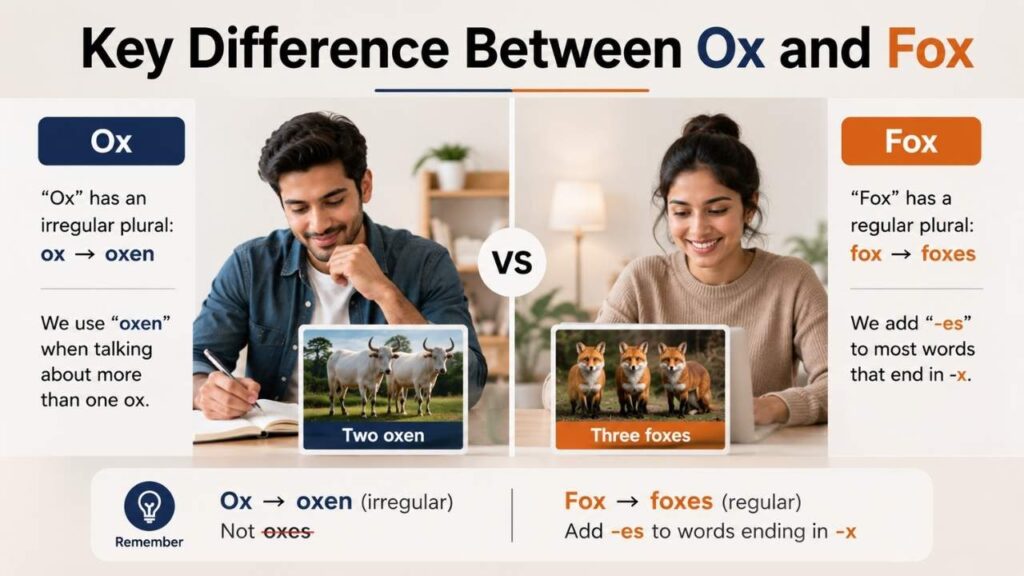
The main difference between ox and fox plural forms is how English grammar treats them. One follows an old rule, and the other follows a modern rule. This is why learners often search for oxen vs foxes explanation or why fox doesn’t become foxen.
| Word | Singular | Plural | Rule Type |
| Ox | ox | oxen | irregular (Old English form) |
| Fox | fox | foxes | regular modern rule |
So, oxen comes from historical English, while foxes follows today’s standard English plural rules. This simple comparison helps understand why both words behave differently even though they look similar.
Why English Has Two Different Plural Systems
English has two different plural systems because it is a mix of old languages. Over time, English changed a lot and borrowed rules from different sources. This is why we see both regular plurals like foxes and irregular plurals like oxen.
Old English used endings like “-en”, which is why words such as oxen still exist. Later, English became more simple and started using “-s” or “-es” for most words. That is why modern words follow patterns like fox → foxes.
This mix of old and new rules explains many confusing cases in English plural rules and irregular plurals in English. So, the difference is not random—it is the result of language change over hundreds of years.
Common Confusions
Many learners wonder why we do not say “foxen” or **“oxes.” This confusion comes from trying to apply one rule to all words. In English, not all nouns follow the same pattern, which is why questions like why isn’t fox plural foxen like oxen are common.
The word oxen is an old form that stayed in the language, while fox follows modern rules. So “foxen” feels logical, but it is not correct in English grammar.
Another confusion is why English has so many irregular plural nouns. The answer is simple: English changed over time, and some old forms were never updated. That is why we still see differences like oxen vs foxes today.
Related Irregular Plurals
English has many irregular plural nouns that do not follow the normal “-s” rule. These words often confuse learners, just like ox and fox plural forms.
Some common examples include:
- goose → geese
- mouse → mice
- child → children
- tooth → teeth
These words are part of older English systems that still exist today. They are often used when explaining irregular plurals in English.
Even though most nouns now follow simple rules like fox → foxes, these special cases remain in daily use. Learning them helps you understand how English grammar rules evolved over time and why some words do not follow modern patterns.
FAQs
Why is ox plural oxen and not oxes?
Because oxen is an old irregular plural form that comes from Old English and was never changed to modern rules.
Why is fox plural foxes and not foxen?
Because English grammar uses the “-es” rule for words ending in x, so fox becomes foxes.
What is the plural of ox and fox?
The plural forms are oxen for ox and foxes for fox.
Is oxen still correct English today?
Yes, oxen is still correct and commonly used in modern English.
Why does English have irregular plurals?
Because English evolved over time and kept some older word forms unchanged.
Can we say foxen in English?
No, foxen is incorrect in modern English grammar.
What rule does fox follow in plural form?
Fox follows the regular plural rule (-es) used for words ending in x.
Conclusion
The difference between oxen vs foxes shows how English grammar has changed over time. The word oxen is an old irregular plural noun that comes from early English, while foxes follows a simple modern English plural rule where we add “-es” to words ending in x.
So, even though both words are animals, they follow different systems. This mix of old and new rules is why English has both regular and irregular plurals like ox → oxen and fox → foxes. Understanding this makes English grammar easier and clears common confusion.

Fahad is a seasoned English language trainer with a focus on IELTS and TEFL preparation.
He holds a Ph.D. in Applied Linguistics and has over 10 years of teaching experience.
Fahad is passionate about helping students achieve fluency and global opportunities.
His classes combine practical techniques with a supportive, student-first approach.