
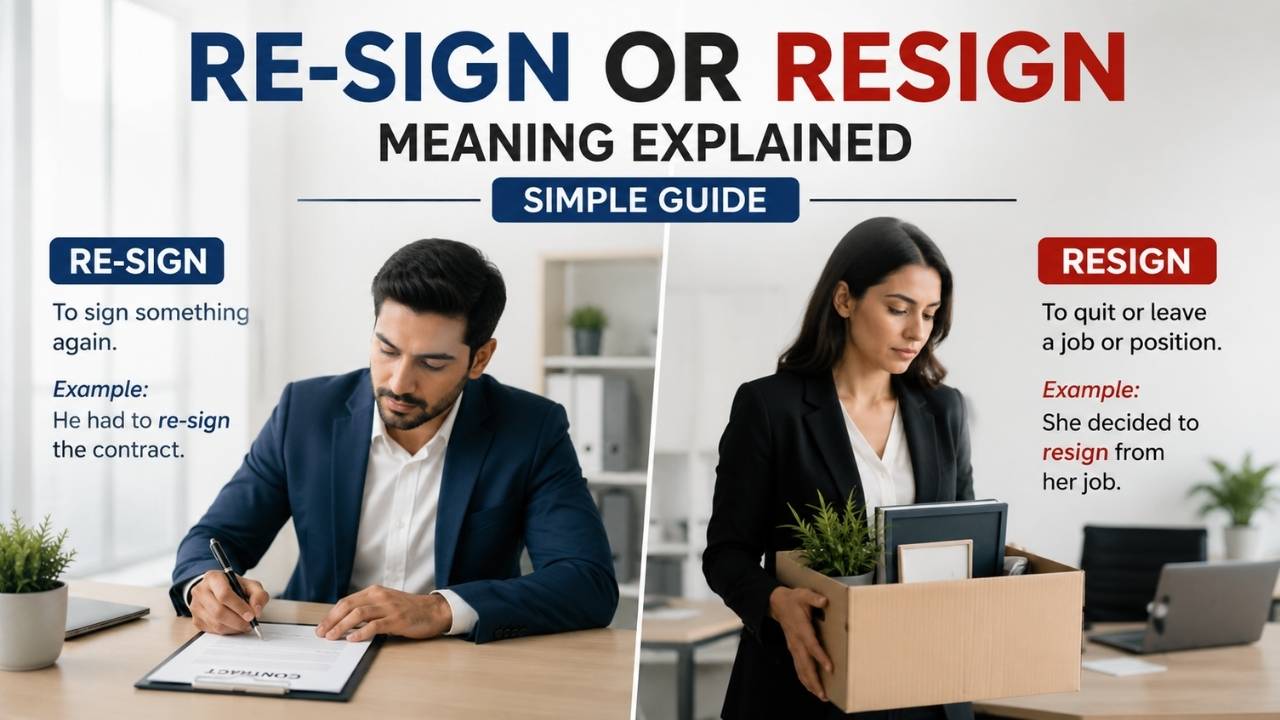
The words resign and re-sign often create confusion because they look almost identical but carry completely opposite meanings. This mix-up usually happens in writing, headlines, and even professional communication.
In simple terms, resign meaning refers to leaving a job, position, or responsibility, while re-sign meaning refers to signing again or renewing an agreement. This is why people often search for resign vs re-sign difference or difference between resign and re-sign with examples to understand them clearly.
The confusion becomes stronger because both words are verbs and are used in formal contexts like work, sports, and contracts. A small hyphen changes everything, turning one action into an opposite meaning. In this article, we will break down re-sign vs resign meaning, show real examples, and explain how to use them correctly in sentences without making common mistakes in English writing.
Quick Answer
Resign vs Re-sign are often confused because they look similar but mean opposite things. Resign meaning is to leave a job or position, while re-sign meaning is to sign again or renew a contract. The hyphen changes everything. For example, resign from a job means quitting, while re-sign with a team means continuing an agreement. Context is very important.
What Does “Resign” Mean?

The word resign meaning is simple: it means to leave a job, position, or responsibility officially. When someone resigns, they decide to quit their role, often by giving notice to their employer. This is commonly used in workplaces, politics, and formal settings. For example, a manager may resign from a company, or a leader may resign from office.
People often search for resign definition, resign meaning in job context, and how to use resign in a sentence because it is widely used in professional life. The word is a verb and is usually followed by “from,” such as “resign from a job.”
Example: “She decided to resign from her position after five years.” Understanding resign vs re-sign difference is important because without context, the word can be easily misunderstood. In short, resign always means leaving something, not renewing it or continuing it.
What Does “Re-sign” Mean?
The term re-sign meaning refers to signing again or renewing an agreement. It is mostly used in sports, business contracts, and rental agreements. When someone re-signs, they are continuing their relationship with a team, company, or organization by signing a new contract.
People often search for re-sign meaning in sports contracts, what does re-sign mean in business, and re-sign vs resign difference because the spelling is very similar but the meaning is different. The hyphen in re-sign definition is very important because it changes the meaning completely.
Example: “The football player decided to re-sign with his club for three more years.” This shows continuation, not leaving. Unlike resign meaning, which shows an exit, re-sign shows renewal. Understanding difference between resign and re-sign with examples helps avoid confusion in reading news, contracts, and headlines where both terms are commonly used.
Why “Resign” and “Re-sign” Have Opposite Meanings
The main reason resign and re-sign have opposite meanings is the role of the prefix and hyphen. In re-sign vs resign meaning, the small hyphen changes the structure of the word and completely changes its meaning. The prefix “re-” means “again,” so re-sign meaning becomes “to sign again” or renew something.
On the other hand, resign meaning does not include the idea of “again.” It comes from a different word structure and is used to mean leaving a job or position. This is why people often search for why do resign and re-sign have opposite meanings or how does hyphen change meaning in English words.
For example, “He will resign from his job” means leaving, while “He will re-sign the contract” means continuing. This simple difference shows how English spelling rules can change meaning completely. Understanding this helps avoid mistakes in writing and reading.
Resign vs Re-sign: Key Differences
The difference between resign vs re-sign becomes clear when we compare their meaning, usage, and context. Many learners search for difference between resign and re-sign, resign vs re-sign examples, and re-sign vs resign difference table to understand it easily.
Here is a simple comparison:
| Feature | Resign | Re-sign |
| Meaning | To leave a job or position | To sign again or renew contract |
| Context | Work, politics, official roles | Sports, business, leases |
| Action | Exit or quit | Continue or renew |
| Example | Resign from a job | Re-sign a contract |
In short, resign meaning is about leaving, while re-sign meaning is about continuing. The hyphen is the key difference that changes everything. Understanding this table helps avoid confusion in real-life reading, especially in news headlines and professional communication.
Real-Life Situations Where Confusion Happens
Confusion between resign vs re-sign often happens in real-life situations like news headlines, emails, and social media posts. Many readers quickly misread resign meaning as renewal or mistake re-sign meaning as quitting because the words look almost the same.
For example, in sports news, a headline like “Player re-signs with club” clearly means contract renewal. But if someone misses the hyphen, they may wrongly think the player is leaving. This is why people search for resign vs re-sign difference, common mistakes resign re-sign, and how to use resign and re-sign correctly.
The confusion also appears in workplaces when reading contracts or HR messages. A small spelling change can completely change the meaning. That is why understanding difference between resign and re-sign with examples is very important. In short, context and hyphen placement decide the real meaning in everyday communication.
Resign vs Re-sign in Headlines
In news and media writing, resign vs re-sign is used very carefully because a small mistake can change the meaning completely. Journalists often rely on correct spelling to avoid confusion between resign meaning and re-sign meaning.
For example, a headline like “CEO resigns after scandal” clearly shows that the person is leaving their position. On the other hand, “Star player re-signs with team” means the player has renewed their contract. This shows the difference between exit and continuation.
People often search for re-sign vs resign examples, resign vs re-sign headlines, and difference between resign and re-sign in sports because they see these words frequently in news. Media writing depends heavily on clarity, so the hyphen in re-sign definition is very important. Without it, the meaning can be misunderstood. Understanding this helps readers interpret news correctly and avoid confusion in professional content.
How to Use “Resign” in Sentences
The word resign meaning is commonly used in formal sentences when someone leaves a job or position. It is important to use it correctly in professional writing. Many learners search for how to use resign in a sentence, resign usage examples, and resign meaning in job context to understand it better.
Here are simple examples:
- “He decided to resign from his job last month.”
- “The manager will resign from the company next week.”
- “She had to resign due to personal reasons.”
In most cases, resign is followed by “from” when talking about a position. It always shows an exit or departure, not continuation. This is different from re-sign meaning, which shows renewal. Understanding resign vs re-sign difference with examples helps avoid mistakes in writing. Using the word correctly makes your communication clear and professional in both formal and everyday English.
How to Use “Re-sign” in Sentences
The term re-sign meaning is used when someone signs again or renews a contract. It is mostly seen in sports, business, and legal agreements. Many people search for how to use re-sign in a sentence, re-sign meaning in sports contracts, and re-sign vs resign examples because the meaning can be confusing.
Here are simple examples:
- “The football club will re-sign the player for another season.”
- “She decided to re-sign her lease for one more year.”
- “The company plans to re-sign the contract with its partner.”
Unlike resign meaning, which shows leaving, re-sign meaning shows continuation or renewal. The hyphen is very important because it changes the meaning completely. Without it, the word becomes resign, which means quitting a job. Understanding difference between resign and re-sign with examples helps you use both words correctly in real-life writing and communication.
Pronunciation Difference
The pronunciation of resign vs re-sign is slightly different, even though they look similar. Many people search for resign pronunciation, re-sign pronunciation difference, and why resign and re-sign sound different to avoid confusion in speaking.
The word resign meaning is pronounced as ri-ZINE (/rɪˈzaɪn/), and it means to leave a job or position. On the other hand, re-sign meaning is pronounced as ree-SINE (/riːˈsaɪn/), which means to sign again or renew a contract.
The difference comes from stress and sound patterns in English. Even though spelling is very close, spoken English helps separate the meanings clearly. This is why understanding resign vs re-sign difference is important not only in writing but also in speaking.
Correct pronunciation helps avoid misunderstandings in conversations, especially in professional or formal settings where both terms are commonly used.
Common Mistakes People Make
Many people confuse resign vs re-sign because the words look very similar in spelling. This often leads to mistakes in writing, emails, and even news reading. Learners frequently search for common mistakes resign re-sign, difference between resign and re-sign examples, and how to use resign correctly to avoid errors.
One common mistake is forgetting the hyphen in re-sign meaning, which can change the word into resign meaning, leading to a completely different interpretation. Another mistake is using “resign” when the writer actually means renewal or continuation.
Examples:
- Incorrect: “The player will resign with the club.”
- Correct: “The player will re-sign with the club.”
Understanding resign vs re-sign difference is important for clear communication. A small spelling error can change the whole meaning of a sentence. That is why careful attention to context and hyphen use is necessary in professional and everyday writing.
Quick Memory Trick to Remember the Difference
A simple way to remember resign vs re-sign difference is to focus on the word structure. Many people search for easy way to remember resign and re-sign, difference between resign and re-sign trick, and how to avoid confusion resign re-sign.
Here is a very easy trick:
- Resign = Exit
- Re-sign = Sign again
Think of “re-” as meaning “again.” So, re-sign meaning always means renewal or continuation. On the other hand, resign meaning has no “again” idea, so it means leaving.
Example:
- “He will resign from his job” = leaving
- “He will re-sign the contract” = continuing
This simple memory trick helps you quickly understand resign vs re-sign difference with examples without confusion. Once you remember this rule, you will rarely mix these two words in writing or speaking.
FAQs
Is resign and re-sign the same?
No, resign meaning is to leave a job, while re-sign meaning is to sign again or renew a contract.
What does re-sign mean in sports?
It means a player renews their contract with a team.
Why do resign and re-sign have different meanings?
Because the hyphen and prefix “re-” change the meaning completely.
Can resign mean renew?
No, resign always means leaving a position.
How do I remember the difference easily?
“Resign = leave” and “re-sign = sign again.”
Where is resign commonly used?
It is mostly used in jobs, offices, and formal positions.
Where is re-sign commonly used?
It is used in sports, business contracts, and leases.
What is the main confusion between them?
Their spelling is similar, but their meanings are completely opposite.
conclusion
Conclusion
The difference between resign vs re-sign is simple but very important in English. Resign meaning is to leave a job or position, while re-sign meaning is to sign again or renew an agreement. The small hyphen completely changes the meaning, which is why many people get confused.
Understanding difference between resign and re-sign with examples helps you avoid mistakes in writing, reading, and communication. Whether in jobs, sports, or contracts, context decides the correct meaning. Once you remember “resign = leave” and “re-sign = continue,” you will never mix them up again in real-life use.

Fahad is a seasoned English language trainer with a focus on IELTS and TEFL preparation.
He holds a Ph.D. in Applied Linguistics and has over 10 years of teaching experience.
Fahad is passionate about helping students achieve fluency and global opportunities.
His classes combine practical techniques with a supportive, student-first approach.