
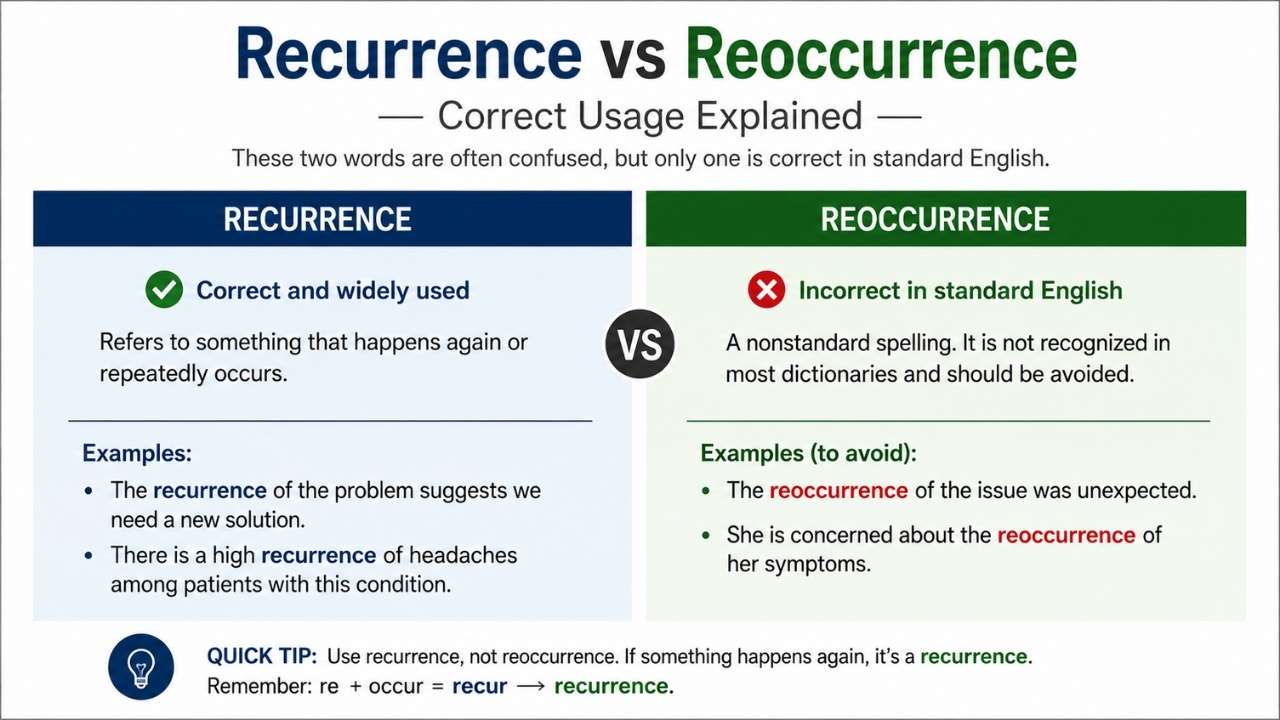
Many English learners get confused when they see recurrence vs reoccurrence, especially because both words seem to describe something happening again. At first glance, they look interchangeable, but in real usage, there is a clear difference in how they are understood and accepted in English grammar.
In simple terms, this topic is about understanding recurrence meaning, reoccurrence meaning, and how each word is used in writing. It also connects closely with other commonly confused terms like recur vs reoccur, which often appear in grammar discussions.
This guide will help you clearly understand the difference between recurrence and reoccurrence, when to use each word, and which one is more correct in formal English. By the end, you will know the proper usage of both terms and avoid one of the most common English grammar mistakes related to repeated actions or events.
Quick Answer
The main difference between recurrence and reoccurrence is usage. Recurrence meaning refers to something happening again and is the standard, widely accepted word in English. Reoccurrence meaning has the same idea but is rarely used in formal writing. When people ask which is correct recurrence or reoccurrence, the correct and preferred choice is recurrence in most contexts.
What Does “Recurrence” Mean?

Recurrence meaning is the idea of something happening again after a period of time. It is often used when an event, problem, or condition repeats in a pattern. For example, a storm, issue, or illness can have a recurrence if it returns after stopping for a while.
In English grammar, recurrence is a standard and widely accepted word. It is often used in both daily language and formal writing. You will also see it in medical terms like disease recurrence meaning, where a condition comes back after treatment.
When people compare recurrence vs reoccurrence, recurrence is the more natural and preferred word. It sounds simpler and is used more often in books, articles, and professional content. In short, recurrence refers to repetition in a clear and correct way, making it the main choice in most writing situations.
What Does “Reoccurrence” Mean?
Reoccurrence meaning refers to something happening again after it has already happened before. It carries the same basic idea as recurrence, but it is not used as commonly in modern English writing.
When looking at recurrence vs reoccurrence, many grammar experts prefer recurrence because it is simpler and more natural. The word reoccurrence can still be understood, but it often feels unnecessary in formal writing.
In most cases, writers choose recurrence instead of reoccurrence to keep their language clear and direct. This is why you will rarely see reoccurrence meaning used in academic or professional content.
When people ask is reoccurrence a correct word, the answer is yes, but it is less preferred. It is not wrong, but it is not the standard choice either. So, reoccurrence exists, but recurrence is the better and more widely accepted option in English usage.
Recurrence vs Reoccurrence (Comparison Table)
The recurrence vs reoccurrence comparison helps us see how both words differ in real usage. While both words talk about something happening again, their usage is not equal in English.
Recurrence meaning is widely accepted and used in formal writing, education, and medical language. It is clear, simple, and standard. In contrast, reoccurrence meaning is less common and often avoided in professional contexts.
In terms of usage frequency, recurrence is much more popular in books, articles, and research papers. Reoccurrence appears rarely and is mostly seen in informal or less edited writing.
When it comes to correctness, recurrence is preferred in grammar guides and dictionaries. So, in the debate of recurrence vs reoccurrence difference, recurrence clearly wins.
Overall, recurrence is the safer and more professional choice, while reoccurrence is understandable but not commonly used in modern English writing.
Why “Recurrence” Is the Preferred Word
The main reason recurrence is preferred over reoccurrence is simplicity. In English, shorter and clearer words are often used in formal writing. Recurrence meaning already covers the idea of something happening again, so adding “re” in reoccurrence can feel unnecessary.
In the comparison of recurrence vs reoccurrence, most grammar experts choose recurrence because it sounds more natural and is widely accepted in academic and professional writing.
Another reason is usage. Recurrence appears more often in books, medical studies, and news articles. For example, disease recurrence meaning is a common phrase in healthcare.
Reoccurrence is not considered incorrect, but it is less common and not preferred in formal contexts. That is why when people ask which is correct recurrence or reoccurrence, the answer is almost always recurrence.
In short, recurrence is the clearer and more standard choice in English usage.
Is “Reoccurrence” Grammatically Correct?
Yes, reoccurrence is grammatically correct, but it is not the preferred word in modern English. When we compare recurrence vs reoccurrence, both words can describe something happening again, but they are not used equally.
Reoccurrence meaning is easy to understand, but it is rarely used in formal writing, academic papers, or professional content. Instead, writers usually choose recurrence because it is simpler and more natural.
Grammar experts often explain that recurrence already includes the idea of repetition, so adding “re-” in reoccurrence can feel unnecessary. This is why recurrence is more common in dictionaries and writing guides.
So, when people ask is reoccurrence a correct word, the answer is yes, but it is not the standard choice. In most cases, recurrence is preferred for clear communication, especially in formal English writing and education.
Key Difference Explained in Simple Terms
The key recurrence vs reoccurrence difference is about clarity and usage, not meaning. Both words describe something happening again, but they are not used in the same way in English.
Recurrence meaning is widely accepted and commonly used in both formal and informal writing. It clearly shows repetition over time, such as events, problems, or conditions returning again.
On the other hand, reoccurrence meaning is less common and often seen as unnecessary because the idea of repetition is already covered in recurrence. This is why many grammar guides avoid using reoccurrence in professional writing.
A simple way to understand it is this: recurrence is the standard word, while reoccurrence is a rare alternative. So, when choosing between recurrence vs reoccurrence, recurrence is almost always the better and safer option for clear English communication.
Medical Usage: Recurrence in Healthcare
In medical language, recurrence meaning is very important. It refers to a disease or condition returning after treatment or a period of improvement. For example, doctors may talk about the recurrence of cancer or other illnesses when symptoms come back.
When comparing recurrence vs reoccurrence, the medical field strongly prefers recurrence. It is the standard term used in hospitals, research papers, and clinical reports. You will often see phrases like disease recurrence meaning in healthcare discussions.
Reoccurrence is rarely used in medical writing because it is not considered the standard term. Even though it is understandable, professionals avoid it to keep communication clear and precise.
So, in healthcare and science, recurrence is always the preferred choice. It helps maintain accuracy and consistency in important medical information where clear language is very important for doctors and patients.
Real Usage Frequency Insight
When we look at real writing, recurrence vs reoccurrence shows a clear pattern. The word recurrence is used far more often in books, articles, research papers, and online content. It is the standard choice in both academic and professional writing.
Recurrence meaning appears in many contexts, especially in medical and scientific topics. For example, phrases like disease recurrence meaning are very common in healthcare writing.
On the other hand, reoccurrence meaning appears much less often. It is not widely used in formal English and is rarely seen in trusted publications.
This difference in usage is important for writers. When choosing between recurrence vs reoccurrence difference, recurrence is the safer and more natural option. It matches how English is commonly used in real-world writing, making it the preferred choice for clear and professional communication.
Common Mistakes Writers Make
One common mistake in recurrence vs reoccurrence is thinking both words are completely equal. While they have similar meanings, they are not used the same way in English writing.
Many writers also confuse recurrence meaning with simple repetition. Recurrence usually refers to something happening again over time, not just repeating once. Another mistake is overusing the word reoccurrence when recurrence would sound more natural.
Some people also believe that adding “re-” makes the word stronger, but in this case, it only creates unnecessary repetition. This is why reoccurrence meaning is often avoided in formal writing.
To avoid mistakes, it is better to remember that recurrence is the standard choice. So, when writing about recurrence vs reoccurrence difference, always prefer recurrence for clearer and more correct English usage in most situations.
Sentence Examples
Here are simple examples to understand recurrence vs reoccurrence better. These help show how the words are used in real sentences.
For recurrence meaning, we can say: “The recurrence of the problem made it difficult to fix.” Another example is: “Doctors are monitoring the recurrence of the disease.”
For reoccurrence meaning, we can say: “The reoccurrence of the issue surprised the team.” However, this word is not commonly used in formal writing.
When comparing both, recurrence is more natural and widely accepted. That is why in most cases, writers prefer recurrence over reoccurrence in sentences.
So, in the discussion of recurrence vs reoccurrence difference, the examples clearly show that recurrence fits better in both formal and professional contexts, while reoccurrence is less common and used only in limited situations.
Memory Trick to Remember the Difference
A simple way to remember recurrence vs reoccurrence is to focus on clarity. Think of recurrence as the clean and correct option used in everyday English writing.
Recurrence meaning already shows that something is happening again over time, so it does not need extra letters or changes. That is why it feels more natural and is widely used in formal writing.
On the other hand, reoccurrence meaning is less common and often avoided because it sounds unnecessary. It is understandable, but not preferred.
A helpful memory trick is: “If unsure, choose recurrence.” This rule works in most cases, especially in academic, medical, and professional writing.
So, when you think about recurrence vs reoccurrence difference, just remember that recurrence is the safe, standard, and more accepted word in English communication.
FAQs
Is reoccurrence a real word?
Yes, but rarely used in writing.
Which is correct, recurrence or reoccurrence?
Recurrence is the standard correct choice.
What is recurrence meaning?
Something happening again over time.
Are both words interchangeable?
No, recurrence is preferred in usage.
What is reoccurrence meaning?
A repeated event happening again.
Which is more formal?
Recurrence is more formal and accepted.
Is reoccurrence common in English?
No, it is rarely used.
Conclusion
In the end, the difference between recurrence and reoccurrence is mainly about usage, not meaning. Both words describe something happening again, but recurrence meaning is the standard and most widely accepted form in English writing. It is commonly used in academic, medical, and professional contexts.
On the other hand, reoccurrence meaning is understandable but rarely used in formal English. Most writers and grammar guides prefer recurrence because it sounds clearer and more natural.

Fahad is a seasoned English language trainer with a focus on IELTS and TEFL preparation.
He holds a Ph.D. in Applied Linguistics and has over 10 years of teaching experience.
Fahad is passionate about helping students achieve fluency and global opportunities.
His classes combine practical techniques with a supportive, student-first approach.