

The past tense of wear often confuses English learners and even native speakers. Many people wonder whether they should use wore or worn in a sentence. Because English includes many irregular verbs, the verb wear does not follow the simple “-ed” pattern used by regular verbs.
Today, the word appears constantly in everyday American English. People use it when talking about clothing, fashion, uniforms, accessories, expressions, and even emotions. Understanding the correct form helps your speech and writing sound more natural.
In modern communication, mistakes with wear, wore, and worn are common in emails, texts, social media captions, and casual conversation. However, the rules are actually simple once you see how each form works in context.
Quick Answer
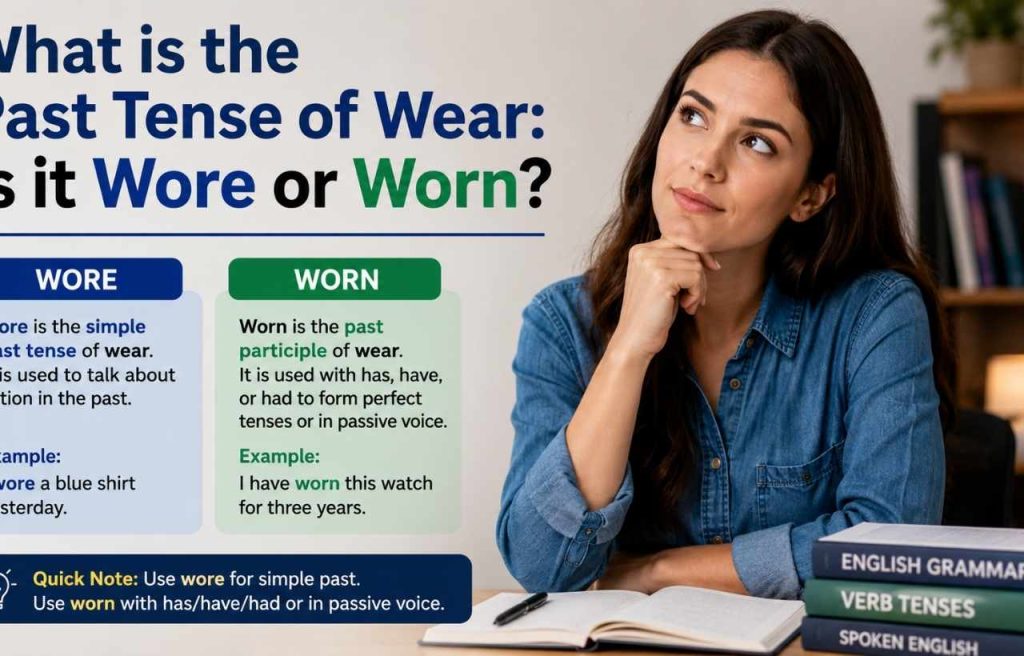
The past tense of wear is wore. The past participle is worn. Use wore for simple past sentences and worn with helping verbs like has, have, or had.
TL;DR
- Wear → Wore → Worn
- Use wore for actions completed in the past.
- Use worn with helping verbs.
- “I wore a jacket yesterday” is correct.
- “I have worn that jacket before” is correct.
- “I worn a jacket yesterday” is incorrect.
Understanding the Verb Wear
The verb wear usually means to have clothing, jewelry, or accessories on your body. However, it can also describe expressions, hairstyles, perfumes, or even emotional appearances.
In American English, wear is extremely common in both spoken and written communication. People use it daily when discussing fashion, work uniforms, weather clothing, or special events. Because of this frequent use, learning its tense forms is important for fluent communication.
Present Form of Wear
The base form is wear. In third-person singular sentences, it becomes wears.
For example, someone may say, “I wear sneakers every day,” or “She wears glasses to work.” These examples describe present or repeated actions.
Past Form of Wear
The simple past form is wore. It describes something someone wore at a specific time in the past.
For example:
| Context | Correct Usage | Example | Notes |
| Casual speech | Wore | I wore boots yesterday. | Simple past |
| Formal writing | Wore | He wore a navy suit to the meeting. | Completed action |
| Present perfect | Worn | She has worn that dress before. | Needs helping verb |
| Past perfect | Worn | They had worn coats all winter. | Uses “had” |
Why Wear Is an Irregular Verb
Most English verbs form the past tense by adding -ed. For example, walk becomes walked, and jump becomes jumped. However, wear belongs to a group called irregular verbs.
Irregular verbs developed from older forms of English spoken centuries ago. Many of these verbs changed sounds naturally over time instead of adopting the newer “-ed” ending pattern. Because of this history, English still keeps forms like wear, wore, worn today.
Historical Development of Wear
The word comes from Old English forms related to clothing and carrying items on the body. Over time, pronunciation shifted across Middle English and Early Modern English. Eventually, the forms settled into the pattern modern speakers use today.
Although English spelling changed greatly between the 1400s and 1800s, common irregular verbs remained surprisingly stable. That is why Americans today still say wore instead of “weared.”
Wore vs Worn: What’s the Difference?
This is the most common confusion connected to the past tense of wear. Both words refer to past time, but they serve different grammar roles.
When to Use Wore
Use wore in the simple past tense without a helping verb. It describes a completed action in the past.
For example:
- “She wore a red coat last night.”
- “They wore matching shirts to school.”
- “I wore my old sneakers yesterday.”
In each sentence, the action happened in the past and ended there.
When to Use Worn
Use worn as the past participle. It must appear with helping verbs such as has, have, had, or was in passive constructions.
For example:
- “He has worn that hat for years.”
- “The uniform had been worn many times.”
- “She had worn glasses since childhood.”
Without a helping verb, worn sounds incomplete or incorrect.
Common Mistakes With the Past Tense of Wear
Many English learners mix up wore and worn because both refer to the past. However, sentence structure determines which one works correctly.
A very common mistake is saying, “I worn a jacket yesterday.” This sentence is incorrect because the simple past tense requires wore, not worn.
Another common mistake happens in perfect tenses. Some speakers say, “I have wore that before.” The correct version is “I have worn that before.”
Why These Errors Happen
English irregular verbs often create confusion because their patterns are unpredictable. Unlike regular verbs, learners cannot simply memorize one rule.
Also, spoken English sometimes causes people to hear forms incorrectly. Fast speech, regional accents, and casual conversation can blur the difference between wore and worn.
How Americans Commonly Use Wear Today
In modern American English, wear appears in fashion, sports, business, entertainment, and online communication. People also use it in emotional or figurative ways.
For example, someone might say:
- “She wore a confident smile.”
- “He wears stress on his face.”
- “They wore black to the ceremony.”
These uses go beyond clothing alone. Because of this flexibility, the verb remains highly active in everyday speech.
Wear in Digital Communication
Social media has increased the frequency of fashion-related language. People often post captions about what they wore to events, vacations, or parties.
In texting and online conversation, grammar sometimes becomes less formal. Even so, standard forms like wore and worn still dominate edited writing and professional communication.
Formal and Informal Usage
The rules for wear, wore, and worn stay mostly the same in both formal and informal English. However, sentence style may change depending on context.
In formal writing, speakers usually use complete sentence structures carefully. For example, a workplace email may say, “Employees wore identification badges during the event.”
In casual speech, sentences become shorter and more conversational. Someone might simply say, “I wore that already.”
Spoken American English
Americans often shorten phrases in conversation. For example, “I’ve worn it before” may sound like “I’ve wornit before.” This blending can make the grammar harder for learners to hear clearly.
However, educated and standard American English still follows the same core grammar rules.
British and American Differences
There is very little difference between British and American English regarding the verb wear. Both varieties use:
- Wear for present
- Wore for simple past
- Worn for past participle
However, style and vocabulary around clothing can differ. Americans may say sneakers, while British speakers may say trainers. Still, the tense structure remains identical.
Pronunciation Differences
Some pronunciation differences exist between accents. American speakers often pronounce wore similarly to “war,” while some British accents produce a rounder vowel sound.
Even with pronunciation variation, the grammar stays consistent across English-speaking regions.
Real-Life Examples of Wear in Sentences
Seeing the verb in realistic contexts helps learners understand it naturally. Everyday examples show how native speakers actually use the forms.
Everyday Conversation
A parent may ask, “What did you wear to school today?” A friend might say, “I wore my favorite hoodie.”
These examples use the simple past because they refer to completed actions.
Workplace and Professional Use
Professional English also uses the verb frequently. For example:
- “Employees wore formal attire during the conference.”
- “The actor had worn several costumes during filming.”
These structures appear regularly in business writing and news reporting.
Social Media and Casual Writing
Online captions often use past tense forms naturally:
- “I wore this dress to dinner.”
- “She’s worn that style for years.”
Although online writing can be informal, most users still recognize correct tense forms.
How the Meaning of Wear Has Expanded
Originally, wear mainly referred to clothing or physical items. However, modern English uses the word more broadly.
Today, people use it for emotions, facial expressions, hairstyles, perfumes, and even damage over time. For example, someone may say a road has “worn down” after years of traffic.
Figurative Uses
English speakers often use figurative expressions involving wear:
- “Wear your heart on your sleeve”
- “Wear a smile”
- “Wear someone down”
These expressions show how deeply the verb has become part of English communication.
Why English Keeps Irregular Verbs
Many learners wonder why English still keeps confusing forms like wore and worn. The answer largely involves habit and history.
Frequently used verbs change more slowly than rare words. Because people use wear constantly, older forms survived while other grammar patterns disappeared.
Language also evolves naturally over time. Even though some speakers make mistakes, standard English grammar still recognizes wear, wore, worn as the accepted pattern today.
FAQs
Is wore the correct past tense of wear?
Yes. Wore is the correct simple past tense form of wear. Use it for completed actions in the past.
Is worn past tense too?
Worn is the past participle form, not the simple past tense. It needs a helping verb like has, have, or had.
Why isn’t “weared” correct?
The verb wear is irregular. Therefore, it does not follow the standard “-ed” rule used by regular verbs.
Can I say “I have wore”?
No. The correct form is “I have worn.” After have, English requires the past participle.
Do Americans use wore and worn differently from British speakers?
Not really. Both American and British English use the same grammar forms for this verb.
What tense is “had worn”?
“Had worn” is the past perfect tense. It describes an action completed before another past event.
Is “worn out” related to the verb wear?
Yes. “Worn out” comes from the verb wear and describes something exhausted, damaged, or overused.
Can wear describe emotions?
Yes. English speakers sometimes use wear figuratively. For example, someone may “wear a sad expression.”
Conclusion
The past tense of wear is wore, while worn serves as the past participle. Although irregular verbs can seem confusing at first, the difference becomes easier once you understand sentence structure.
Today, Americans use these forms constantly in daily conversation, professional writing, texting, and online communication. Because the verb appears so often, mastering it improves both clarity and confidence in English.
When choosing between wore and worn, remember one simple rule: use wore alone for simple past actions, and use worn with a helping verb. With practice, the correct form will start to feel natural in everyday speech and writing.

Fahad is a seasoned English language trainer with a focus on IELTS and TEFL preparation.
He holds a Ph.D. in Applied Linguistics and has over 10 years of teaching experience.
Fahad is passionate about helping students achieve fluency and global opportunities.
His classes combine practical techniques with a supportive, student-first approach.