

The plural of knife is a small grammar topic that often confuses learners and even native speakers. At first glance, you might expect it to follow a simple pattern like most nouns, but English has its quirks.
Because English developed from several languages, some plural forms don’t follow the usual “add -s” rule. Instead, they change spelling in ways that feel surprising at first.
Understanding this pattern helps you write and speak more naturally. It also prevents common mistakes that can make your English sound less polished.
Quick Answer
The plural of knife is knives. The “f” changes to “v” and you add “es” instead of just “s.”
TL;DR
- Knife → knives (not knifes)
- The “f” changes to “v” before adding “es”
- This pattern applies to similar words like life → lives
- However, not all “f” words follow this rule
- Always check irregular plurals when unsure
What Is the Plural of Knife?
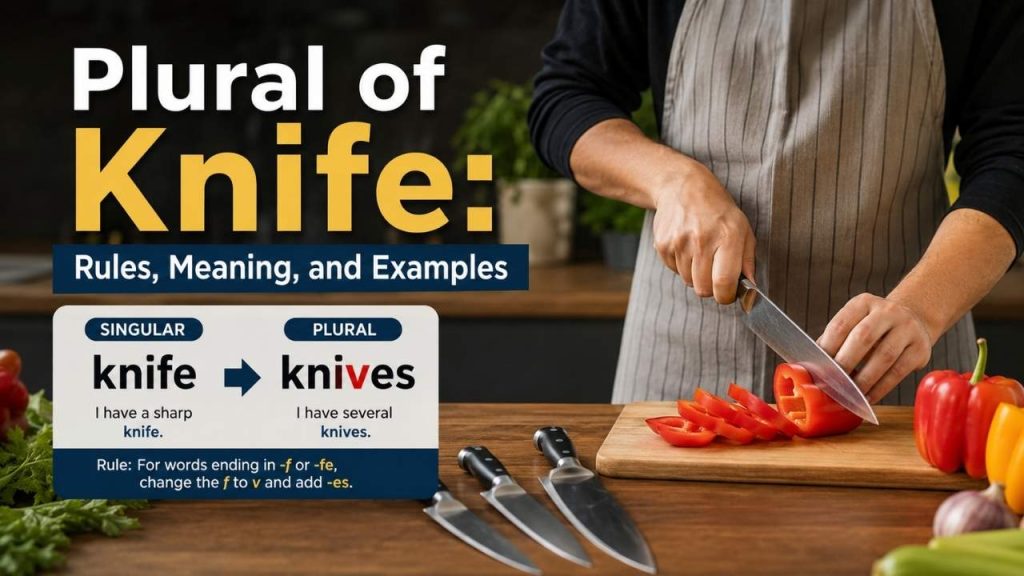
The plural of knife is knives, and it follows an irregular plural pattern in English. Instead of simply adding “-s,” the word changes internally.
How the Structure Works
The word knife ends in “-fe.” When forming the plural, the “f” sound shifts to “v”, and “es” is added. This results in knives.
Why This Matters
This pattern isn’t random. It reflects older pronunciation rules in English, where certain sounds softened between vowels. Over time, spelling adapted to match speech.
Why Does Knife Become Knives?
At first, knife → knives may seem odd. However, there’s a clear linguistic reason behind it.
Historical Sound Change
In early English, “f” sounds often became “v” when placed between vowel sounds. When forming plurals, this change naturally occurred in speech.
Spelling Followed Pronunciation
As English spelling became more standardized, writers began reflecting these pronunciation changes. That’s why we now write knives instead of knifes.
Words That Follow the Same Pattern
Knife is not alone. Several English nouns follow the same “f to v” plural rule.
Common Examples
Words like life → lives, wife → wives, and leaf → leaves follow the same transformation. These words share similar endings and historical roots.
Important Note
However, not every word ending in “f” changes. For example, roof → roofs keeps the “f.” This inconsistency is one reason English can be tricky.
Words That Do NOT Follow This Rule
While many words change from “f” to “v,” others don’t. This is where confusion often happens.
Examples That Stay Regular
Words like chief → chiefs, belief → beliefs, and cliff → cliffs simply add “-s.” They do not change the “f” to “v.”
Why the Difference Exists
These differences come from word origins. Some words entered English later or from different languages, so they didn’t follow the same sound shifts.
Usage in Everyday American English
In modern American English, knives is the only accepted plural form in both formal and informal contexts.
In Speaking and Writing
People use knives naturally in daily conversation. For example, someone might say, “We need more knives for dinner.”
In Professional Contexts
In formal writing, such as emails or reports, using the correct plural shows attention to detail. Writing knifes would be considered an error.
Common Mistakes with Knife Plural
Even advanced learners sometimes make mistakes with irregular plurals like this one.
Using “Knifes” Instead of “Knives”
This is the most common error. It happens because many English nouns form plurals by adding “-s.”
Overgeneralizing the Rule
Some learners apply the “f to v” rule too widely. For example, writing rooves instead of roofs is incorrect in standard American English.
Real-Life Examples of Knives
Understanding how knives appears in real sentences helps you remember it better.
Everyday Sentences
You might hear someone say, “The chef sharpened all the knives before cooking.” This shows natural usage in a real setting.
Digital Communication
Even in texts or social media, people use knives correctly. For example, “Don’t forget to bring knives for the picnic.”
British vs American Usage
For the word knife, both American and British English use the same plural: knives.
Consistency Across Regions
Unlike some spelling differences, this word does not vary between regions. That makes it easier to learn and remember.
Minor Pronunciation Differences
While pronunciation may differ slightly between accents, the spelling remains the same.
Table: Knife and Similar Plurals
| Context | Correct Usage | Example | Notes |
| Singular | knife | I bought a new knife. | Base form |
| Plural | knives | The knives are sharp. | “f” → “v” + “es” |
| Similar word | life → lives | Many lives were changed. | Same pattern |
| Exception | roof → roofs | The roofs are damaged. | No “v” change |
Why English Has Irregular Plurals
The plural of knife reflects a larger pattern in English grammar.
Mixed Language Origins
English developed from Germanic, Latin, and French influences. Because of this, plural rules are not always consistent.
Sound Changes Over Time
As pronunciation evolved, spelling sometimes changed to match it. However, not all words updated in the same way.
Changes in Usage Over Time
Language is always evolving, but some forms remain stable.
Historical Variations
In older English texts, spelling was less standardized. You might see different plural forms, though knives became dominant over time.
Modern Standard
Today, knives is firmly established as the correct plural. There’s no serious debate about its usage.
Misunderstandings and Confusion
Some confusion around this topic comes from mixing rules.
Mixing Regular and Irregular Patterns
Learners often assume all nouns behave the same way. However, English requires memorizing certain irregular forms.
Influence of Spelling Simplicity
Because “add -s” is simpler, people sometimes default to it. Still, correctness matters in clear communication.
How to Remember the Plural of Knife
Learning irregular plurals becomes easier with patterns and practice.
Use Word Families
Grouping similar words like knife, life, wife helps reinforce the rule.
Practice in Context
Writing full sentences with knives helps you remember it naturally instead of memorizing rules alone.
FAQs
Is “knifes” ever correct?
No, knifes is not correct in standard English. The correct plural is always knives.
Why does knife change to knives?
It changes because of historical sound patterns where “f” became “v” between vowels.
Are all “f” words pluralized this way?
No, many words like roof → roofs do not follow this rule. You must learn exceptions.
Is knives used in formal writing?
Yes, knives is correct in both formal and informal contexts.
Do British and American English differ here?
No, both use knives as the plural form.
Conclusion
The plural of knife is knives, and it follows an irregular but meaningful pattern in English. Instead of adding “-s,” the word changes internally, reflecting older pronunciation rules.
Although this pattern may seem confusing at first, it becomes easier once you see similar examples and understand the history behind it. Over time, using knives correctly will feel natural.
The key takeaway is simple: when in doubt, check irregular forms and practice them in real sentences. That’s how grammar turns into confident, everyday communication.

Fahad is a seasoned English language trainer with a focus on IELTS and TEFL preparation.
He holds a Ph.D. in Applied Linguistics and has over 10 years of teaching experience.
Fahad is passionate about helping students achieve fluency and global opportunities.
His classes combine practical techniques with a supportive, student-first approach.