
If you’ve ever wondered whether to say “born in” or “born on,” you’re not alone. This small grammar choice can confuse even fluent English speakers, especially in everyday conversations and writing.
At first glance, both phrases seem similar. However, they serve different purposes depending on what you’re talking about. Understanding the difference between Born in or Born on helps you speak more naturally and avoid common mistakes.
Today, we’ll break it down in a clear and simple way. By the end, you’ll know exactly when to use each phrase without second-guessing yourself.
Quick Answer
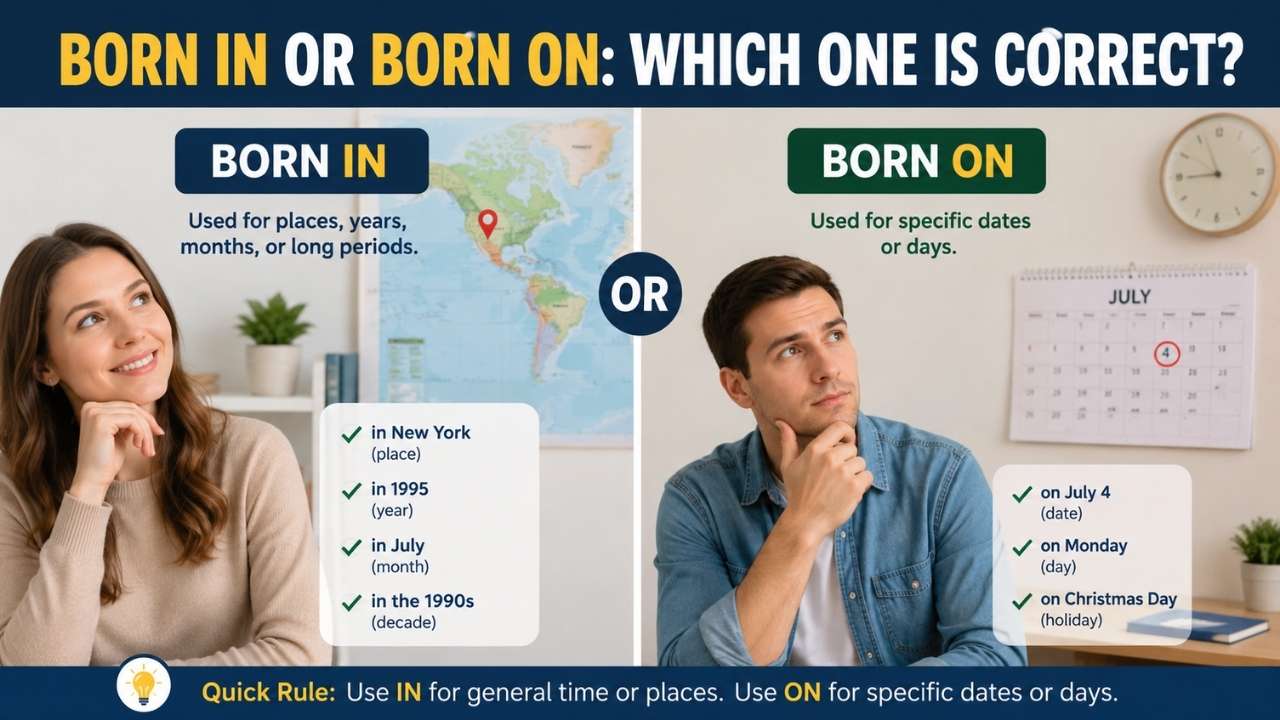
Use “born in” for places, years, months, or long periods, and use “born on” for specific dates and days. That’s the core rule behind Born in or Born on.
TL;DR
- “Born in” is used for locations and longer time periods.
- “Born on” is used for exact dates or specific days.
- Use “in” for years, months, and cities.
- Use “on” for dates like January 1 or Monday.
- Mixing them up is a common but easy-to-fix mistake.
What Does “Born In or Born On” Mean?
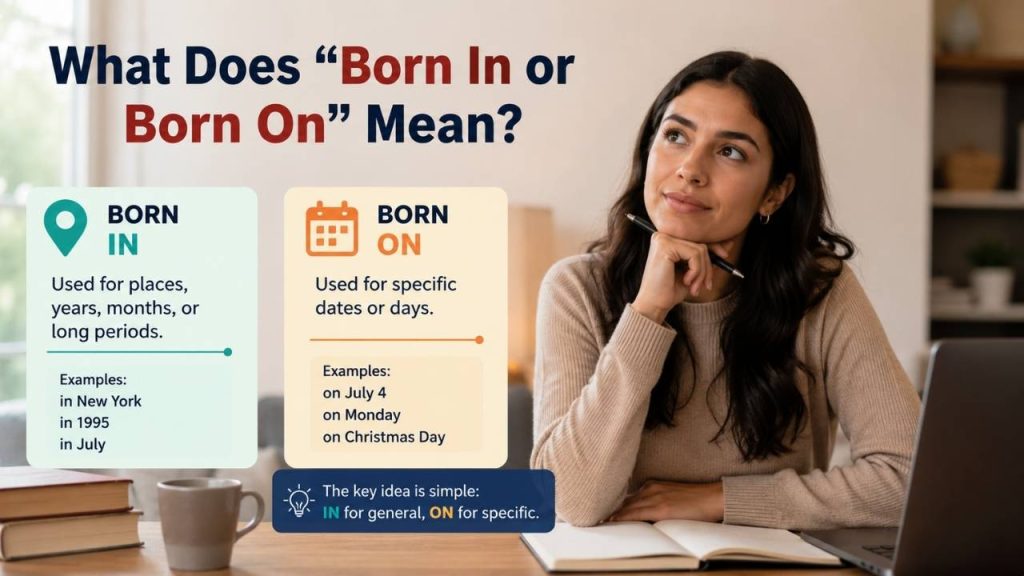
The phrases “born in” and “born on” are prepositional expressions. They connect the verb “born” with information about time or place. While both are correct, they are used in different contexts.
“Born In” Explained
“Born in” is used when referring to a general time frame or a place. This includes years, months, decades, countries, or cities. For example, you might say, “She was born in 2001” or “He was born in New York.”
“Born On” Explained
“Born on” is used when talking about a specific day or date. For example, “She was born on July 4” or “He was born on Monday.” The key idea is precision.
Because of this difference, choosing the right preposition depends on how detailed your information is.
Core Rules at a Glance
Understanding the rules behind these phrases becomes easier when you focus on the type of information being shared.
Time vs Specific Time
Use “in” when the time is broad, like a year or month. Use “on” when the time is exact, like a date or day.
Place vs Date
“Born in” works with locations, such as cities or countries. In contrast, “born on” never refers to a place.
These simple distinctions cover most situations in everyday English.
Historical Background of These Expressions
The use of prepositions like “in” and “on” goes back to Old English. At that time, prepositions were already used to show relationships between words, especially time and space.
Over centuries, English became more structured. Prepositions started following clearer patterns. For example, “in” became linked with larger or more general periods, while “on” became associated with specific points in time.
By the modern era, these rules became standardized. Today, they are widely taught and used across American English.
Usage in Everyday American English
In the United States, these phrases are used daily in both formal and informal contexts. Whether you’re filling out a form or chatting with friends, the distinction matters.
Formal Contexts
In official documents, such as birth certificates or applications, accuracy is important. You’ll often see phrases like “born on March 10, 1995” and “born in California.”
Informal Conversations
In casual speech, people still follow the same rules, even if they don’t think about them. For example, “I was born in Texas” sounds natural, while “I was born on Texas” sounds incorrect.
Because these phrases are so common, using them correctly helps you sound more fluent and confident.
British vs American Usage
The good news is that there is no major difference between British and American English for these expressions. Both follow the same rules for “in” and “on.”
However, date formats may vary. Americans often write dates as “July 4,” while British English may use “4 July.” Even so, the preposition “on” remains the same in both styles.
Common Mistakes People Make
Even though the rules are simple, many learners mix up “in” and “on.” This usually happens when they translate directly from another language.
Mixing Time Levels
A common mistake is saying “born in July 4.” This mixes a month with a specific date. The correct version is “born on July 4.”
Using “On” for Places
Another error is saying “born on New York.” Since New York is a place, the correct phrase is “born in New York.”
These mistakes are easy to fix once you understand the logic behind each preposition.
Real-Life Examples in Sentences
Seeing examples helps make the rules clearer and easier to remember.
| Context | Correct Usage | Example | Notes |
| Year | Born in | She was born in 1990. | General time period |
| Month | Born in | He was born in June. | Not specific day |
| Date | Born on | She was born on June 5. | Exact date |
| Day | Born on | He was born on Monday. | Specific day |
| Place | Born in | She was born in Chicago. | Location only |
These patterns appear everywhere, from social media profiles to job applications.
Why “Born In” Is Used for Places
The reason “in” is used for places comes from how English views space. “In” suggests being inside something, such as a city, state, or country.
When you say “born in California,” you’re describing the location where the birth happened. The same logic applies to countries and regions.
This spatial meaning has remained consistent throughout the history of English.
Why “Born On” Is Used for Dates
On the other hand, “on” is used for specific points in time. Think of it like placing a marker on a calendar.
When you say “born on January 1,” you’re pointing to one exact day. Because of this precision, “on” is always tied to specific dates and days.
This rule also applies to other expressions like “on Monday” or “on Christmas Day.”
Born In vs Born On vs Born At
Sometimes, learners wonder about “born at.” While it’s less common, it can be used for very specific places.
When “Born At” Is Used
You might hear “born at the hospital” or “born at home.” This focuses on a precise location rather than a general place.
However, in most cases, “born in” is more natural and widely used.
Misunderstandings and Gray Areas
There are a few situations where people get confused, especially when combining time expressions.
Combining Month and Date
If both a month and a date are mentioned, “on” is always used. For example, “born on July 10,” not “in July 10.”
Combining Place and Date
Sometimes, both are used together. For example, “She was born in Texas on June 5.” In this case, each preposition matches its role.
Understanding these combinations helps avoid confusion.
Changes in Usage Over Time
While the rules for “in” and “on” have stayed stable, the way people use them has become more relaxed in casual settings.
For example, in texting or social media, people might shorten phrases or omit details. However, the core grammar remains the same.
Even in 2025–2026, standard usage still follows traditional rules, especially in writing and formal communication.
Why This Grammar Rule Matters
At first, this might seem like a small detail. However, correct preposition use plays a big role in clarity.
Using the wrong preposition can make a sentence sound unnatural. In some cases, it can even confuse the listener or reader.
Because of this, mastering simple rules like this improves both speaking and writing skills.
FAQs
Is it correct to say “born in a date”?
No, that’s incorrect. Use “born on” for dates, such as “born on May 5.” “In” is used for months or years instead.
Can I say “born on a year”?
No, you should say “born in a year,” like “born in 2000.” Years are considered general time periods.
Is “born at” wrong?
Not exactly. It’s used for very specific locations, like “born at home,” but it’s less common than “born in.”
Do Americans and British people use this differently?
No, both follow the same rules. The only difference may be how dates are written, not the prepositions.
What’s the easiest way to remember the rule?
Think of “in” for general and “on” for specific. This simple idea works in most cases.
Conclusion
Understanding the difference between Born in or Born on is simple once you know the rule. Use “in” for places and general time, and use “on” for specific dates and days.
Although it’s a small detail, it makes a big difference in how natural your English sounds. Over time, using the correct form will become automatic.
In everyday communication, clarity matters. So next time you talk about someone’s birth, you’ll know exactly which phrase to use—and why.

Fahad is a seasoned English language trainer with a focus on IELTS and TEFL preparation.
He holds a Ph.D. in Applied Linguistics and has over 10 years of teaching experience.
Fahad is passionate about helping students achieve fluency and global opportunities.
His classes combine practical techniques with a supportive, student-first approach.