

The past tense of see is one of the most common grammar topics in English, yet it still causes confusion for many learners. Even native speakers sometimes mix up its forms, especially when deciding between “saw” and “seen.”
Because “see” is an irregular verb, it doesn’t follow the usual “-ed” pattern. Instead, it changes form depending on the tense and structure of the sentence. That’s why understanding how it works can help you speak and write more naturally in everyday American English.
In this guide, you’ll learn the correct forms, how to use them in real life, and why they developed the way they did.
Quick Answer
The past tense of see is “saw.” The past participle form is “seen,” which is used with helping verbs like “have,” “has,” or “had.”
TL;DR
- “Saw” is the simple past form of “see.”
- “Seen” is the past participle and needs a helping verb.
- “I saw it yesterday” is correct.
- “I have seen it before” is also correct.
- “I seen it” is incorrect in standard American English.
What Is the Past Tense of See?
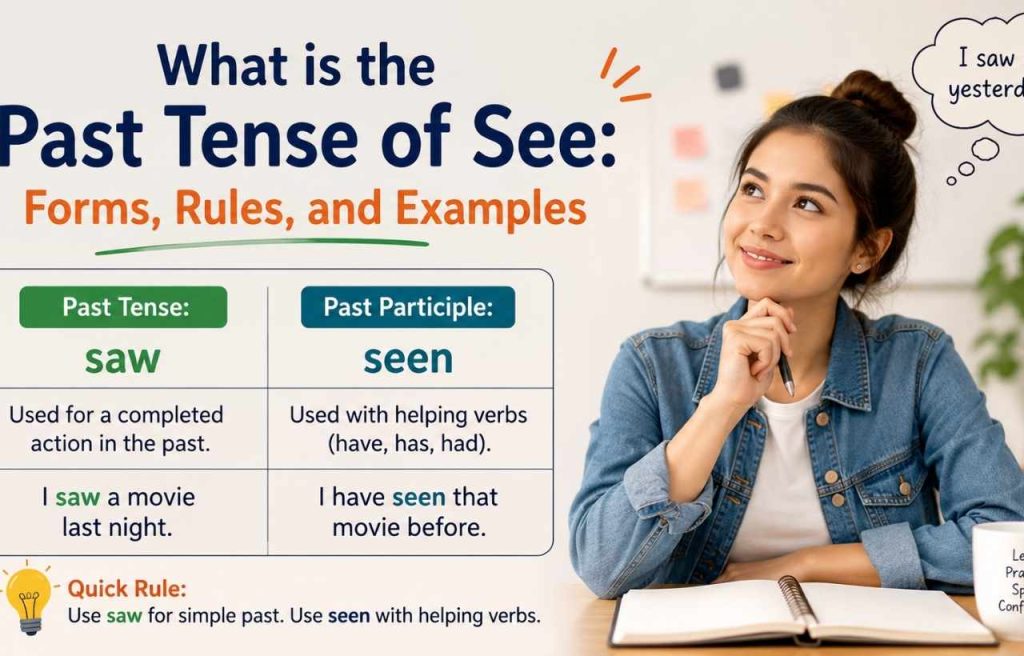
The verb “see” means to notice something using your eyes. However, when talking about the past, it changes form because it’s irregular.
Simple Past Form
The simple past form is “saw.” This form is used when describing something that happened at a specific time in the past.
For example, you might say, “I saw a movie last night.” In this case, the action is finished and clearly placed in the past.
Past Participle Form
The past participle is “seen.” However, it cannot stand alone. It must be used with a helping verb like “have,” “has,” or “had.”
For example, “I have seen that movie before” is correct, while “I seen that movie” is not.
Core Rule at a Glance
Using “Saw” in Simple Past
“Saw” is used without any helping verb. It describes a completed action in the past.
For example, “She saw her friend at the mall.” This sentence clearly places the action in the past.
Using “Seen” With Helping Verbs
“Seen” always appears with helping verbs. Without them, the sentence is incomplete or incorrect.
For instance, “They have seen the results already” is correct. However, removing “have” would make it wrong in standard grammar.
Time Context Matters
The choice between “saw” and “seen” depends on whether the sentence uses a helping verb and whether the action connects to the present.
For example, “I saw it yesterday” focuses on a specific time. In contrast, “I have seen it before” connects past experience to the present.
Historical Background of “See”
The verb “see” comes from Old English “seon.” Like many common verbs, it evolved over time and kept irregular forms instead of adopting the regular “-ed” ending.
In early English, strong verbs like “see” changed vowels to show tense. This pattern is why we have “see,” “saw,” and “seen” today. These changes followed sound patterns rather than fixed endings.
Over centuries, English simplified many verbs, but highly used ones like “see” kept their irregular forms. As a result, these forms are still standard in modern American English.
How “Saw” Is Used in Everyday American English
In the United States, “saw” is widely used in casual and formal speech. It appears in conversations, storytelling, and writing.
Everyday Conversations
People often use “saw” when sharing past experiences. For example, “I saw him at the store” is a typical sentence you might hear daily.
This form feels natural because it clearly shows the action is complete.
Writing and Formal Use
In formal writing, “saw” is used the same way. For instance, in reports or essays, you might read, “The study saw significant changes over time.”
Even in professional settings, the rule remains simple: use “saw” for completed past actions without helping verbs.
How “Seen” Works in Modern Usage
While “saw” stands alone, “seen” depends on helping verbs. This makes it slightly more complex.
Present Perfect Tense
“Seen” often appears in present perfect tense, which connects past actions to the present.
For example, “I have seen that show” suggests the experience matters now.
Past Perfect Tense
“Seen” also appears in past perfect sentences. For example, “She had seen the movie before we talked about it.”
Here, the action happened before another past event.
Saw vs Seen: What’s the Difference?
Many learners confuse “saw” and “seen,” but the difference is clear once you understand their roles.
“Saw” is a simple past verb, while “seen” is a past participle. The key difference is that “seen” requires a helping verb.
For example, “I saw the accident” is correct. Meanwhile, “I have seen the accident” is also correct. However, “I seen the accident” is incorrect in standard grammar.
Common Mistakes With “See”
Mistakes with “see” often happen because people mix spoken habits with formal rules.
Using “Seen” Without a Helping Verb
One of the most common errors is saying “I seen it.” While this appears in some regional speech, it’s not considered standard American English.
Instead, you should say “I saw it” or “I have seen it.”
Mixing Tenses
Another mistake is combining “did” with “saw.” For example, “Did you saw it?” is incorrect.
The correct form is “Did you see it?” because “did” already marks the past tense.
Real-Life Examples of Usage
Understanding real-life examples makes these rules easier to remember.
| Context | Correct Usage | Example | Notes |
| Simple Past | Saw | I saw her yesterday. | Completed action |
| Present Perfect | Have seen | I have seen that movie. | Past linked to present |
| Past Perfect | Had seen | He had seen it before. | Earlier past action |
| Question Form | See | Did you see that? | Uses base form |
| Incorrect Usage | Seen alone | I seen it. | Not standard |
In everyday life, you’ll hear both correct and incorrect forms, but using the standard forms will make your English clearer and more polished.
British vs American Usage
In both American and British English, the forms “saw” and “seen” follow the same grammar rules.
However, informal speech patterns may vary. In some regions, especially in casual British or American dialects, people might say “I seen it,” but this is still considered nonstandard in formal writing.
Overall, the difference between the two varieties is minimal for this verb.
Why “Seen” Causes So Much Confusion
The confusion around “seen” often comes from how people learn English through speech rather than rules.
In casual conversations, grammar rules are sometimes relaxed. As a result, people may hear incorrect forms and assume they are acceptable everywhere.
Also, because “seen” sounds similar to “saw,” it’s easy to mix them up, especially for learners.
How Usage Has Changed Over Time
Over time, English has become simpler, but irregular verbs like “see” have stayed mostly the same.
In earlier centuries, many verbs followed patterns like “see.” However, most of them became regular with “-ed” endings. Still, high-frequency verbs kept their irregular forms.
Today, while informal speech sometimes bends the rules, standard grammar still follows the traditional forms.
When to Use “See” Instead of “Saw”
Sometimes, learners mistakenly use “saw” when “see” is needed.
For example, after “did,” you should always use the base form. So instead of saying “Did you saw it?” you should say “Did you see it?”
This happens because “did” already signals the past tense, so the main verb stays in its base form.
Examples in Digital Communication
In texts and social media, people often shorten or simplify language. You might see sentences like “I seen that video,” especially in casual posts.
However, in professional emails or formal writing, it’s important to stick to standard forms like “I saw that video” or “I have seen that video.”
This distinction helps maintain clarity and credibility.
FAQs
Is “seen” ever used alone?
No, “seen” must always be used with a helping verb. Without one, the sentence is not correct in standard English.
Why is “see” irregular?
“See” comes from Old English and follows a vowel-change pattern instead of adding “-ed.” This pattern stayed because the verb is used so often.
Can I say “I seen it” in casual speech?
You may hear it in informal speech, but it’s not considered correct in standard American English. It’s better to use “I saw it.”
What tense is “have seen”?
“Have seen” is present perfect tense. It describes past actions that are still relevant now.
What is the difference between “I saw” and “I have seen”?
“I saw” refers to a specific past time. “I have seen” connects past experience to the present.
Is “seen” past tense?
No, “seen” is the past participle, not the simple past tense. The simple past form is “saw.”
Conclusion
The past tense of see may seem tricky at first, but it becomes simple once you understand the difference between “saw” and “seen.” “Saw” is used for completed past actions, while “seen” works with helping verbs to form perfect tenses.
Although informal speech sometimes bends the rules, standard American English keeps these forms clear and consistent. By practicing real-life examples and paying attention to sentence structure, you can use them confidently.
In the end, mastering this small but important verb helps you communicate more clearly and naturally in everyday English.

Fahad is a seasoned English language trainer with a focus on IELTS and TEFL preparation.
He holds a Ph.D. in Applied Linguistics and has over 10 years of teaching experience.
Fahad is passionate about helping students achieve fluency and global opportunities.
His classes combine practical techniques with a supportive, student-first approach.