

The letter M might just be English’s most generous letter when it comes to adjectives. Ask any writer chasing the perfect word, and M usually delivers — from the everyday (modern, messy) to the downright impressive (magnificent, meticulous). When I help learners sharpen their writing, swapping in a precise M adjective instead of reaching for “good” or “nice” for the tenth time is one of the fastest upgrades I recommend.
M brings real range: warm and positive words like marvelous and mindful sit right alongside sharper, more critical ones like miserly and malicious. That mix is exactly what makes this letter so useful — whatever mood or meaning you’re going for, there’s probably an M word built for it.
With hundreds of M adjectives in English, this guide organizes them the way you’d actually want to use them — by meaning, tone, and real sentence examples — so you can find the exact word you need without wading through an endless, unsorted list.
You’ll also get plenty of example sentences and quick practice along the way, because vocabulary sticks best when you actually use it. Whether you need a word for a person, a place, an event, or just a more interesting text message, M has you covered.
Quick Answer
Adjectives Start with M are descriptive words that begin with the letter M and modify nouns or pronouns. For example, “She gave a meaningful speech” uses meaningful to describe the noun speech.
TL;DR
- M adjectives describe nouns or pronouns and add specific information.
- Common examples include modern, mature, modest, magical, massive, and mysterious.
- Most adjectives can appear before a noun or after a linking verb.
- The best adjective depends on its meaning, tone, and context.
- Some M adjectives are positive, while others are negative or neutral.
- Natural usage matters more than choosing the most unusual word.
What Are Adjectives That Start With M?
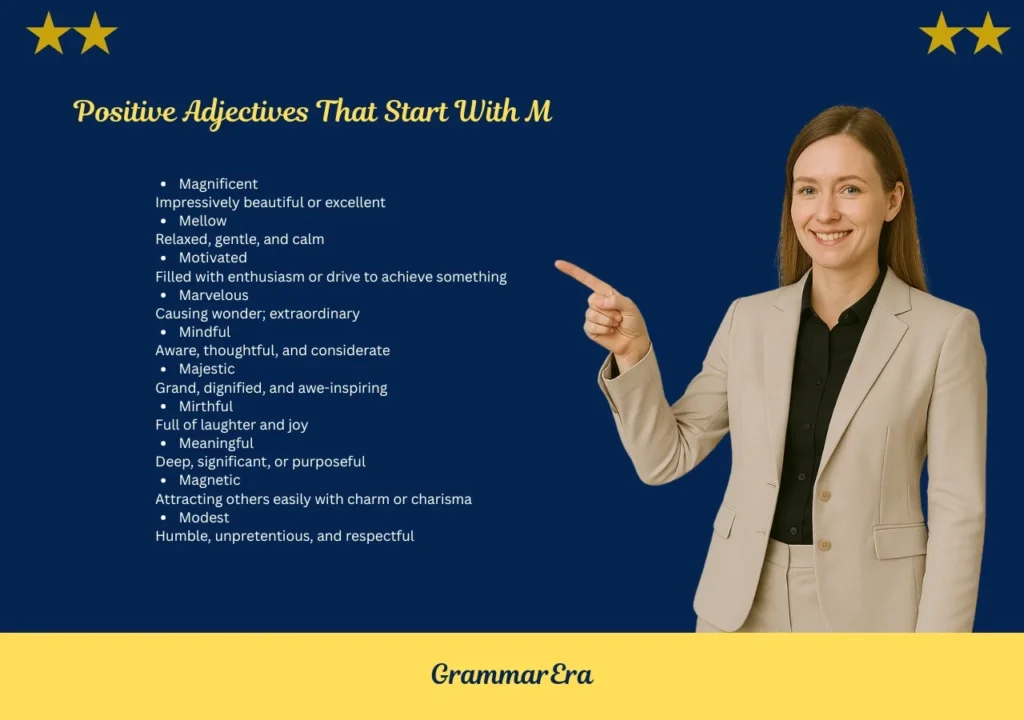
Adjectives are words that describe or modify nouns and pronouns. The letter M begins hundreds of English adjectives, ranging from simple everyday words to specialized vocabulary.
For example, “a massive building” describes size, while “a modern building” describes its style or age. Similarly, “a mysterious sound” tells readers that the sound is difficult to explain.
Common M Adjectives and Their Meanings
Some M adjectives are especially useful in everyday American English. Mature can describe a person, idea, or decision that shows good judgment. Modest can describe someone who doesn’t boast or something that is moderate in size or cost.
Other words have more specific meanings. Meticulous means very careful about details, while mindful means aware and considerate. Mellow often describes a relaxed person, mood, sound, or flavor.
| Adjective | Meaning | Example | Notes |
| Magical | Wonderful or enchanting | The evening was magical. | Usually positive |
| Mature | Fully developed or sensible | She made a mature decision. | People and ideas |
| Modest | Humble or moderate | He has a modest home. | Meaning depends on context |
| Massive | Extremely large | They built a massive stadium. | Stronger than “large” |
| Meticulous | Very careful and detailed | She is meticulous at work. | Usually positive |
| Mysterious | Difficult to explain | A mysterious noise woke me. | Often creates curiosity |
| Miserable | Very unhappy or uncomfortable | He felt miserable after the loss. | Usually negative |
| Mindful | Aware and considerate | Be mindful of the time. | Common in modern English |
Where Do M Adjectives Appear?
Most English adjectives can appear before a noun. For example, we can say “a magnificent view,” “a messy room,” or “a meaningful conversation.”
However, adjectives can also follow a linking verb. In “The view is magnificent,” the adjective magnificent describes the subject view. This pattern is common with verbs such as be, seem, become, feel, look, and remain.
A Brief History of M Adjectives in English
The letter M has a long history in written language. Its form can be traced through ancient writing systems before becoming part of the Latin alphabet used by English.
English itself developed from severalGermanic varieties. Later, Latin, French, Greek, Norse, and other languages added thousands of words to English vocabulary.
How M Vocabulary Developed
Many familiar M adjectives have different historical paths. Mature came into English through French and ultimately traces back to Latin. Modern also has Latin roots, while mysterious is connected to Greek through Latin and French.
Meanwhile, everyday words such as mad, mild, and many have older Germanic roots. This mixture explains why M adjectives can look and sound very different from one another.
Why English Has So Many M Adjectives
English has continually borrowed words while also creating new ones from existing vocabulary. For example, modern English can form adjectives using endings such as -ful, -less, -ic, -al, -ous, and -able.
Words such as meaningful, musical, mysterious, measurable, and manageable show how different word-building patterns create new descriptive terms. As society changes, new adjectives also enter everyday use.
How M Adjectives Are Used in American English
In American English, M adjectives are used across almost every type of communication. Some are extremely common, while others are better suited to formal or creative writing.
For example, Americans commonly say “a major problem,” “a modern apartment,” “a messy kitchen,” or “a meaningful conversation.” These words sound natural in both speech and writing.
Formal and Informal Usage
Some M adjectives work well in professional communication. Major, measurable, meaningful, moderate, and mutual can appear naturally in reports, emails, and workplace discussions.
However, other words may create a more informal tone. Messy, mad, mellow, and mushy are common in conversation but may need more careful use in formal writing.
Describing People
M adjectives can describe a person’s personality, behavior, appearance, or abilities. For example, someone can be mature, modest, motivated, meticulous, or mischievous.
Context matters greatly. Calling someone meticulous can be praise because it suggests care and accuracy. Calling someone meddlesome, however, suggests that the person interferes too much in other people’s affairs.
Positive, Negative, and Neutral M Adjectives
M adjectives don’t all have the same emotional effect. Some express praise, some communicate criticism, and others simply provide information without strong emotion.
Positive M Adjectives
Words such as magnificent, marvelous, mindful, motivated, mature, masterful, and magnanimous can express positive qualities.
For example, “She gave a magnificent performance” clearly praises her performance. Likewise, “He is a mindful coworker” suggests that he pays attention to other people’s needs.
Negative M Adjectives
Some M adjectives communicate an unfavorable quality. Examples include malicious, manipulative, miserable, miserly, moody, messy, and mean.
These words should be chosen carefully when describing people. For example, “He is meticulous” describes a useful quality, while “He is manipulative” makes a much stronger judgment about behavior.
Neutral M Adjectives
Many M adjectives are mainly descriptive. Metallic, marine, mathematical, mechanical, middle, measurable, and microscopic usually provide information rather than praise or criticism.
For instance, “The sculpture has a metallic surface” simply describes its appearance. The adjective doesn’t automatically tell readers whether the surface is good or bad.
Common Mistakes With M Adjectives
M adjectives can be easy to recognize but harder to use naturally. The biggest problems usually involve meaning, word choice, comparison, and sentence structure.
Confusing Similar Meanings
Some M adjectives have meanings that overlap but aren’t identical. Mature and modern, for example, describe completely different qualities even though both can describe ideas or products.
Similarly, miserable means extremely unhappy or uncomfortable, while miserly means unwilling to spend or give money. Saying “He is miserly” does not mean that he is simply unhappy.
Using an Adjective in the Wrong Position
Most adjectives can come before a noun, but not every adjective behaves in exactly the same way. For example, “a mysterious story” is natural, as is “the story is mysterious.”
However, learners should avoid assuming that every descriptive word can be placed anywhere. English adjective patterns depend on the individual word and its meaning.
Overusing Strong Adjectives
Another common mistake is using very strong words when a simple adjective is enough. Massive means extremely large, so it can sound exaggerated when describing an ordinary object.
Instead, choose words according to the actual meaning. Large, major, massive, and microscopic all communicate different levels or types of description.
M Adjectives in Everyday Communication
M adjectives are useful because they help people communicate specific ideas without long explanations. They appear naturally in conversations, emails, text messages, school assignments, and social media.
In Speaking and Texting
People often use simple M adjectives in casual speech. Someone might say, “That movie was amazing,” “My room is messy,” or “The weather is miserable today.”
In texting, adjectives are often shortened by context rather than grammar. A message such as “Such a magical night!” can communicate a complete emotional reaction without a traditional sentence structure.
In School and Workplace Writing
More precise M adjectives can improve formal writing. For example, measurable, meaningful, major, mutual, and moderate can make an explanation more specific.
Instead of writing “We made a big improvement,” a writer might say “We made a measurable improvement.” The second sentence gives readers a clearer idea of what kind of improvement occurred.
British and American Differences
Most M adjectives have the same spelling and meaning in American and British English. Words such as modern, mature, modest, mysterious, and magnificent are widely understood in both varieties.
However, pronunciation, preferred expressions, and regional vocabulary can sometimes differ. These differences usually don’t prevent communication because the core adjective remains recognizable.
Meaning Can Change With Context
Some adjectives have multiple meanings in American English. Mean, for example, can describe someone who is unkind, but it can also refer to mathematical value or intention.
Likewise, mad can mean angry in American English, while it can also mean mentally unwell in some contexts. Therefore, surrounding words are important when interpreting an M adjective.
How M Adjectives Have Changed Over Time
English adjective usage continues to change as speakers create new expressions and give older words new meanings. Some adjectives that once sounded formal now appear in everyday conversation.
For example, major is commonly used as an adjective meaning important or significant. In modern American speech, it can also appear in informal expressions that emphasize something strongly.
Modern Digital Communication
Social media and texting have also encouraged flexible adjective use. People often use adjectives creatively to express reactions, humor, excitement, or criticism.
However, formal writing still benefits from standard grammar. A playful phrase may work in a text message but sound inappropriate in a school paper or professional email.
How to Choose the Right M Adjective
The strongest adjective isn’t always the longest or most unusual one. Good writing depends on selecting a word that matches the exact meaning and tone you want.
For example, use modest when you mean moderate or unassuming. Use miserly when you mean unwilling to spend money. Use meticulous when you mean extremely careful about details.
Also, consider your audience. A familiar word such as major or modern is usually easier for general readers than a rare term such as munificent or mellifluous.
FAQs
1. What are adjectives that start with M?
They are describing words that begin with the letter M. Examples include majestic, marvelous, mindful, and meticulous.
2. How many M adjectives are there?
There are hundreds of adjectives beginning with M in the English language. Different word lists may contain different numbers of common and less common choices.
3. What are some positive M adjectives?
Some positive choices include majestic, marvelous, meaningful, mindful, and motivated. The best word depends on what you want to describe.
4. Can M adjectives describe a person?
Yes. Words such as mindful and meticulous can describe a person’s qualities, habits, or behavior.
5. Can M adjectives describe places and things?
Yes. M adjectives can describe a place, thing, or event. For example, majestic can describe an impressive place or sight.
6. Why should I learn M adjectives?
Learning M adjectives gives you more vocabulary choices and helps make your writing clearer, more detailed, and more interesting.
7. How can I choose the right M adjective?
Think about the exact meaning you need, then check whether the adjective fits the noun and the context. Practicing it in a sentence can also help.
8. Where can I practice M adjectives?
You can practice through adjective activities, sentence examples, vocabulary lists, and short writing exercises. These methods help you remember new words.
Test Your Understanding
1. Which word means “very careful about details”?
A. Massive
B. Meticulous
C. Mellow
D. Mysterious
2. Which sentence uses an M adjective after a linking verb?
A. “A magnificent view”
B. “The view is magnificent”
C. “Magnificent, isn’t it”
D. “Viewing the magnificent”
3. Which word describes someone who is unwilling to spend money?
A. Miserable
B. Mindful
C. Miserly
D. Modest
4. Which of these is a neutral, mostly descriptive M adjective?
A. Malicious
B. Magnificent
C. Metallic
D. Miserable
5. What’s the biggest reason to choose a precise M adjective over a strong or unusual one?
A. It sounds more impressive
B. It matches your exact meaning and audience
C. It’s always the longest option
D. It works in every sentence position
Answer Key:
1. B — Meticulous means very careful about details.
2. B — Linking verbs like “is” place the adjective after the subject.
3. C — Miserly means unwilling to spend or give money.
4. C — Metallic simply describes an appearance, without praise or criticism.
5. B — The right word matches your meaning and fits your reader.
Conclusion
Learning adjectives that start with M gives you many ways to make your vocabulary stronger and your writing more detailed. The English language contains hundreds of M adjectives, ranging from common words to less familiar choices. Words such as majestic, marvelous, mindful, and meticulous can describe a person, place, thing, or event with greater detail.
Instead of using the same simple words repeatedly, you can choose an adjective that matches your exact meaning and improves your sentence. Exploring an adjective list can also help you discover positive, descriptive, and meaningful vocabulary.
Regular practice through sentence examples and adjective activities makes these words easier to remember. Whether you need a word for school, everyday communication, or creative writing, M adjectives provide plenty of useful options to make your writing sharper.
Related Grammar and Language Guides
Adjectives Start with L: Boost Your Vocabulary
Adjectives Start With K: Meaning, Use, and Examples
Adjectives Start With X: Meanings and Examples
Adjectives Start With Y: Meanings and Examples

Fahad is a seasoned English language trainer with a focus on IELTS and TEFL preparation.
He holds a Ph.D. in Applied Linguistics and has over 10 years of teaching experience.
Fahad is passionate about helping students achieve fluency and global opportunities.
His classes combine practical techniques with a supportive, student-first approach.