
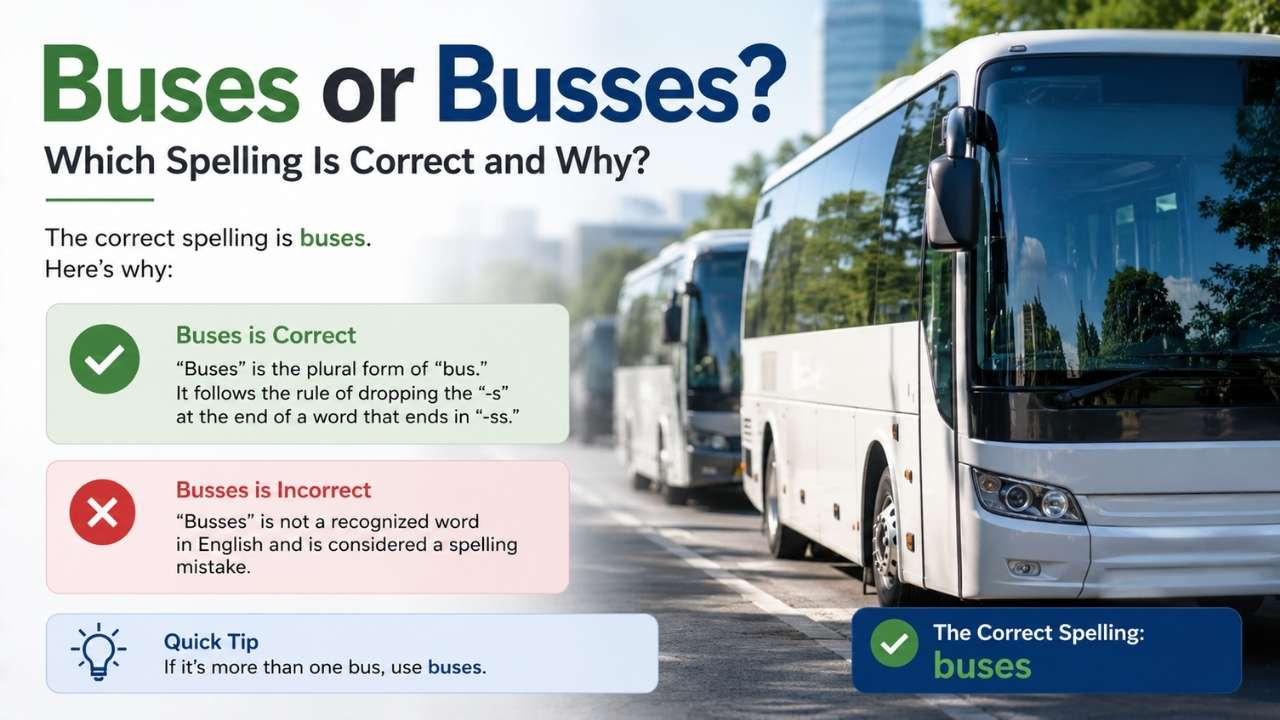
Many English learners and writers get confused when they see the words “buses or busses” and wonder which one is correct. This confusion often appears when people search for the plural of bus, especially in grammar checks or writing tools. The correct form is actually buses, not busses, in most cases. This simple spelling rule comes from standard English grammar rules for plural nouns, especially words ending in -s, -ss, -sh, -ch, and -x.
However, the confusion grows because both forms look and sound similar, and some people assume both are acceptable. In reality, buses is the correct plural spelling of bus, while busses is only used in rare cases as a verb.
In this article, we will clearly explain the difference between buses vs busses, why this rule exists, and how you can easily remember the correct form in everyday writing.
Quick Answer
The correct plural of bus is buses, not busses. This follows standard English grammar rules for plural nouns, where words ending in -s usually add -es. The form busses is generally incorrect as a noun but can appear as a rare verb meaning “to transport or serve.” In all normal usage, always write buses.
What Is the Plural of Bus?

The correct plural of bus is buses. This is the standard form used in both British and American English, so there is no regional difference in this case. When one bus becomes more than one, we simply add -es instead of just -s. So, one bus becomes two buses, not busses.
This follows a basic English spelling rule for plural nouns, where words ending in -s often need -es to make pronunciation clearer. This rule helps keep words easy to read and speak. You will see this pattern in many other words too, like glass → glasses and class → classes.
So whenever you think about the plural form of bus in English, always remember this simple rule: bus becomes buses. This is the correct and widely accepted form in all formal and informal writing.
Why “Buses” Is Correct
The reason buses is correct comes from a simple plural noun rule in English grammar. Words that end in -s, -ss, -sh, -ch, or -x usually form their plural by adding -es instead of just -s. This rule helps make the word easier to pronounce and avoids awkward sound combinations.
For example, if we only added “s” to bus, it would become buss, which is confusing and does not follow natural English sound patterns. So, English adds -es, forming buses, which is smoother and clearer.
This rule applies to many other words too, like box → boxes, brush → brushes, and class → classes. Because of this consistent pattern, buses or busses confusion becomes easy to solve once you understand the rule. So, the correct spelling always remains buses, and it follows a standard rule used in both UK vs US English spelling systems.
Is “Busses” Ever Correct?
Yes, but only in a very different meaning. The word “busses” is sometimes correct, but it is not the plural of bus. Instead, it can be used as a verb form. For example, in English, “to buss” means to kiss someone lightly or, in modern usage, to serve or transport in certain contexts like cleaning tables in restaurants.
So, when someone says “he busses the dishes,” it is a verb, not a noun. This is where many learners get confused between buses vs busses grammar usage. One is a noun (transport vehicles), and the other is a verb (an action).
Because of this difference, busses is not used as the plural of bus in standard English grammar. Most confusion happens when people assume both spellings mean the same thing. However, in correct usage, buses is the plural form, and busses is only a rare verb form.
Buses vs Busses: Key Differences
The difference between buses and busses is simple once you break it down. The word buses is a noun, and it represents more than one bus. On the other hand, busses is usually a verb, meaning an action, not a quantity.
For example:
- Buses arrive at the station every hour. (noun)
- She busses the tables after dinner. (verb)
This shows that context is very important in English grammar. Many people searching “is it buses or busses” actually want to know the correct plural form, and the answer is always buses when talking about transport.
Understanding this difference also helps with other commonly confused words in English grammar. Once you learn how verbs and nouns change meaning, it becomes easier to avoid spelling mistakes like this in writing, exams, or professional communication.
Examples of “Buses” in Sentences
The word buses is widely used in everyday English, and it always represents the correct plural form of bus. Here are simple examples that show how it works in real sentences.
- The buses arrived late due to traffic.
- School buses carry children every morning.
- We waited for two buses at the station.
- City buses are often crowded during rush hours.
These examples clearly show how buses works as a plural noun in both formal and informal contexts. You will never need to write busses in these situations. This also helps answer common questions like “is buses correct” or “what is the plural of bus in English”.
By practicing these simple examples, you can easily remember the correct spelling and avoid confusion in writing tasks, grammar tests, and daily communication.
Common Mistakes People Make
Many learners make mistakes when using buses or busses because they try to apply spelling rules without fully understanding them. One common mistake is adding only -s, which leads to incorrect forms like buss instead of buses. Another mistake is assuming that every word ending in “s” should double the letter, which is not true in English grammar.
People also confuse pronunciation with spelling, thinking that “busses” sounds more natural, but English spelling does not always match sound. This is a common issue in English spelling rules for beginners.
Another frequent error is mixing up noun and verb forms, especially in phrases like buses vs bussed meaning confusion. Because of this, writers often use the wrong form in essays or emails. Understanding the basic rule of plural nouns ending in -s → add -es helps avoid all these mistakes easily.
Why This Confusion Happens
The confusion between buses and busses happens mainly because English spelling does not always follow pronunciation. When people hear the word, both forms sound almost the same, so they assume both spellings are correct. This is a common issue in English grammar for beginners and ESL learners.
Another reason is pattern confusion. English has many irregular plural forms, so learners sometimes guess instead of applying rules. This leads to errors like busses instead of buses.
In addition, some learners try to overapply spelling rules from other words, which creates mistakes in commonly confused grammar words. The lack of clear understanding of pluralization rules in English grammar also adds to the problem.
Once you learn that words ending in -s, -ss, -sh, -ch, -x usually take -es, the confusion becomes much easier to avoid in writing and communication.
Quick Memory Trick to Remember the Rule
A simple way to remember the correct spelling is to use this rule: “Add -es after s-ending words.” So, bus becomes buses. This small trick works for many similar words in English and helps you avoid spelling mistakes in exams, writing tasks, and daily communication.
You can also remember it like this: if a word already ends in -s, you usually need -es to make it plural. This is part of standard English grammar rules for plural nouns, especially in beginner-level learning.
For example:
- bus → buses
- class → classes
- box → boxes
By practicing this pattern, you can easily avoid confusion between buses or busses and improve your overall spelling accuracy in English writing.
FAQs
Is it buses or busses?
The correct plural of bus is buses, not busses.
Why is buses correct?
Because English grammar adds -es to words ending in -s.
Is busses ever correct?
Yes, but only as a verb, not a plural noun.
What is the plural form of bus?
The correct plural form is buses in all English usage.
Is buses used in UK and US English?
Yes, both use buses with no difference.
Why do people write busses?
It happens due to spelling confusion and pronunciation.
Is busses a real English word?
Yes, but it is rarely used and usually a verb.
Conclusion
In conclusion, the correct spelling is always buses when referring to more than one bus. This follows standard English grammar rules for plural nouns, where words ending in -s typically take -es.
The form busses is not used as a plural noun and only appears in rare verb usage. Once you understand this simple rule, the confusion between buses or busses becomes easy to avoid in both writing and speaking.

Fahad is a seasoned English language trainer with a focus on IELTS and TEFL preparation.
He holds a Ph.D. in Applied Linguistics and has over 10 years of teaching experience.
Fahad is passionate about helping students achieve fluency and global opportunities.
His classes combine practical techniques with a supportive, student-first approach.