
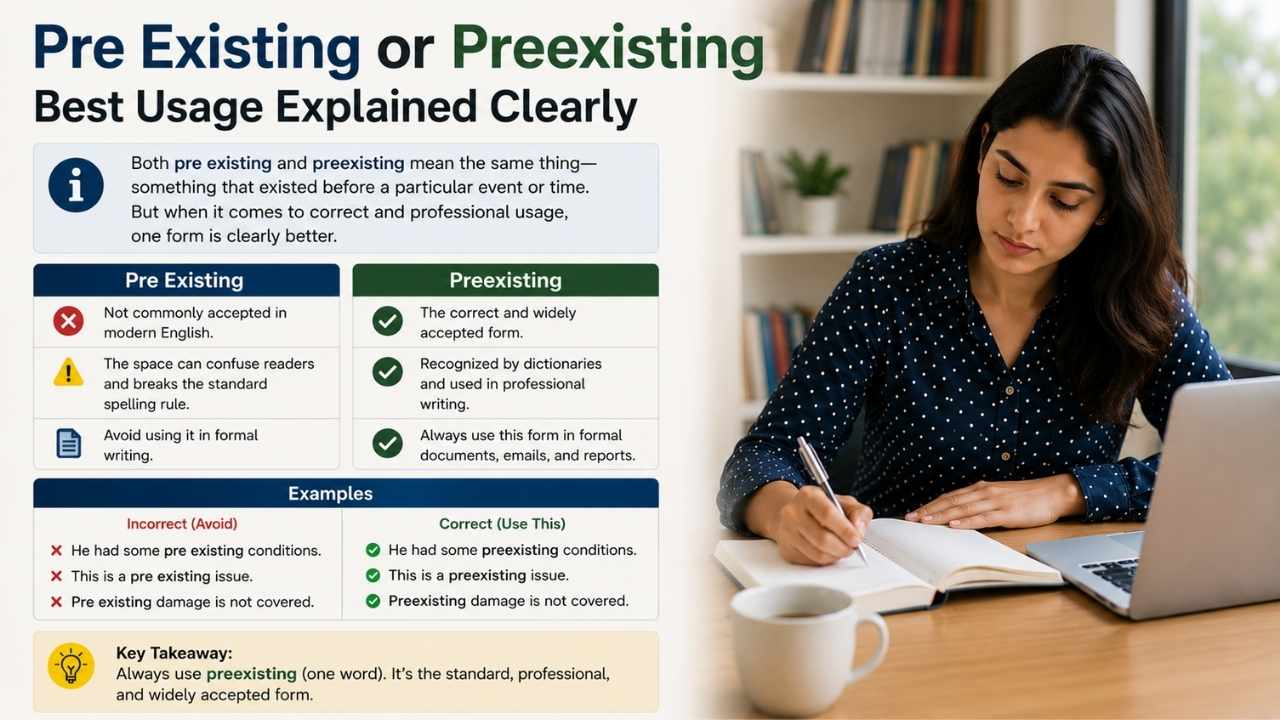
The words pre-existing and preexisting often confuse writers, students, and even professionals. Many people search for questions like “which is correct pre-existing or preexisting” or “is preexisting one word or two words” because both forms appear in different sources. You may see pre-existing meaning, preexisting meaning, or even preexisting definition used in dictionaries, medical documents, and articles.
The truth is simple: both spellings are correct, but usage depends on writing style and context. Some sources prefer the hyphenated form pre-existing, while others use the closed form preexisting in modern writing. This difference creates confusion, especially in grammar rules and style guides.
In this article, you will learn the correct spelling rules, meaning of preexisting, and the real difference between pre-existing vs preexisting with clear examples. We will also explain how usage changes in grammar, medicine, and everyday writing.
Quick Answer
Both pre-existing and preexisting are correct spellings with the same meaning. Pre-existing is more common in formal writing and dictionaries, while preexisting is often used in modern medical and legal contexts. The word refers to something that already existed before a specific time or event. The difference is only in style, not meaning or grammar correctness.
What Does Pre-existing Mean?
The term pre-existing meaning refers to something that already existed before a specific time or event. In simple words, pre-existing definition means “already present before something else happened.” The prefix “pre-” means before, and the word existing means already there. When we combine them, we get a clear idea of something that was present earlier.
You may also see searches like “what does preexisting mean in English” or “preexisting meaning in simple English.” In grammar and dictionary sources such as Cambridge and Merriam-Webster, the meaning stays the same regardless of spelling variation.
For example, a preexisting condition meaning in insurance refers to a health issue that existed before coverage started. This shows how the term works in both general and medical usage. In short, preexisting meaning always stays about something that existed earlier, no matter how you spell it.
Pre-existing vs Preexisting: Key Difference
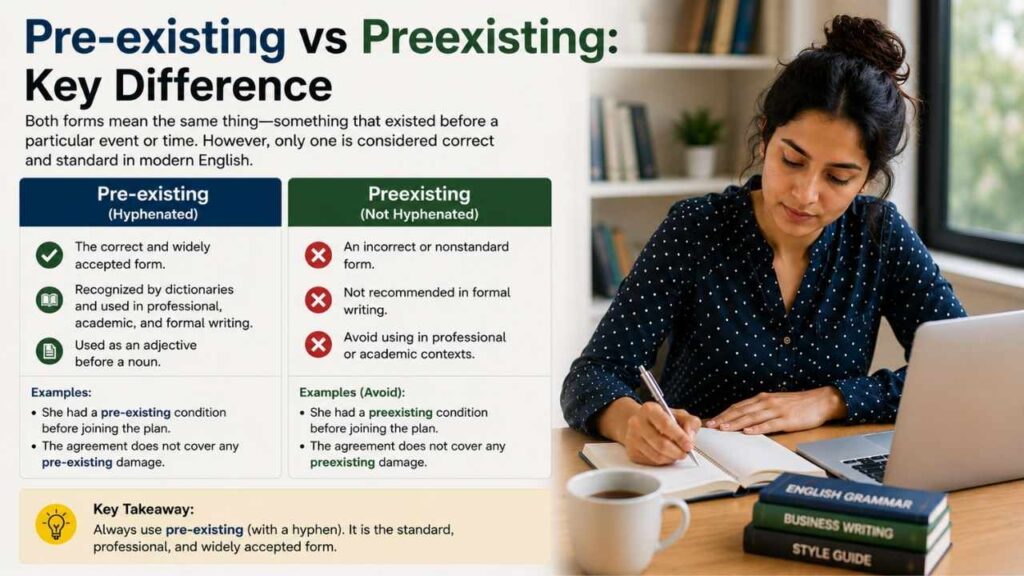
The main difference between pre-existing vs preexisting is not meaning but style. Both forms share the same preexisting meaning, but writers use them differently based on tone and context.
The hyphenated form pre-existing is more common in formal writing, dictionaries, and academic content. It often appears in sources like Cambridge Dictionary definition entries. On the other hand, the closed form preexisting is widely used in modern writing, especially in medical and legal documents. This is why you often see preexisting condition definition in insurance policies.
People often ask, “is preexisting grammatically correct?” The answer is yes. English allows both forms because compound adjectives can change over time. The meaning does not change, even if the spelling does.
So, whether you write pre-existing or preexisting, both are correct. The choice depends on writing style, audience, and formality level.
Is “Preexisting” One Word or Two Words?
Many learners ask, “is preexisting one word or two words?” The correct answer is that preexisting is one word, while pre-existing is the hyphenated form of the same word. Both are accepted in English grammar, but they follow different writing conventions.
In compound adjective rules, English sometimes uses a hyphen to make meaning clearer. This is why you often see pre-existing condition meaning in formal texts. However, as language evolves, many hyphenated words become closed forms. That is why preexisting spelling is now common in modern usage.
Dictionaries like Merriam-Webster may list both forms or prefer one for consistency, but they never change the meaning. Writers choose based on style guides such as AP Style or editorial preference.
So, there is no difference in meaning. The only difference is how the word is written in different contexts.
Grammar Rule Behind Pre-existing
The spelling pre-existing or preexisting follows a simple grammar idea called compound adjective rules. When two words act as one adjective before a noun, English often uses a hyphen for clarity. That is why we write pre-existing condition instead of separating the words.
However, grammar also allows flexibility. When language evolves, hyphens often disappear, creating closed forms like preexisting. This is common in modern English spelling rules.
For example, you may see:
- Pre-existing injury (formal style)
- Preexisting condition (modern style)
Both follow correct English grammar. The difference depends on style guide spelling rules and writing preference. British English often keeps the hyphen longer, while American English tends to drop it faster in everyday usage.
So, the grammar rule is simple: both forms are correct, and usage depends on clarity and context.
Examples of Pre-existing in Sentences
Understanding pre-existing meaning becomes easier when you see real examples. Both pre-existing and preexisting can be used in sentences without changing the meaning.
Here are simple examples:
- The doctor reviewed the patient’s pre-existing condition before treatment.
- The insurance policy does not cover preexisting medical conditions.
- She had a pre-existing injury before joining the team.
- Many contracts exclude pre-existing issues from coverage.
These examples show how preexisting meaning in grammar stays the same in all cases. Whether you use the hyphen or not, the sentence still expresses something that existed earlier.
If you search “how to use pre-existing in a sentence” or “example sentences preexisting,” you will find similar usage in both formal and informal writing. The key point is consistency. Once you choose a form, keep it consistent throughout your writing.
Common Mistakes People Make
Many writers get confused about pre-existing vs preexisting spelling rules, which leads to common mistakes. One major mistake is thinking that the two forms have different meanings. In reality, both mean the same thing.
Another mistake is switching between pre-existing and preexisting in the same article. This creates inconsistency and weakens writing quality. Some users also wrongly assume that one form is “incorrect,” but both are accepted in English grammar.
People also confuse hyphen rules in English grammar, thinking every compound word must always stay hyphenated. However, language evolves, and many words lose hyphens over time.
So, the key rule is simple: choose one form based on style preference and use it consistently. This avoids confusion and keeps your writing clear and professional.
Pre-existing in Medical and Insurance Context
The term pre-existing condition meaning in insurance is one of the most common uses of this word. It refers to a health issue that existed before a person’s insurance coverage began. This is why you often see preexisting condition definition in medical policies.
Examples include conditions like asthma, diabetes, or heart disease that existed earlier. Insurance companies use this term to decide coverage rules, waiting periods, or exclusions.
Many users search “what is a pre-existing medical condition” or “does preexisting condition affect insurance coverage.” The answer depends on the policy, but the term always refers to something that existed before coverage started.
In medical writing, both pre-existing and preexisting appear frequently. However, modern documents often prefer the closed form preexisting for simplicity. The meaning always stays the same, regardless of spelling style.
FAQs
Is preexisting one word or two words?
Both are correct: preexisting is one word, and pre-existing is the hyphenated form.
What does pre-existing mean?
It means something that already existed before a specific time or event.
Which is correct: pre-existing or preexisting?
Both are correct; usage depends on writing style and formality.
Does preexisting change the meaning?
No, both spellings have the same meaning.
Why is pre-existing used in writing?
It follows traditional grammar rules for compound adjectives.
Where is preexisting commonly used?
It is often used in medical and legal documents.
Is preexisting grammatically correct?
Yes, it is fully correct in modern English usage.
Conclusion
The difference between pre-existing vs preexisting is simple: both spellings are correct and share the same preexisting meaning. The hyphenated form pre-existing is commonly used in formal writing and dictionaries like Cambridge and Merriam-Webster, while preexisting appears more in modern medical, legal, and everyday usage.
There is no difference in preexisting definition, only in style and writing preference. Whether you use a hyphen or not, the meaning always refers to something that existed before a specific time or event, such as a pre-existing condition in insurance.

Fahad is a seasoned English language trainer with a focus on IELTS and TEFL preparation.
He holds a Ph.D. in Applied Linguistics and has over 10 years of teaching experience.
Fahad is passionate about helping students achieve fluency and global opportunities.
His classes combine practical techniques with a supportive, student-first approach.