
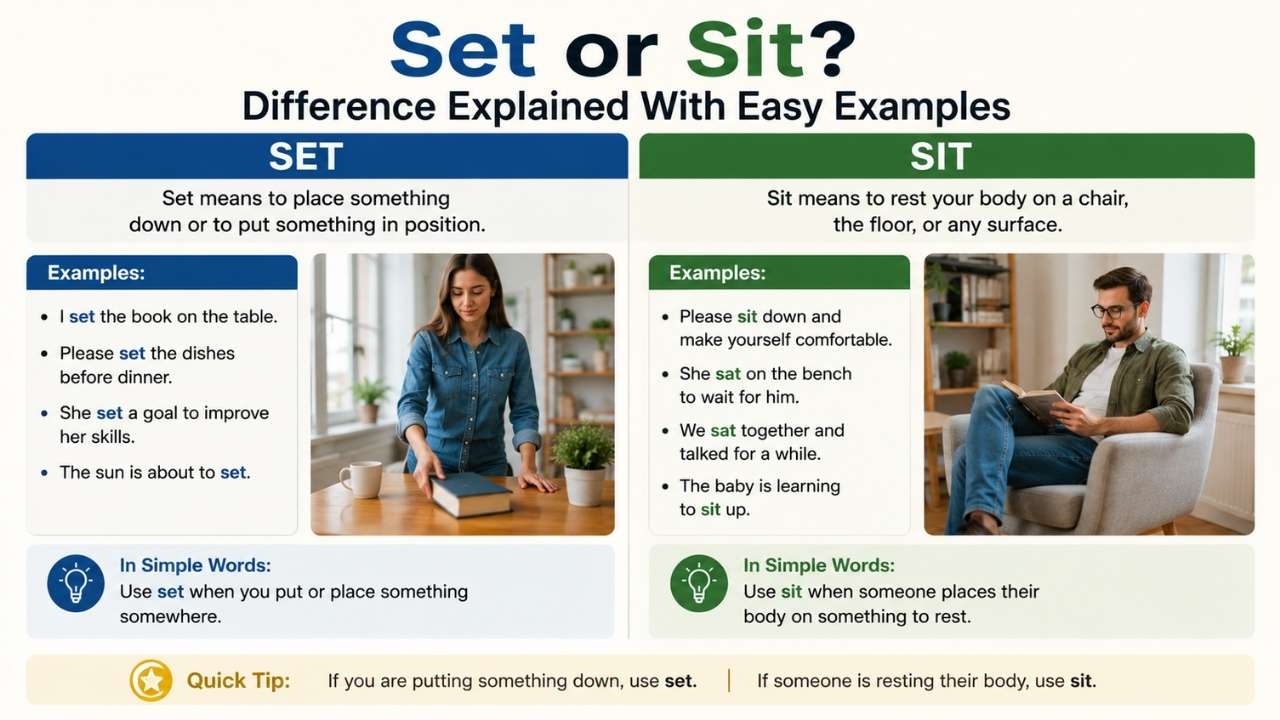
The confusion between sit and set is very common in English grammar, especially for ESL learners. Many people search for sit vs set difference, set vs sit grammar, or correct usage of sit and set because both words sound similar but work in very different ways. In simple terms, “sit” means to rest your body on a chair or surface,” while “set” means to place something somewhere. This small difference creates a lot of mistakes in daily English usage.
Understanding this topic helps improve both speaking and writing skills. You will often see learners asking when to use sit or set in a sentence or searching for sit vs set examples. In this guide, you will learn the rules, examples, common mistakes, and an easy trick to remember the difference clearly and permanently.
Quick Answer
The main difference between sit and set is simple: sit is used when a person rests their body in a seated position, while set is used when someone places or puts an object somewhere. For example, you “sit on a chair,” but you “set the book on the table.” Many learners confuse these two verbs because they look similar, but their grammar rules are different.
In grammar terms, sit is an intransitive verb, which means it does not need an object. On the other hand, set is a transitive verb, which always needs an object after it. This is the core rule behind sit vs set grammar confusion.
If you remember this simple rule, you can easily avoid common mistakes like saying “set here” instead of “sit here.”
What Does “Sit” Mean in English Grammar?
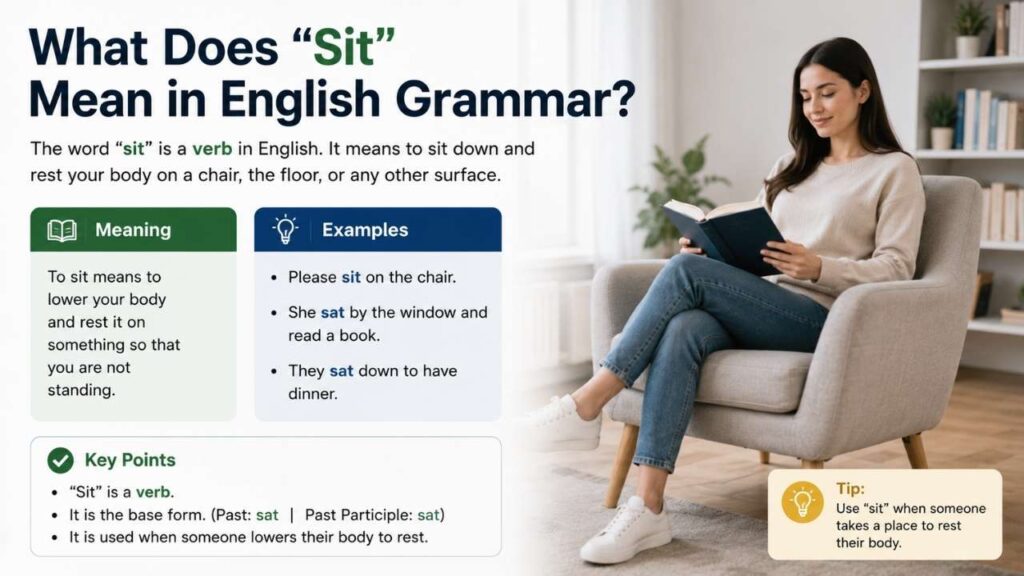
The word “sit” means to place your body in a resting position on a chair, ground, or surface. It is one of the most common verbs in daily English and appears in phrases like sit down, sit here, and sit on the chair. In grammar, sit is an intransitive verb, which means it does not need a direct object to complete its meaning.
For example, you can say, “I sit near the window,” or “Please sit here.” These sentences are complete without adding an object. This is why learners often study sit vs set examples to understand the difference clearly.
A common confusion happens when learners try to use sit like set. But remember, sit always focuses on the person’s position, not on moving objects. This simple rule helps avoid mistakes in everyday English conversations and writing.
What Does “Set” Mean in English Grammar?
The verb “set” means to place, put, or position something in a specific location. Unlike “sit,” the word set always requires an object, which makes it a transitive verb. You cannot use it alone because it needs something to act on.
For example, you say, “I set the book on the table,” or “She set the cup carefully.” These sentences clearly show action on an object. This is why many learners search for set vs sit grammar rules and set meaning in grammar to avoid confusion.
In daily English, set is used for objects, not people’s position. You would not say “set here” for a person; instead, you say “sit here.” Understanding this difference helps you improve accuracy in both writing and speaking and reduces common sit set confusion in English grammar.
Sit vs Set – Key Difference Table
The difference between sit and set becomes very clear when you compare them side by side. The word sit describes a person’s position, while set describes the action of placing an object. This is the most important rule in sit vs set grammar usage.
Sit is an intransitive verb, so it does not need an object. For example, “She sits on the sofa.” On the other hand, set is a transitive verb, so it always needs an object, like “She sets the book on the table.”
Another key difference is meaning. Sit focuses on resting or being seated, while set focuses on placing or arranging something. This simple structure helps learners avoid mistakes in sentences like “set on the chair,” which is incorrect.
Remembering this difference is the foundation of mastering set vs sit grammar rules easily.
Sit vs Set in Real-Life Sentences
Understanding sit vs set examples in real-life situations makes grammar easier to learn. In daily conversations, you use sit when talking about people and their position. For example, “Please sit here,” “He sits near the door,” or “They sit together in class.” These sentences show a natural resting position.
On the other hand, set is used when placing objects. For example, “I set my phone on the table,” “She sets the plate carefully,” or “He set the keys near the door.” These examples show clear action on things.
Many learners confuse these in spoken English, especially when forming quick sentences. That is why understanding sit vs set usage is important for fluency.
If you practice these simple examples daily, you will naturally stop mixing them and improve your overall English grammar accuracy in both speaking and writing.
Common Mistakes People Make with Sit and Set
One of the most common grammar problems is mixing sit and set in sentences. Many learners say things like “I will set here” when they actually mean “I will sit here.” This happens because both words look similar, but their usage is very different in English grammar.
Another frequent mistake is using sit with objects, such as “sit the book on the table,” which is incorrect. The correct sentence is “set the book on the table.” These errors are part of the common sit set confusion in English usage.
Learners also confuse sit down vs set down, especially in fast conversation. The rule is simple: sit is for people, set is for objects.
By understanding these patterns, you can easily avoid grammar mistakes and improve your confidence in using correct sit vs set grammar rules in daily communication.
Easy Trick to Remember Sit vs Set
A simple way to remember sit vs set difference is to connect each word with its action. Think of sit as “self-action”, meaning a person does it alone. You sit yourself down on a chair, so it always relates to a human position. This makes it easy to remember sit is for people, not objects.
Now think of set as “set something somewhere.” The word always needs an object after it. You set a book, set a cup, or set an item on a surface. This helps you remember that set always transfers action to something else.
Another easy trick is: Sit = Self, Set = Something. This memory shortcut is widely used in ESL learning to reduce sit vs set confusion quickly.
If you practice this rule a few times, you will naturally stop making mistakes and improve your everyday English grammar usage.
Sit vs Set in Spoken English
In spoken English, native speakers use sit and set very naturally, but learners often misunderstand their usage. The word sit is commonly used in daily conversation when asking someone to take a seat, such as “Please sit down” or “Sit over here.” It directly refers to a person’s position and comfort.
On the other hand, set is mostly used with objects or instructions, such as “Set the table” or “Set your phone here.” In real conversations, natives rarely confuse these because the object rule is deeply natural to them.
Understanding sit vs set usage in spoken English helps learners sound more natural and confident. Many ESL students struggle with this because they translate directly from their native language.
If you focus on real-life examples and listen carefully to native usage, you will quickly master the difference between sit and set in daily communication.
Sit vs Set – Quick Cheat Sheet
Here is a simple sit vs set cheat sheet to help you remember everything quickly. This summary is useful when you need fast revision of sit vs set grammar rules.
Use SIT when you talk about a person resting or taking a seat. Example: “Please sit here.” Remember, it does not need an object, and it always describes position.
Use SET when you talk about placing or putting something somewhere. Example: “Set the glass on the table.” It always needs an object after it.
A simple rule to remember is: Sit = people, Set = things. This makes it easier to avoid common mistakes in English writing and speaking.
Keep this cheat sheet in mind whenever you feel confused. It will help you quickly choose the correct word in both casual and formal English communication.
Practice Section
Let’s test your understanding of sit vs set usage with a few simple exercises.
Fill in the blanks with the correct word (sit or set):
- Please ___ down on the chair.
- I will ___ the book on the table.
- They ___ together in the classroom.
- She ___ the cup near the window.
- He likes to ___ by the door.
Answers:
- sit
- set
- sit
- set
- sit
This small practice helps reinforce the difference between sit and set in real usage. The more you practice, the easier it becomes to avoid grammar mistakes in daily English.
FAQs
What is the main difference between sit and set?
The main difference is that “sit” is used when a person rests in a seated position, while “set” is used when someone places an object somewhere. For example, you “sit on a chair,” but you “set a book on the table.” This is the core rule behind sit vs set difference in English grammar.
Is it correct to say “sit the book on the table”?
No, this is incorrect. You should say “set the book on the table.” The verb sit is only used for people or subjects taking a seat, not for objects. This is one of the most common mistakes in sit set confusion in English usage.
Can I use sit and set in the same way?
No, sit and set are not interchangeable. They have different grammar roles. Sit is intransitive (no object needed), while set is transitive (needs an object). This rule is important for avoiding errors in set vs sit grammar usage.
When should I use “sit down”?
You use “sit down” when you want someone to take a seat or lower their body into a sitting position. For example, “Please sit down here.” It is commonly used in daily conversation and classroom instructions.
What is the past tense of sit and set?
The past tense of sit is sat, and the past tense of set is also set. For example:
- I sat on the sofa yesterday.
- She set the table before dinner.
This difference is often confusing for learners studying sit vs set grammar rules.
Why do people confuse sit and set?
People confuse them because both words look and sound similar, but they have different meanings and grammar rules. Also, learners often translate directly from their native language, which increases sit set confusion in English usage.
Can “set” be used for people?
No, set is not used for people in the sense of sitting or resting. It is used for objects or arrangements, like “set the plate” or “set the table.” For people, you must use sit.
What is an easy way to remember sit vs set?
A simple trick is:
Sit = Self (people sit themselves)
Set = Something (you set objects somewhere)
This memory rule helps learners quickly understand sit vs set difference in English grammar and avoid mistakes.
Conclusion
The confusion between sit and set is common, but the rule is actually simple once you understand it clearly. Sit is used for people taking a resting or seated position, while set is used for placing or positioning objects somewhere. This core idea is the foundation of all sit vs set grammar rules and helps remove most errors in daily English usage.
Throughout this guide, you learned the difference between sit and set, saw real-life examples, understood common mistakes, and practiced a simple memory trick. These small steps are enough to build strong accuracy in both speaking and writing.
If you remember one thing, keep this rule in mind: sit is for humans, set is for things. Practicing this regularly will reduce sit set confusion in English usage and make your communication more natural and confident.

Fahad is a seasoned English language trainer with a focus on IELTS and TEFL preparation.
He holds a Ph.D. in Applied Linguistics and has over 10 years of teaching experience.
Fahad is passionate about helping students achieve fluency and global opportunities.
His classes combine practical techniques with a supportive, student-first approach.