
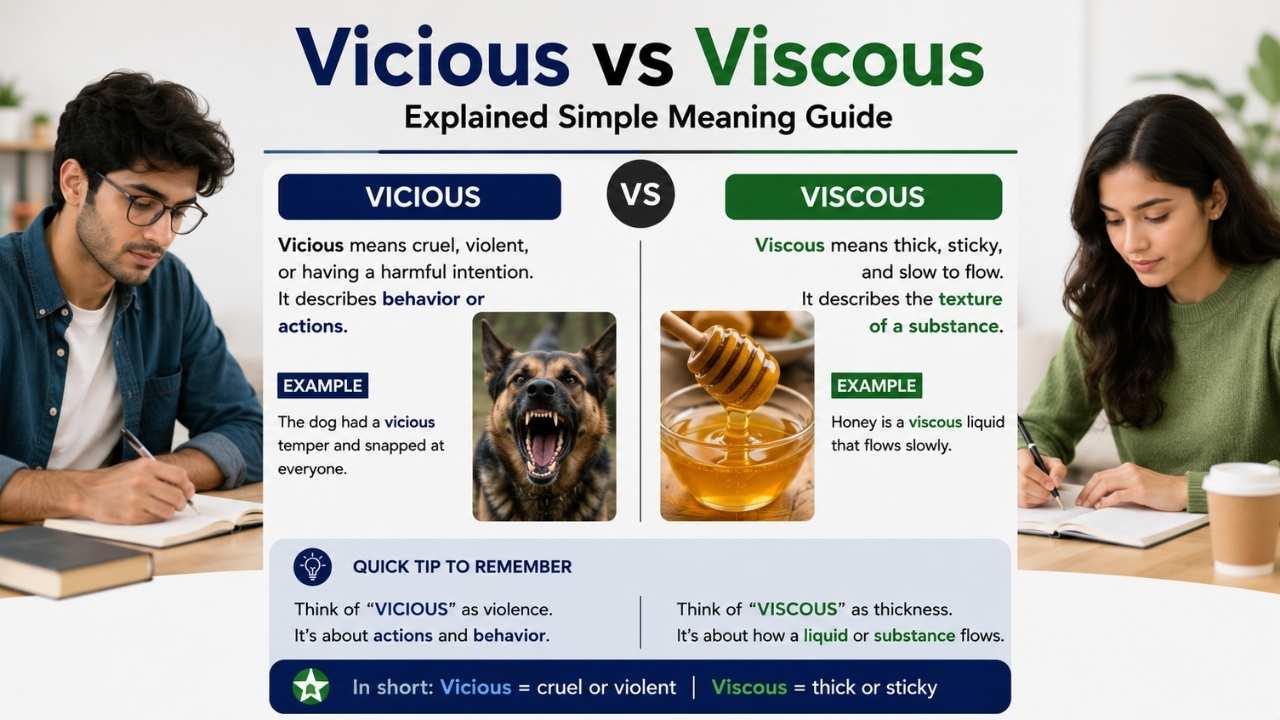
The words “viscous” vs “vicious” are often confused because they look and sound similar, but their meanings are completely different. Many people search for the difference between viscous and vicious when they are unsure which spelling is correct or what each word means.
In simple terms, viscous describes something thick or sticky, usually a liquid that does not flow easily, like honey or syrup. On the other hand, vicious refers to something cruel, violent, or dangerous, often used for behavior, animals, or actions.
This guide will clearly explain the viscous vs vicious difference, including meanings, pronunciation, and easy examples. You will also learn how to use both words correctly in sentences, understand why they are commonly confused words in English, and remember them easily with a simple trick.
Quick Answer
The difference between viscous and vicious is simple. Viscous means a thick, sticky liquid that flows slowly, like honey or oil. Vicious means cruel, violent, or harmful behavior, like a vicious dog or attack. Both words sound similar but describe completely different things—one is about physical texture, and the other is about aggressive behavior.
What Does “Vicious” Mean?
The word vicious meaning refers to something that is cruel, violent, or harmful. It is often used to describe a person, animal, action, or situation that shows aggression or danger. For example, a vicious dog may attack without warning, or a vicious fight can mean a very harsh and intense fight. Unlike viscous, this word is not about liquids or physical thickness. Instead, it is about behavior and actions that are aggressive or dangerous.
In simple terms, the vicious definition means “very cruel or violent.” You can say, “The lion is vicious,” or “He made a vicious comment.” It is also used in phrases like “vicious cycle,” which means a bad situation that keeps repeating. Understanding the viscous vs vicious difference helps you avoid mistakes in writing. Always remember: vicious is about harmful behavior, not physical texture or flow.
Viscous vs Vicious: Key Differences
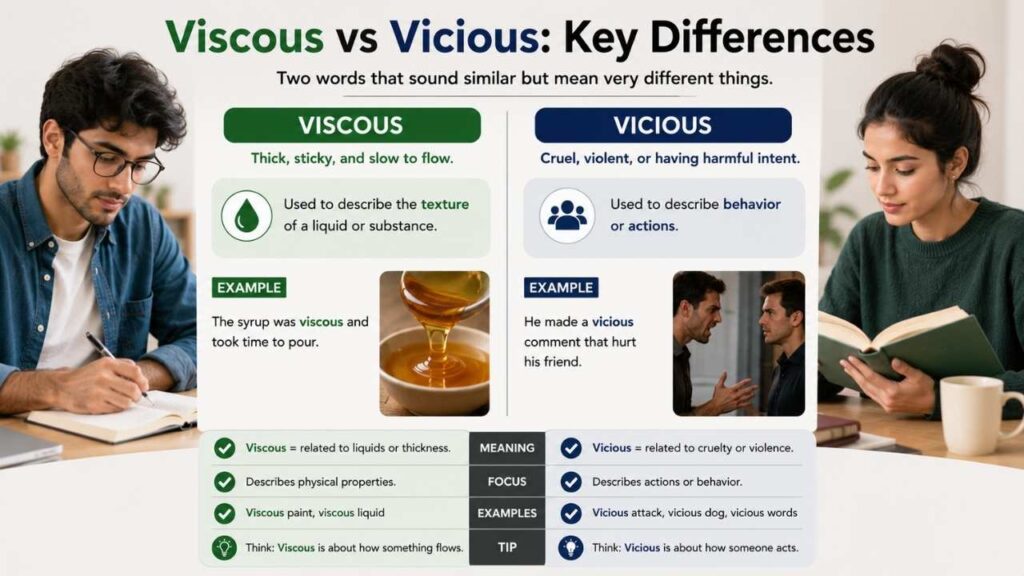
The viscous vs vicious difference is easy to understand when you compare them side by side. These two words sound similar, but they belong to completely different meanings and uses. Viscous is always related to physical thickness, while vicious is related to behavior and actions. One describes liquids, and the other describes aggression or cruelty.
For example, honey is viscous because it flows slowly, but a dog can be vicious if it behaves aggressively. This is why people often search for viscous vs vicious examples or ask about the difference between viscous and vicious words.
In simple terms, viscous belongs to science and liquids, while vicious belongs to emotions and behavior. This clear separation helps reduce confusion in writing and speaking. A quick way to remember is: viscous = thick, vicious = violent.
Why Do People Confuse Viscous and Vicious?
People often confuse viscous vs vicious because the two words look and sound very similar. Both words end with “-ous” and have almost the same spelling pattern, which creates confusion in reading and writing. Another reason is pronunciation. The words are close in sound, so learners of English often mix them up when speaking or listening.
This confusion is very common in commonly confused words in English, especially for students and ESL learners. Many people also make spelling mistakes when typing quickly or using speech-to-text tools. Because of this, users often search for difference between viscous and vicious explained simply.
In reality, the meaning is very different. One word is about liquids, and the other is about behavior. Understanding this helps reduce grammar mistakes and improves writing accuracy. Once you learn the pattern, you will rarely confuse them again.
Pronunciation Guide
The pronunciation of viscous vs vicious is one of the main reasons people confuse these words. Even though they look similar, they are spoken differently. Viscous is pronounced as /ˈvɪs.kəs/, which sounds like “VIS-kus.” It has a soft “s” sound in the middle. On the other hand, vicious is pronounced as /ˈvɪʃ.əs/, which sounds like “VISH-us,” using a “sh” sound.
This small sound difference is very important for understanding the viscous vs vicious pronunciation guide. Many learners do not notice the “sh” sound in vicious, which leads to mistakes.
A simple way to remember is: viscous has a soft sound like flowing liquid, while vicious has a sharp sound like aggressive behavior. This helps connect meaning with pronunciation. Learning this makes it easier to use both words correctly in speaking and writing without confusion.
Memory Trick to Remember the Difference
A simple way to remember viscous vs vicious is to use easy word tricks. Viscous = Very Sticky, because it describes thick liquids that move slowly. Think of honey or syrup sticking and flowing slowly. This helps you link the word with something physical and slow-moving.
On the other hand, vicious = Violent Behavior, because it describes cruelty, anger, or harmful actions. Think of a dog growling or a harsh fight. This connects the word with aggression and emotion.
Another easy trick is sound memory. Viscous has a soft “s” sound, which matches smooth, slow liquid flow. Vicious has a sharp “sh” sound, which matches aggressive behavior.
Using these simple memory hooks helps you avoid confusion in writing. This is one of the easiest ways to understand the difference between viscous and vicious and remember it for a long time without effort.
Common Mistakes Writers Make
Many writers confuse viscous vs vicious in everyday writing because the words look similar. One common mistake is using vicious when they actually mean a thick liquid, like saying “vicious oil” instead of viscous oil. This is incorrect because viscous only describes thickness and flow, not behavior. Another mistake is using viscous in emotional situations, such as “a viscous attack,” which should actually be vicious attack.
These errors often happen in fast writing, exams, or when people rely on spelling suggestions. The confusion also increases in commonly confused words in English, especially for learners who do not fully understand the meanings. Many users search for viscous vs vicious examples sentences to fix these mistakes.
To avoid errors, always check the context. If you are talking about liquids, use viscous. If you are talking about aggression or harm, use vicious. This simple rule helps improve writing accuracy and reduces confusion.
Viscous vs Vicious in Academic and Professional Writing
In academic and professional writing, using viscous vs vicious correctly is very important because both words belong to different fields. Viscous is commonly used in science, especially in physics, chemistry, and engineering. It describes how liquids flow, such as honey, oil, or lava. For example, researchers may write about “viscous fluids” when studying movement and resistance.
On the other hand, vicious is used in literature, psychology, and general writing to describe harmful or aggressive behavior. You may see phrases like “vicious cycle” in essays or “vicious attack” in news reports.
Understanding the difference between viscous and vicious words helps maintain clarity in formal writing. Using the wrong word can confuse readers and reduce credibility. That is why professionals carefully choose the correct term based on context. In simple terms, viscous belongs to science, while vicious belongs to behavior and emotions.
Quick Summary Table
The viscous vs vicious difference can be understood quickly with a simple summary. Viscous refers to something thick, sticky, and slow-moving, usually a liquid. It is commonly used in science and everyday descriptions of substances like honey, syrup, or oil. In contrast, vicious refers to something cruel, violent, or aggressive, and it is used to describe behavior, actions, or situations.
A quick comparison helps clear confusion. Viscous is about physical texture, while vicious is about behavior and emotion. For example, honey is viscous, but a dog attack can be vicious.
Many learners search for viscous vs vicious examples or a quick explanation to avoid mistakes. The easiest way to remember is simple: viscous = thick liquid, vicious = violent action. This short rule helps you use both words correctly in writing and speaking without confusion.
FAQs
Are viscous and vicious homophones?
No, viscous vs vicious are not true homophones, but they sound very similar. This is why many people confuse them in speaking and writing. The small pronunciation difference often causes spelling mistakes.
What is the main difference between viscous and vicious?
The main difference between viscous and vicious is meaning. Viscous refers to thick, slow-flowing liquids, while vicious refers to cruel, violent, or harmful behavior. One is physical, the other is behavioral.
What does viscous mean in simple words?
Viscous meaning is simple: it describes a thick liquid that moves slowly. Examples include honey, syrup, and oil. It is commonly used in science and everyday descriptions.
What does vicious mean in simple words?
Vicious meaning refers to something very cruel, aggressive, or dangerous. It is often used for animals, people, or actions that cause harm or show anger.
How do you pronounce viscous and vicious?
Viscous is pronounced “VIS-kus” (/ˈvɪs.kəs/), while vicious is pronounced “VISH-us” (/ˈvɪʃ.əs/). The “sh” sound in vicious is the key difference.
Why do people confuse viscous vs vicious?
People confuse them because they look similar, sound close, and share the same “-ous” ending. This makes them part of commonly confused English words.
What is an easy way to remember viscous vs vicious?
A simple trick is: viscous = very sticky liquid, and vicious = violent behavior. This memory rule helps avoid confusion in writing and speaking.
Conclusion
Understanding viscous vs vicious is important because these two words are often confused but have completely different meanings. Viscous refers to a thick, sticky liquid that flows slowly, like honey or oil. In contrast, vicious describes something cruel, violent, or harmful, such as a vicious animal or attack.
By learning the difference between viscous and vicious, you can avoid common writing mistakes and improve your English accuracy. Remember that viscous is linked to physical texture and science, while vicious is linked to behavior and emotions.
Using simple examples, pronunciation practice, and memory tricks like “viscous = very sticky” and “vicious = violent behavior” makes it easier to remember both words. With this understanding, you can confidently use them in speaking, writing, and exams without confusion.

Fahad is a seasoned English language trainer with a focus on IELTS and TEFL preparation.
He holds a Ph.D. in Applied Linguistics and has over 10 years of teaching experience.
Fahad is passionate about helping students achieve fluency and global opportunities.
His classes combine practical techniques with a supportive, student-first approach.