

If you’ve ever paused while writing and wondered, “Is the plural of ox oxes or oxen?”—you’re not alone. This small grammar question confuses students, writers, and even native English speakers because it breaks the most common plural rule in English. The good news? The answer is simple, clear, and easy to remember once you understand why it works this way.
In this guide, you’ll learn the correct plural of ox, why English still uses oxen, and how this word connects to other irregular plurals like children and men. With plain language, real examples, and quick memory tricks, you’ll master this rule in minutes—and never second-guess it again.
Quick Answer
The plural of ox is oxen, not oxes.
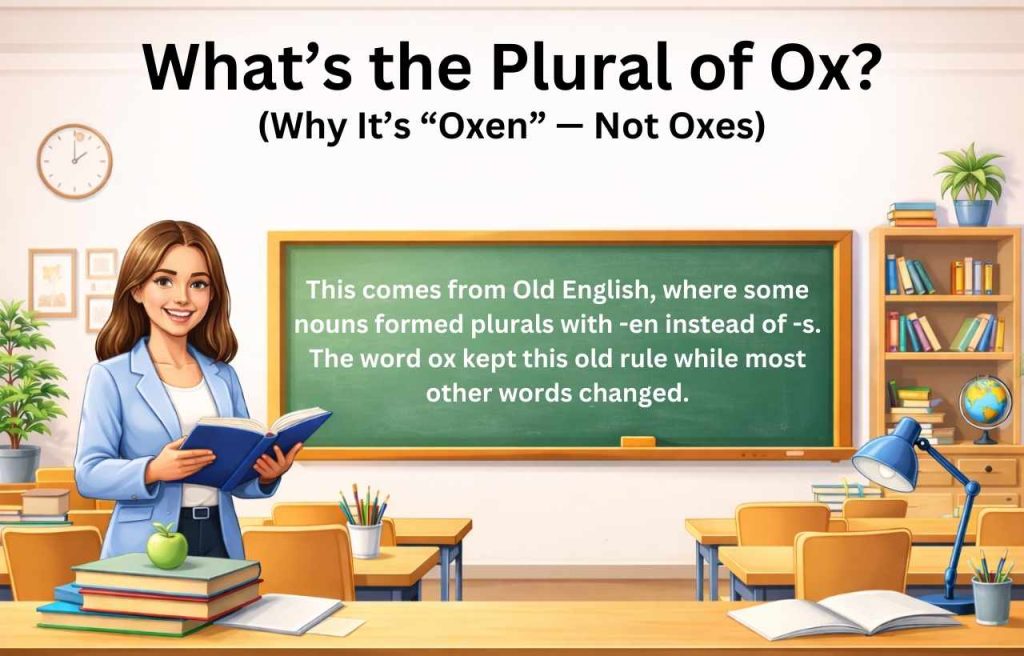
This comes from Old English, where some nouns formed plurals with -en instead of -s. The word ox kept this old rule while most other words changed.
Why “Oxen” Sounds Weird (But Is 100% Correct)
At first glance, oxen looks wrong. Modern English usually adds -s or -es to make plurals:
- cat → cats
- box → boxes
- dog → dogs
So naturally, many people assume:
- ox → oxes
But English isn’t always logical. Some very old words follow ancient grammar rules that survived even as the language changed.
The word ox comes from Old English “oxa”, and its plural form was “oxan,” which later became oxen. While English simplified most plurals over time, oxen stayed exactly as it was.
That’s why oxen may sound unusual—but it’s completely correct.
The 5 English Words That Still Use “-en” Plurals
Only a handful of English words still use the -en plural ending today. That’s why oxen feels so rare.
Here are the most important ones:
- Ox → oxen
- Child → children
- Brother → brethren (rare and formal; mostly religious or poetic)
In the past, English had many more -en plurals, but most disappeared as the language became simpler and more regular.
Today, oxen is one of the last survivors of this old system.
A 30-Second History: Old English Plurals Made Simple
You don’t need a linguistics degree to understand this—just think of English history in three quick steps:
- Old English (over 1,000 years ago)
- Many plural endings existed: -en, vowel changes, -s, and more.
- Many plural endings existed: -en, vowel changes, -s, and more.
- Middle English (after the Norman invasion)
- English mixed with French and Latin.
- Speakers preferred simpler patterns.
- English mixed with French and Latin.
- Modern English
- -s became the standard plural ending.
- A few old forms stayed because people kept using them.
- -s became the standard plural ending.
Oxen survived because the word ox was very common in farming and daily life, so its old plural form never faded away.
Common Mistakes People Make With “Ox”
Even fluent English speakers make mistakes with this word. Let’s fix the most common ones.
❌ Oxes
This is the most frequent error. It sounds logical, but it’s wrong.
- ❌ Three oxes pulled the cart.
- ✅ Three oxen pulled the cart.
❌ An oxen (Using plural as singular)
Oxen is always plural. It cannot refer to one animal.
- ❌ An oxen was in the field.
- ✅ An ox was in the field.
❌ Ox’s vs oxen’s (Possessive confusion)
- Ox’s = something belonging to one ox
- Oxen’s = something belonging to multiple oxen
Examples:
- The ox’s horn was damaged.
- The oxen’s yoke was heavy.
Is “Oxen” Ever Optional or Regional?
Short answer: No.
Unlike some words that change across dialects, oxen is the plural everywhere:
- British English ✅ oxen
- American English ✅ oxen
- Australian English ✅ oxen
- Other global English varieties ✅ oxen
There are no accepted alternatives in standard modern English. Oxes is considered incorrect in all formal and informal contexts.
How to Remember It Forever (Memory Trick)
Here’s a simple pattern-based trick that works amazingly well:
Child → children
Ox → oxen
Both are:
- Very old English words
- Living things
- Irregular plurals ending in -en
If you already accept children without question, just link oxen to it in your mind. Once you see the pattern, it sticks.
Another quick reminder:
If it sounds ancient, it probably is ancient—and still correct.
Oxen vs Oxes: Why English Broke Its Own Rules
English didn’t really “break” its rules—it changed them over time.
The modern rule (add -s) came later. Words like ox were already deeply rooted in everyday speech before that rule became dominant.
Because people kept saying oxen, the form never disappeared. Language follows usage, not logic.
That’s why:
- ox → oxen
- but box → boxes
Different histories, different rules.
Words That Trick Native Speakers Like “Ox”
Ox isn’t alone. Several common nouns still ignore modern plural rules:
- Mouse → mice
- Goose → geese
- Man → men
- Woman → women
These words use vowel changes instead of endings. They survived for the same reason oxen did: people used them constantly.
Why “Oxen” Never Became Obsolete
Oxen played a huge role in human history. For centuries, they were essential for:
- Farming
- Transport
- Heavy labor
Because they were so important, the word ox stayed common—and so did its plural oxen. Words that remain useful tend to keep their original forms longer.
The #1 Mistake Spellcheck Won’t Save You From
Some spellcheck tools:
- Don’t flag oxes
- Treat it as a rare but possible plural
This can trick writers into thinking it’s correct. Always remember: spellcheck is not grammar-check.
When in doubt, trust the rule:
One ox, two oxen
Can “Ox” Be Both Singular and Plural?
No. Unlike words such as sheep or deer, ox changes form in the plural.
- One ox
- Two oxen
There is no context where ox alone refers to more than one animal.
How Teachers Explain “Oxen” to Students Today
Teachers usually keep it simple:
- “Most plurals use -s.”
- “Some old words don’t.”
- “Ox is one of those old words.”
For English learners, oxen is often taught alongside children as an example of irregular plurals you just have to learn.
Bottom Line: What to Use in Writing
No matter what you’re writing, the rule stays the same:
- Academic writing: oxen
- Professional writing: oxen
- Casual writing: oxen
There are no exceptions, shortcuts, or modern alternatives.
Final Takeaway
The plural of ox is oxen—always.It may sound strange, but it’s a powerful reminder that English carries pieces of its history right into modern speech. Learn the pattern once, connect it to children, and you’ll never get it wrong again.

Fahad is a seasoned English language trainer with a focus on IELTS and TEFL preparation.
He holds a Ph.D. in Applied Linguistics and has over 10 years of teaching experience.
Fahad is passionate about helping students achieve fluency and global opportunities.
His classes combine practical techniques with a supportive, student-first approach.