
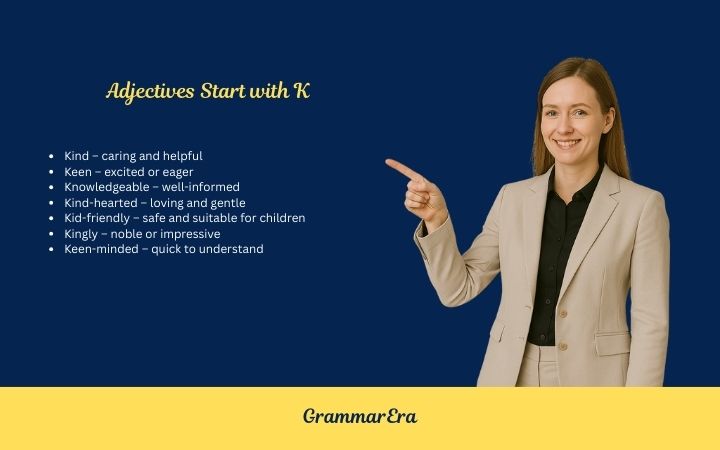
Adjectives Start With K may seem like a small niche in English, but they play an important role in how we describe people, places, and ideas. Words like kind, keen, and knowledgeable add detail and emotion to everyday communication.
Today, people often search for specific adjective lists to improve writing, expand vocabulary, or sound more natural in conversation. However, simply knowing a list isn’t enough—you also need to understand how these adjectives work in real sentences.
In this guide, you’ll learn not only what these adjectives mean, but also how they developed, how Americans use them today, and how to avoid common mistakes.
Quick Answer
Adjectives Start With K are descriptive words beginning with the letter K that modify nouns or pronouns, such as kind, keen, and key, helping add detail and clarity in sentences.
TL;DR
- Adjectives describe nouns and answer questions like “what kind?”
- K adjectives are less common, but still useful in daily English
- Words like “kind” and “keen” are widely used in the U.S.
- They appear before nouns or after linking verbs
- Context matters, especially for tone and formality
What Are Adjectives That Start With K?

Adjectives that begin with K are part of the broader adjective category in English grammar. They follow the same rules as all adjectives: they describe or modify a noun. For example, in the phrase “a kind person,” the word kind explains what type of person you’re talking about.
Although the letter K is less productive than letters like S or C, it still contributes useful descriptive words. Some are everyday terms, while others are more formal or specialized.
Structure and Placement
In English, adjectives usually appear before the noun they modify. However, they can also follow linking verbs like “is” or “seems.” For example, “She is kind” shows the adjective placed after the verb.
Function in Sentences
These adjectives help clarify meaning, express emotion, and add personality to language. Without them, sentences would feel flat and unclear.
Common Adjectives That Start With K
Many K adjectives are short and easy to use, which makes them helpful for both writing and speaking.
Everyday Examples
Words like kind, keen, and key appear often in American English. For instance, “a key point” means something important, while “a keen interest” suggests strong enthusiasm.
Less Common Examples
Other adjectives such as knotty or klutzy are more informal or context-specific. These words often carry a stronger tone and may not be suitable in formal writing.
Historical Background of K Adjectives
The letter K has an interesting history in English. Many K adjectives come from Old English or were borrowed from other languages like German and Greek.
Origins and Development
In early English, the letter K often appeared alongside C, as in “knight.” Over time, pronunciation changed, but spelling stayed the same. This is why many K words still have silent letters today.
Changes Over Time
As English evolved, some K adjectives fell out of use, while others became more common. For example, kind has remained stable for centuries, while words like knavish are now rare.
How Americans Use K Adjectives Today
In modern American English, K adjectives are used in both casual and formal contexts, though some are more common than others.
Everyday Conversation
Words like kind and keen appear frequently in daily speech. People might say, “That’s very kind of you,” or “I’m keen to try that.”
Professional and Academic Writing
More formal adjectives like knowledgeable or key are common in business or academic settings. For example, “She is a knowledgeable expert” sounds polished and professional.
Common Mistakes With K Adjectives
Even simple adjectives can cause confusion if used incorrectly.
Misusing Meaning
One common issue is misunderstanding the tone. For example, klutzy is informal and slightly negative, so it doesn’t fit in formal writing.
Wrong Placement
Some learners place adjectives incorrectly, such as after nouns without a linking verb. English typically requires “The person is kind,” not “The person kind.”
Real-Life Examples in Sentences
Seeing these adjectives in context helps you use them naturally.
| Context | Correct Usage | Example | Notes |
| Daily conversation | Before noun | She is a kind neighbor. | Very common |
| Informal speech | After verb | He seems klutzy today. | Casual tone |
| Professional writing | Before noun | This is a key factor. | Formal usage |
| Academic tone | Before noun | A knowledgeable teacher explained it. | Neutral/formal |
Digital Communication
In texting or social media, shorter adjectives like kind or keen are preferred because they are quick and clear. Longer words may appear less often in casual posts.
Are K Adjectives Different in British vs American English?
Most K adjectives are used similarly in both American and British English. However, frequency and tone may differ slightly.
Subtle Differences
For example, keen is more common in British English, especially to mean “eager.” In the U.S., it’s still used but slightly less frequent in casual speech.
Spelling and Usage
Unlike some words, K adjectives rarely change spelling between regions, which makes them easier to learn.
Why Are There Fewer Adjectives That Start With K?
Compared to other letters, K produces fewer adjectives in English.
Linguistic Reasons
This is partly due to historical sound patterns. English borrowed many words from Latin and French, where K was less common.
Modern Vocabulary Trends
Today, new words are less likely to start with K, so the number of adjectives remains limited.
How to Use K Adjectives Effectively
Using these adjectives well can improve your communication.
Choosing the Right Word
Always consider tone and context. For example, kind works in almost any situation, while klutzy fits only informal contexts.
Balancing Simplicity and Detail
Short adjectives are easier to understand, but longer ones like knowledgeable add precision when needed.
FAQs
What is an example of an adjective that starts with K?
A common example is kind, which describes someone who is caring or helpful. It’s widely used in everyday English.
Are K adjectives common in English?
They are less common than adjectives starting with other letters. However, several are still widely used.
Can K adjectives be used in formal writing?
Yes, words like knowledgeable and key are suitable for formal contexts. Others may be too casual.
What does “keen” mean in American English?
It usually means eager or interested. For example, “She’s keen to learn.”
Is “klutzy” a formal adjective?
No, it’s informal and often used humorously. It’s best for casual conversation.
Do K adjectives follow the same grammar rules?
Yes, they follow standard adjective rules in English. Their placement and function are the same.
Why are there so few adjectives starting with K?
This is due to historical language development. English simply didn’t form many words with K.
Conclusion
Adjectives Start With K may be fewer in number, but they are still valuable in everyday English. Words like kind, keen, and knowledgeable help express ideas clearly and naturally.
Understanding their meaning, tone, and correct placement makes your communication stronger. Whether you’re writing an email or speaking casually, choosing the right adjective can make a big difference.
In the end, mastering even a small group of adjectives helps you sound more confident and precise in real-life conversations.

Fahad is a seasoned English language trainer with a focus on IELTS and TEFL preparation.
He holds a Ph.D. in Applied Linguistics and has over 10 years of teaching experience.
Fahad is passionate about helping students achieve fluency and global opportunities.
His classes combine practical techniques with a supportive, student-first approach.